




(i) How is nitric acid manufactured by the Ostwald process? (ii) Write down the reaction of Ozone with black lead sulphide. (iii) Draw the structure of ${ IF }_{ 7 }$.
Answer
 Verified
615.3k+ views
Hint: Nitric acid is manufactured using Ostwald’s process with ammonia as the starting material. Ozone gas is a very good oxidising agent and reacts with lead sulphide resulting in its oxidation while itself getting reduced. In ${ IF }_{ 7 }$, the central atom undergoes ${ sp }^{ 3 }{ d }^{ 3 }$ hybridisation.
Complete step by step answer:
(i) Nitric acid is manufactured through Ostwald’s process. It is a two-step process in which ammonia is converted into nitric acid. The first step involves the oxidation of ammonia into nitric oxide and nitrogen dioxide. The nitrogen dioxide formed in the first step is then dissolved in water which leads to the formation of nitric acid.
The first step involves two mini steps:
Step 1: Primary oxidation
Ammonia is oxidised to nitric oxide using oxygen at a temperature of $600\quad ^{ o }{ C }$ in the presence of Pt as a catalyst. The reaction is given below:
$4{ NH }_{ 3 }(g)+5{ O }_{ 2 }(g)\xrightarrow [ 600^{ o }{ C } ]{ Pt } 4NO(g)+6{ H }_{ 2 }O(g)$
Step 2: Secondary oxidation
The nitric oxide from step 1 is cooled to a temperature of $150\quad ^{ o }{ C }$ and is oxidised to nitrogen dioxide at a temperature of 50 $ ^{ o }{ C }$. The reaction is shown below:
$ 2NO(g)+{ O }_{ 2 }(g)\xrightarrow { 50\quad ^{ o }{ C } } 2{ NO }_{ 2 }(g)$
The second step involves two mini steps:
Step 1: Absorption of nitrogen dioxide
The nitrogen dioxide is reacted with water in order to give nitric acid. The reaction is given below:
$ 3N{ O }_{ 2 }(g)+{ H }_{ 2 }O(l)\rightarrow 2{ HNO }_{ 3 }(aq)+NO(g)$
Step 2: Concentration
To increase the concentration of nitric acid, its vapours are passed over concentrated sulphuric acid; since sulphuric acid is a dehydrating agent, it absorbs the water molecules from nitric acid vapour due to which we get the concentrated nitric acid.
Hence nitric acid is manufactured using Ostwald’s method.
(ii) Lead sulphide reacts with Ozone at room temperature to give lead sulphate and oxygen. The reaction is given below:
$ \begin{matrix} PbS(s) \\ Lead(II)\quad sulphate \end{matrix}+\begin{matrix} { 4O }_{ 3 }(g) \\ Ozone \end{matrix}\xrightarrow { RT } \begin{matrix} Pb{ SO }_{ 4 }(s) \\ Lead(II)\quad sulphate \end{matrix}+\begin{matrix} 4{ O }_{ 2 }(g) \\ Oxygen \end{matrix} $
(iii) In ${ IF }_{ 7 }$, the central atom i.e. It undergoes ${ sp }^{ 3 }{ d }^{ 3 }$ hybridisation and forms seven bonds with seven Fluorine atoms. The geometry of the molecule is pentagonal bipyramidal according to VSEPR theory. Its structure is shown below:
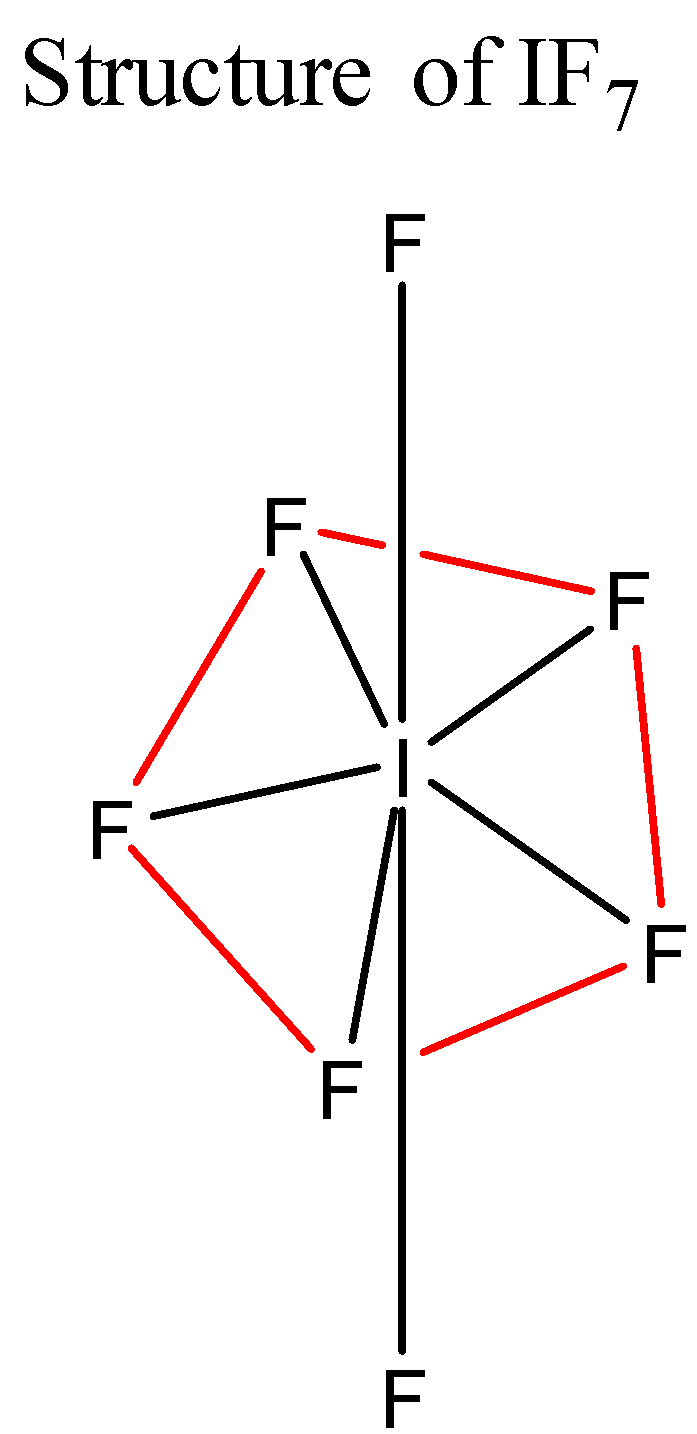
Note: In the molecule ${ IF }_{ 7 }$ all the bonds are not equivalent. The two axial bonds are shorter than the five equatorial bonds. This is because the s-character in the hybrid orbitals is not the same. The s-character in the axial orbitals is more than in the equatorial orbitals. Greater the s-character in a bond, shorter will be the bond.
Complete step by step answer:
(i) Nitric acid is manufactured through Ostwald’s process. It is a two-step process in which ammonia is converted into nitric acid. The first step involves the oxidation of ammonia into nitric oxide and nitrogen dioxide. The nitrogen dioxide formed in the first step is then dissolved in water which leads to the formation of nitric acid.
The first step involves two mini steps:
Step 1: Primary oxidation
Ammonia is oxidised to nitric oxide using oxygen at a temperature of $600\quad ^{ o }{ C }$ in the presence of Pt as a catalyst. The reaction is given below:
$4{ NH }_{ 3 }(g)+5{ O }_{ 2 }(g)\xrightarrow [ 600^{ o }{ C } ]{ Pt } 4NO(g)+6{ H }_{ 2 }O(g)$
Step 2: Secondary oxidation
The nitric oxide from step 1 is cooled to a temperature of $150\quad ^{ o }{ C }$ and is oxidised to nitrogen dioxide at a temperature of 50 $ ^{ o }{ C }$. The reaction is shown below:
$ 2NO(g)+{ O }_{ 2 }(g)\xrightarrow { 50\quad ^{ o }{ C } } 2{ NO }_{ 2 }(g)$
The second step involves two mini steps:
Step 1: Absorption of nitrogen dioxide
The nitrogen dioxide is reacted with water in order to give nitric acid. The reaction is given below:
$ 3N{ O }_{ 2 }(g)+{ H }_{ 2 }O(l)\rightarrow 2{ HNO }_{ 3 }(aq)+NO(g)$
Step 2: Concentration
To increase the concentration of nitric acid, its vapours are passed over concentrated sulphuric acid; since sulphuric acid is a dehydrating agent, it absorbs the water molecules from nitric acid vapour due to which we get the concentrated nitric acid.
Hence nitric acid is manufactured using Ostwald’s method.
(ii) Lead sulphide reacts with Ozone at room temperature to give lead sulphate and oxygen. The reaction is given below:
$ \begin{matrix} PbS(s) \\ Lead(II)\quad sulphate \end{matrix}+\begin{matrix} { 4O }_{ 3 }(g) \\ Ozone \end{matrix}\xrightarrow { RT } \begin{matrix} Pb{ SO }_{ 4 }(s) \\ Lead(II)\quad sulphate \end{matrix}+\begin{matrix} 4{ O }_{ 2 }(g) \\ Oxygen \end{matrix} $
(iii) In ${ IF }_{ 7 }$, the central atom i.e. It undergoes ${ sp }^{ 3 }{ d }^{ 3 }$ hybridisation and forms seven bonds with seven Fluorine atoms. The geometry of the molecule is pentagonal bipyramidal according to VSEPR theory. Its structure is shown below:
Note: In the molecule ${ IF }_{ 7 }$ all the bonds are not equivalent. The two axial bonds are shorter than the five equatorial bonds. This is because the s-character in the hybrid orbitals is not the same. The s-character in the axial orbitals is more than in the equatorial orbitals. Greater the s-character in a bond, shorter will be the bond.
Recently Updated Pages
Master Class 9 General Knowledge: Engaging Questions & Answers for Success

Master Class 9 Maths: Engaging Questions & Answers for Success
Master Class 9 Science: Engaging Questions & Answers for Success
Master Class 9 English: Engaging Questions & Answers for Success
Master Class 9 Social Science: Engaging Questions & Answers for Success
Class 9 Question and Answer - Your Ultimate Solutions Guide
Trending doubts
One Metric ton is equal to kg A 10000 B 1000 C 100 class 11 physics CBSE
Difference Between Prokaryotic Cells and Eukaryotic Cells
Two of the body parts which do not appear in MRI are class 11 biology CBSE
1 ton equals to A 100 kg B 1000 kg C 10 kg D 10000 class 11 physics CBSE
10 examples of friction in our daily life
Name the Largest and the Smallest Cell in the Human Body ?