




How is hydrogen bonding among water molecules related to the structure of the water molecule?
Answer
 Verified
597.6k+ views
Hint:We know that hydrogen bonding is one of the strongest molecular forces (second only to ionic bonding). Hydrogen bonding does influence the water molecules when they are in bulk or in solution as they have strong interaction between themselves.
Complete step-by-step answer: Let’s understand how the structure of water molecules plays a role in hydrogen bonding.
Also, oxygen and hydrogen atoms are connected by a covalent bond where a shared pair of electrons is pulled by an oxygen atom and becomes partially negative-charged. So, ultimately, the H atom will become partially positive-charged. When we talk about the bulk of water molecules, then there occurs an interaction between the positive charge of H atom of one molecule and negative charge of O atom of the neighboring molecule. This interaction is very strong and hence named hydrogen bonding.
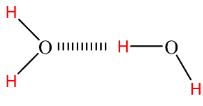
Hydrogen bonding is the reason behind adhesion and cohesion property of water as well as its surface tension.
Generally hydrogen bonding would not occur if there is only a single molecule of water. This hydrogen bonding leads to some unusual but important properties. It helps to give distinctive properties to water and ice (as ice (${{H}_{2}}O$) has lower density than liquid (${{H}_{2}}O$)). Due to strong hydrogen bonds, water molecules are able to stay condensed in liquid state.
Note: Remember that Hydrogen bonding can occur in those molecules where hydrogen atom is covalently bonded to highly electronegative atoms such as Fluorine, Oxygen or Nitrogen because they tend to withdraw electron density of the covalent bond with Hydrogen atom, making itself completely electron deficient. Hence H atoms tend to act like a proton which gets attracted towards lone pairs easily.
Complete step-by-step answer: Let’s understand how the structure of water molecules plays a role in hydrogen bonding.
Also, oxygen and hydrogen atoms are connected by a covalent bond where a shared pair of electrons is pulled by an oxygen atom and becomes partially negative-charged. So, ultimately, the H atom will become partially positive-charged. When we talk about the bulk of water molecules, then there occurs an interaction between the positive charge of H atom of one molecule and negative charge of O atom of the neighboring molecule. This interaction is very strong and hence named hydrogen bonding.
Hydrogen bonding is the reason behind adhesion and cohesion property of water as well as its surface tension.
Generally hydrogen bonding would not occur if there is only a single molecule of water. This hydrogen bonding leads to some unusual but important properties. It helps to give distinctive properties to water and ice (as ice (${{H}_{2}}O$) has lower density than liquid (${{H}_{2}}O$)). Due to strong hydrogen bonds, water molecules are able to stay condensed in liquid state.
Note: Remember that Hydrogen bonding can occur in those molecules where hydrogen atom is covalently bonded to highly electronegative atoms such as Fluorine, Oxygen or Nitrogen because they tend to withdraw electron density of the covalent bond with Hydrogen atom, making itself completely electron deficient. Hence H atoms tend to act like a proton which gets attracted towards lone pairs easily.
Recently Updated Pages
Which will be the least stable resonating structure class 11 chemistry CBSE

How many 5 digit telephone numbers can be construc-class-11-maths-CBSE
How do you find the angle of the resultant vector class 11 physics CBSE
Draw labelled diagram of the following i Gram seed class 11 biology CBSE
1 Quintal is equal to a 110 kg b 10 kg c 100kg d 1000 class 11 physics CBSE
What is the need and importance of classification class 11 biology CBSE
Trending doubts
One Metric ton is equal to kg A 10000 B 1000 C 100 class 11 physics CBSE
Find the value of the expression given below sin 30circ class 11 maths CBSE
Draw a diagram of nephron and explain its structur class 11 biology CBSE
10 examples of friction in our daily life
Proton was discovered by A Thomson B Rutherford C Chadwick class 11 chemistry CBSE
The teeth used for biting and cutting food are called class 11 biology CBSE