




What is hydraulic washing a method for?
a) The refining of metals.
b) Chemical Separation
c) Physical Separation
d) The concentration of ores.
Answer
 Verified
635.7k+ views
Hint:
· One of the given options follows one of the others to carry out a specific procedure pertaining to metals.
· Hydraulic – Denoting or relating to a liquid moving under confined pressure
Complete answer:
· An ore of a metal is an impure source of the required metal, meaning that other than the metal it consists of many other impurities such as sand, grit, clay, rocks etc. are found in the ore of a metal which we collectively refer as gangue.
· A few examples of what ores: Cinnabar (HgS) is an ore for Mercury and Sphalerite (ZnS) is an ore for Zinc.
· Gangue holds little economic worth and must be separated from the ore; thus, we must first cause concentration of the ore before we can carry out the refining of the metal.
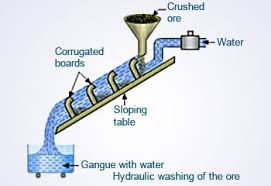
· The Hydraulic Washing method of ore concentration is based on the differences in weight between the gangue and the metal and the concentration of ore is caused by facilitating effective physical separation as the metal particles of the ore are mostly heavier than the gangue.
· Thus, the principle of gravity separation can be used to separate them.
Note:
· To answer this question, it is very important to be conceptually clear with metallurgical chemistry and especially the process of metal extraction.
· Be very careful of the chronology of the processes of ore concentration and metal refining, with the latter taking place only AFTER the former has been completed.
· And while processes both involving physical and chemical separation exist to cause the concentration of ores, the process of Hydraulic Washing is not carried out only for the purpose of physical separation.
· Be very careful about the particulars of these processes before giving a definitive answer.
· One of the given options follows one of the others to carry out a specific procedure pertaining to metals.
· Hydraulic – Denoting or relating to a liquid moving under confined pressure
Complete answer:
· An ore of a metal is an impure source of the required metal, meaning that other than the metal it consists of many other impurities such as sand, grit, clay, rocks etc. are found in the ore of a metal which we collectively refer as gangue.
· A few examples of what ores: Cinnabar (HgS) is an ore for Mercury and Sphalerite (ZnS) is an ore for Zinc.
· Gangue holds little economic worth and must be separated from the ore; thus, we must first cause concentration of the ore before we can carry out the refining of the metal.
· The Hydraulic Washing method of ore concentration is based on the differences in weight between the gangue and the metal and the concentration of ore is caused by facilitating effective physical separation as the metal particles of the ore are mostly heavier than the gangue.
· Thus, the principle of gravity separation can be used to separate them.
In this process, crushed ore is mixed with an upward stream of running water. The lighter particles of gangue wash away in the running water leaving the heavier metal particles to settle down and be separated from the gangue easily.
This method is used for ores that contain comparatively heavier metals, for instance: lead (Pb) and tin (Sn).
Therefore, the answer to this question is d) The concentration of ores.
Note:
· To answer this question, it is very important to be conceptually clear with metallurgical chemistry and especially the process of metal extraction.
· Be very careful of the chronology of the processes of ore concentration and metal refining, with the latter taking place only AFTER the former has been completed.
· And while processes both involving physical and chemical separation exist to cause the concentration of ores, the process of Hydraulic Washing is not carried out only for the purpose of physical separation.
· Be very careful about the particulars of these processes before giving a definitive answer.
Recently Updated Pages
Master Class 12 Business Studies: Engaging Questions & Answers for Success

Master Class 12 Chemistry: Engaging Questions & Answers for Success
Master Class 12 Biology: Engaging Questions & Answers for Success
Class 12 Question and Answer - Your Ultimate Solutions Guide
Master Class 11 English: Engaging Questions & Answers for Success
Master Class 11 Social Science: Engaging Questions & Answers for Success
Trending doubts
Which are the Top 10 Largest Countries of the World?
Draw a labelled sketch of the human eye class 12 physics CBSE
The end of compass needle which points towards north class 12 physics CBSE
Differentiate between homogeneous and heterogeneous class 12 chemistry CBSE
Why is the cell called the structural and functional class 12 biology CBSE
When was the first election held in India a 194748 class 12 sst CBSE