




‘Hydraulic lift’ works on the basis of -
A. Stoke’s Law
B. Bernoulli’s Law
C. Torricelli's Law
D. Pascal’s Law
Answer
 Verified
649.5k+ views
Hint: Any force applied to a confined liquid is transmitted uniformly in all directions throughout the fluid. Hydraulic press is used to lift a heavy object with the help of less force. So, instead of pulling the entire weight of the car, we give a small amount of force. Understand the working principle of the hydraulic and match it with the laws mentioned in the options.
Complete step by step answer:
Let us look at the working principle of a hydraulic lift.
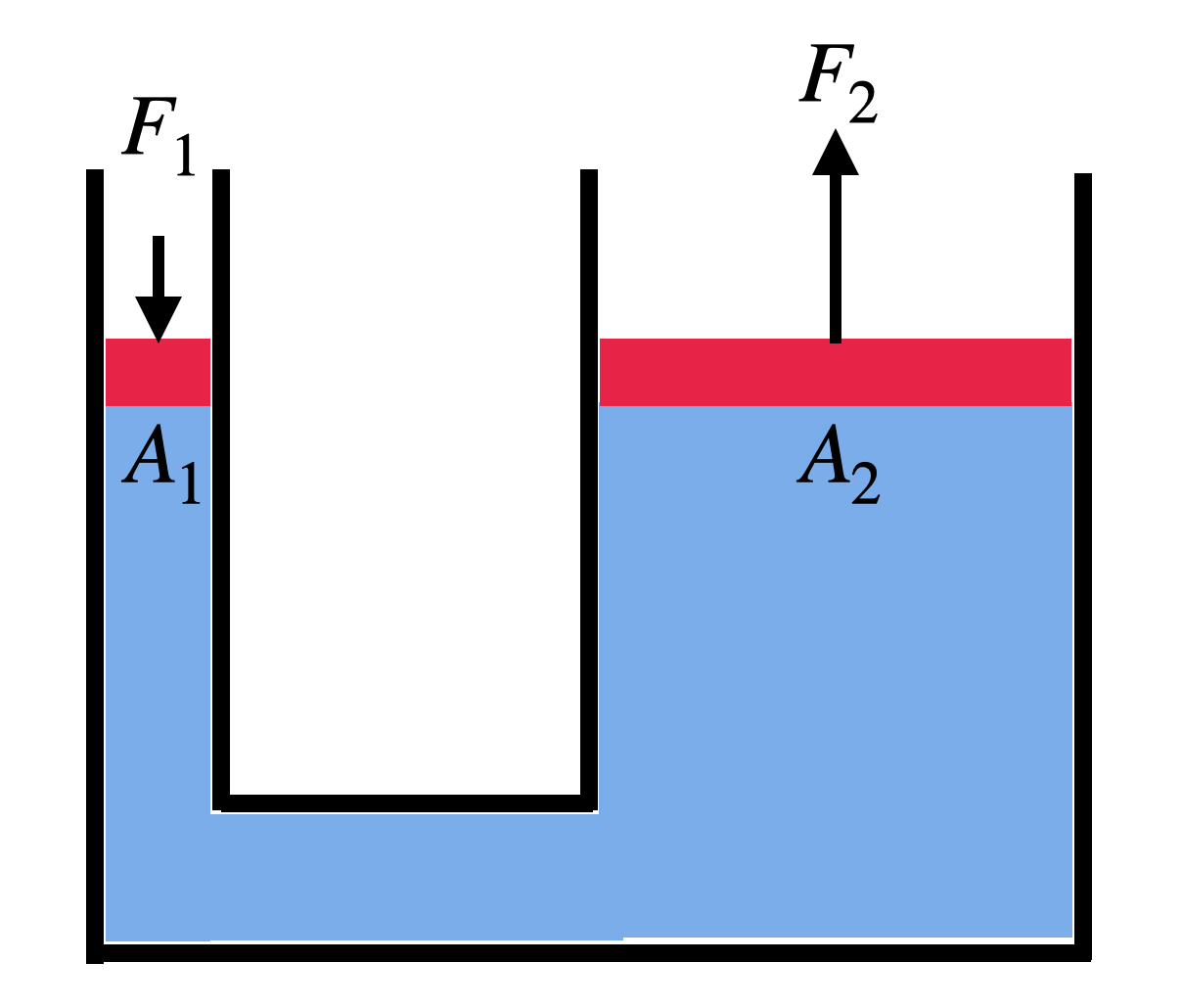
In the hydraulic press, we give less force on the narrow piston and experience more force on the larger piston.
In this case, we assume that the fluid is incompressible. It is one of the ideal properties of the fluid.
So, if we apply pressure at one point of the liquid, it is experienced at every part of the liquid. However, the liquid must be contained in a closed container.
In the case of a Hydraulic lift, we apply force at the narrow piston. Hence the pressure on the piston is,
$\dfrac{{{F}_{1}}}{{{A}_{1}}}$
Now, if the same pressure is experienced at every point in the liquid, the pressure at the larger piston is also the same.
Hence, the force on the piston is,
${{F}_{2}}={{A}_{2}}\times \dfrac{{{F}_{1}}}{{{A}_{1}}}$
As
${{A}_{2}} > {{A}_{1}}$
We can say for sure that,
${{F}_{2}} > {{F}_{1}}$
So, we get a larger force on the bigger piston. As a result, we can lift heavier objects without applying much force.
This is the working principle of the hydraulic press.
The basis of the principle is Pascal’s Law, which states that,
“If any force is applied to any point of a confined fluid, then the pressure is equally transmitted throughout the liquid.”
So, the correct answer is - (D).
Note: Another well-known example of Pascal’s Law is Pascal’s ball. If there are multiple holes on a rubber ball which is filled with water. Giving pressure on it will make water flow out of the holes at equal speed. Hence, the pressure remains the same.
You need to remember the fluid dynamics laws to know how they differ from one another.
Complete step by step answer:
Let us look at the working principle of a hydraulic lift.
In the hydraulic press, we give less force on the narrow piston and experience more force on the larger piston.
In this case, we assume that the fluid is incompressible. It is one of the ideal properties of the fluid.
So, if we apply pressure at one point of the liquid, it is experienced at every part of the liquid. However, the liquid must be contained in a closed container.
In the case of a Hydraulic lift, we apply force at the narrow piston. Hence the pressure on the piston is,
$\dfrac{{{F}_{1}}}{{{A}_{1}}}$
Now, if the same pressure is experienced at every point in the liquid, the pressure at the larger piston is also the same.
Hence, the force on the piston is,
${{F}_{2}}={{A}_{2}}\times \dfrac{{{F}_{1}}}{{{A}_{1}}}$
As
${{A}_{2}} > {{A}_{1}}$
We can say for sure that,
${{F}_{2}} > {{F}_{1}}$
So, we get a larger force on the bigger piston. As a result, we can lift heavier objects without applying much force.
This is the working principle of the hydraulic press.
The basis of the principle is Pascal’s Law, which states that,
“If any force is applied to any point of a confined fluid, then the pressure is equally transmitted throughout the liquid.”
So, the correct answer is - (D).
Note: Another well-known example of Pascal’s Law is Pascal’s ball. If there are multiple holes on a rubber ball which is filled with water. Giving pressure on it will make water flow out of the holes at equal speed. Hence, the pressure remains the same.
You need to remember the fluid dynamics laws to know how they differ from one another.
Recently Updated Pages
Basicity of sulphurous acid and sulphuric acid are

Master Class 10 Computer Science: Engaging Questions & Answers for Success
Master Class 10 Social Science: Engaging Questions & Answers for Success
Master Class 10 Science: Engaging Questions & Answers for Success
Class 10 Question and Answer - Your Ultimate Solutions Guide
Master Class 10 Maths: Engaging Questions & Answers for Success
Trending doubts
What is the Total Duration of Football Match?
Explain the Treaty of Vienna of 1815 class 10 social science CBSE
In football, which nation is called "La Roja"?
Why is there a time difference of about 5 hours between class 10 social science CBSE
10 examples of evaporation in daily life with explanations
What is the full form of POSCO class 10 social science CBSE