




Hydra are ?
A.Monoecious
B.Dioecious
C.Both of the above
D.None of the above
Answer
 Verified
651.9k+ views
Hint: The body of Hydra is cylindrical and highly contractile. It contains 3 parts, namely basal disc, column and manubrium. It is primarily a sedentary animal. But it can slowly move. Its locomotion is accomplished by its great powers for contraction and extension. Hydra is a carnivore, which feeds on small aquatic organisms.
Complete answer:
Hydra is a solitary polypoid coelenterate. It is a sedentary freshwater organism, living attached to submerged objects in ponds, lakes and streams. Basal disc of the Hydra is the flat basal part for the attachment. Manubrium is the conical elevation at the free terminal end. Column is the cylindrical and highly contractile middle portion between basal disc and manubrium. Manubrium is also known as hypostome. Basally, manubrium is encircled by a ring of 6-10 contractile and hollow tentacles. Tentacles and the rim of the mouth are armed with stinging cells. Mouth leads internally into a spacious digestive cavity called gastro-vascular cavity.
Body wall of Hydra is diploblastic and is formed of two cell layers, outer epidermis and inner endodermis. In between these two layers there is jelly like mesogloea.
Hydra exhibits four major modes of locomotion, namely gliding, looping, somersaulting and walking. Apart from these, Hydra occasionally floats and drifts passively in an upside down posture, usually attached to a floating gas bubble or a solid object. Slow movement of Hydra is commonly affected by gliding its basal disc on a substratum. Rapid movements are affected by looping and somersaulting.
Hydra feeds on aquatic insects, insect larvae, small crustaceans, fish embryos etc. Tentacles are used for food capture and ingestion of the food.
Definite structure or regions for respiration and excretion are absent in Hydra. Exchange of gas and the elimination of nitrogenous waste take place by simple diffusion through the body wall.
Hydra reproduces asexually and sexually. Asexual reproduction occurs during favorable conditions, and sexual reproduction occurs during unfavorable conditions. Asexual reproduction take place by budding or gemmation. Hydra contains high powers of regeneration. Male and female gonads occur in the same individual is known as monoecious or hermaphrodite. Some individuals are monoecious. Some other individuals are dioecious or unisexual. In which we can clearly distinguish male and female individuals separately.
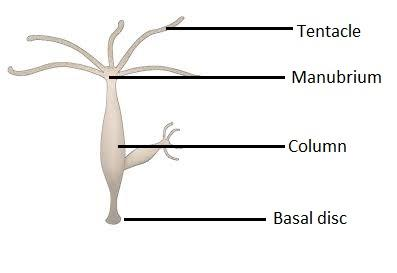
Figure: Hydra
Hence the correct answer is option(C)
Note: Hydra has the nervous system in the form of a nerve net. It is structurally simple compared to the nervous system of higher animals. It does not contain a well developed brain or true muscles. Nerve nets connect the sensory photoreceptors and touch sensitive nerve cells, which are located in the body wall and tentacles.
Complete answer:
Hydra is a solitary polypoid coelenterate. It is a sedentary freshwater organism, living attached to submerged objects in ponds, lakes and streams. Basal disc of the Hydra is the flat basal part for the attachment. Manubrium is the conical elevation at the free terminal end. Column is the cylindrical and highly contractile middle portion between basal disc and manubrium. Manubrium is also known as hypostome. Basally, manubrium is encircled by a ring of 6-10 contractile and hollow tentacles. Tentacles and the rim of the mouth are armed with stinging cells. Mouth leads internally into a spacious digestive cavity called gastro-vascular cavity.
Body wall of Hydra is diploblastic and is formed of two cell layers, outer epidermis and inner endodermis. In between these two layers there is jelly like mesogloea.
Hydra exhibits four major modes of locomotion, namely gliding, looping, somersaulting and walking. Apart from these, Hydra occasionally floats and drifts passively in an upside down posture, usually attached to a floating gas bubble or a solid object. Slow movement of Hydra is commonly affected by gliding its basal disc on a substratum. Rapid movements are affected by looping and somersaulting.
Hydra feeds on aquatic insects, insect larvae, small crustaceans, fish embryos etc. Tentacles are used for food capture and ingestion of the food.
Definite structure or regions for respiration and excretion are absent in Hydra. Exchange of gas and the elimination of nitrogenous waste take place by simple diffusion through the body wall.
Hydra reproduces asexually and sexually. Asexual reproduction occurs during favorable conditions, and sexual reproduction occurs during unfavorable conditions. Asexual reproduction take place by budding or gemmation. Hydra contains high powers of regeneration. Male and female gonads occur in the same individual is known as monoecious or hermaphrodite. Some individuals are monoecious. Some other individuals are dioecious or unisexual. In which we can clearly distinguish male and female individuals separately.
Figure: Hydra
Hence the correct answer is option(C)
Note: Hydra has the nervous system in the form of a nerve net. It is structurally simple compared to the nervous system of higher animals. It does not contain a well developed brain or true muscles. Nerve nets connect the sensory photoreceptors and touch sensitive nerve cells, which are located in the body wall and tentacles.
Recently Updated Pages
Which will be the least stable resonating structure class 11 chemistry CBSE

How many 5 digit telephone numbers can be construc-class-11-maths-CBSE
How do you find the angle of the resultant vector class 11 physics CBSE
Draw labelled diagram of the following i Gram seed class 11 biology CBSE
1 Quintal is equal to a 110 kg b 10 kg c 100kg d 1000 class 11 physics CBSE
What is the need and importance of classification class 11 biology CBSE
Trending doubts
Find the value of the expression given below sin 30circ class 11 maths CBSE
One Metric ton is equal to kg A 10000 B 1000 C 100 class 11 physics CBSE
10 examples of friction in our daily life
Draw a diagram of a plant cell and label at least eight class 11 biology CBSE
Difference between physical and chemical change class 11 chemistry CBSE
Proton was discovered by A Thomson B Rutherford C Chadwick class 11 chemistry CBSE