




What is the hybridization of the central metal atom in the following: $P{H_3},P{H_4}^ + $
Answer
 Verified
584.7k+ views
Hint: We know that Hybridization involves the mixing of atomic orbitals of an atom (generally a central atom) to generate a new set of atomic orbitals which is called the hybrid orbitals. Hence to find the hybridization of the central metal atom we need to first write the electronic configuration and then draw the orbitals in which the bonded atom will be filled.
Complete step-by-step answer: The atomic number of phosphorous is $15$ hence its electronic configuration will be: $1{s^2}2{s^2}2{p^6}3{s^2}3{p^3}$
Here the valence orbitals will take part in hybridization i.e. $3{s^2}3{p^3}$
So, for $P{H_3}$
The orbitals will be filled as
$3s$
$3p$
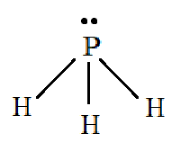
Here the two electrons in $3s$orbital are the lone pair of electrons present on phosphorus and the three hydrogen atoms are filled in the $3p$ orbital. Ideally the molecule should show $s{p^3}$ hybridization but this does not happen. $P{H_3}$ will not show any hybridization as it is considered to be a Drago molecule. Drago molecules do not have any hybridization and have the least bond angle. The geometry will be that of a trigonal pyramidal because there exists a lone pair-bond pair repulsion.
Structure of $P{H_3}$:
For $P{H_4}^ + $:
$3s$
$3p$
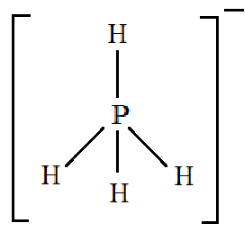
Here we see that since four atoms of hydrogen are present so it will occupy the $3s$ orbital as well as the $3p$ orbital. So, all the four sub orbitals are bonded with hydrogen atoms hence the hybridization will be $s{p^3}$ and hence it will have a geometry of tetrahedral.
Structure of $P{H_4}^ + $:
Note: To understand the Drago molecule you need to understand the Drago’s rule. The rule states that hybridization will not take place if:
1.The central atom belongs to the third or higher period.
2.The central atom possesses a lone pair of electrons.
3.The electronegativity of the terminal atom is less than the carbon atom.
Complete step-by-step answer: The atomic number of phosphorous is $15$ hence its electronic configuration will be: $1{s^2}2{s^2}2{p^6}3{s^2}3{p^3}$
Here the valence orbitals will take part in hybridization i.e. $3{s^2}3{p^3}$
So, for $P{H_3}$
The orbitals will be filled as
| $ \uparrow \downarrow $ |
$3s$
| $ \uparrow $ | $ \uparrow $ | $ \uparrow $ |
$3p$
Here the two electrons in $3s$orbital are the lone pair of electrons present on phosphorus and the three hydrogen atoms are filled in the $3p$ orbital. Ideally the molecule should show $s{p^3}$ hybridization but this does not happen. $P{H_3}$ will not show any hybridization as it is considered to be a Drago molecule. Drago molecules do not have any hybridization and have the least bond angle. The geometry will be that of a trigonal pyramidal because there exists a lone pair-bond pair repulsion.
Structure of $P{H_3}$:
For $P{H_4}^ + $:
| $ \uparrow $ |
$3s$
| $ \uparrow $ | $ \uparrow $ | $ \uparrow $ |
$3p$
Here we see that since four atoms of hydrogen are present so it will occupy the $3s$ orbital as well as the $3p$ orbital. So, all the four sub orbitals are bonded with hydrogen atoms hence the hybridization will be $s{p^3}$ and hence it will have a geometry of tetrahedral.
Structure of $P{H_4}^ + $:
Note: To understand the Drago molecule you need to understand the Drago’s rule. The rule states that hybridization will not take place if:
1.The central atom belongs to the third or higher period.
2.The central atom possesses a lone pair of electrons.
3.The electronegativity of the terminal atom is less than the carbon atom.
Recently Updated Pages
Three beakers labelled as A B and C each containing 25 mL of water were taken A small amount of NaOH anhydrous CuSO4 and NaCl were added to the beakers A B and C respectively It was observed that there was an increase in the temperature of the solutions contained in beakers A and B whereas in case of beaker C the temperature of the solution falls Which one of the following statements isarecorrect i In beakers A and B exothermic process has occurred ii In beakers A and B endothermic process has occurred iii In beaker C exothermic process has occurred iv In beaker C endothermic process has occurred

Master Class 11 Social Science: Engaging Questions & Answers for Success
Master Class 11 Physics: Engaging Questions & Answers for Success
Master Class 11 Maths: Engaging Questions & Answers for Success
Master Class 11 Economics: Engaging Questions & Answers for Success
Master Class 11 Computer Science: Engaging Questions & Answers for Success
Three beakers labelled as A B and C each containing 25 mL of water were taken A small amount of NaOH anhydrous CuSO4 and NaCl were added to the beakers A B and C respectively It was observed that there was an increase in the temperature of the solutions contained in beakers A and B whereas in case of beaker C the temperature of the solution falls Which one of the following statements isarecorrect i In beakers A and B exothermic process has occurred ii In beakers A and B endothermic process has occurred iii In beaker C exothermic process has occurred iv In beaker C endothermic process has occurred
Master Class 11 Social Science: Engaging Questions & Answers for Success
Master Class 11 Physics: Engaging Questions & Answers for Success
Trending doubts
One Metric ton is equal to kg A 10000 B 1000 C 100 class 11 physics CBSE
There are 720 permutations of the digits 1 2 3 4 5 class 11 maths CBSE
State and prove Bernoullis theorem class 11 physics CBSE
Draw a diagram of a plant cell and label at least eight class 11 biology CBSE
Difference Between Prokaryotic Cells and Eukaryotic Cells
Discuss the various forms of bacteria class 11 biology CBSE