




What is the hybridization of carbenes?
(a) $s{{p}^{2}}$
(b) $s{{p}^{3}}$
(c) $sp$
(d) $s{{p}^{3}}d$
Answer
 Verified
609.9k+ views
Hint: Carbenes are those compounds in the carbon consists of total six electrons in its valence and the remaining two electrons are present as unpaired electrons and in singlet carbenes, one s and two p orbitals of the same shell of an atom mix to form three equivalent orbital and in triplet carbenes, one s and one p orbital of the atom mix to form two new equivalent orbitals. Now you can easily identify its hybridization.
Complete answer:
First of all ,let’s discuss what carbenes are. Carbenes are the neutral divalent species in which a carbon is covalently bonded to two atoms and has got two non-bonding orbitals having two electrons between them.
In simple words, we can say that the carbenes contain a neutral carbon atom having six electrons in the valence shell out of which two are unshared.
Carbenes are highly reactive species having a very short life period.
The carbenes exist in two distinct states;
1. Singlet carbenes: These are the carbenes in which unshared electrons are paired(i.e. they are present in one orbitals).
2.Triplet carbenes: These are the carbenes in which unshared electrons are not paired(i.e. they are present in different orbitals).
Example: methylene carbene can have either of the following two structures depending upon its mode of formation.
Triplet carbenes present biradicals i.e. divalent free radicals.
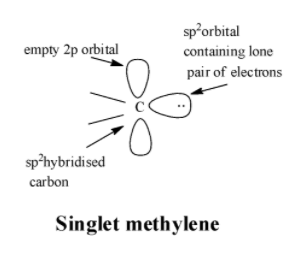
In singlet carbenes, the central carbon atom is in a state of $s{{p}^{2}}$ hybridization. One of the three $s{{p}^{2}}$ hybrid orbitals, two are used in forming two single bonds with the monovalent atoms or groups attached to carbon. The third $s{{p}^{2}}$ orbital contains the unshared pair of electrons while the unhybridized p-orbital is empty. The structure of singlet carbenes is as;
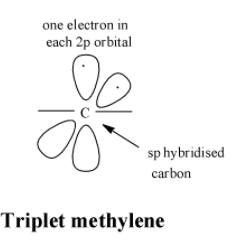
In triplet carbenes, the central carbon atom is in a state of $sp$ hybridization. The two $sp$ hybrid orbitals are used in forming single bonds with the two monovalent atoms or groups attached to carbon. The two unhybridized p-orbitals contain one unshared electron each. The structure of triplet carbenes is as;
So, thus the hybridization of singlet carbenes is $s{{p}^{2}}$ and that of the triplet carbenes is $sp$.
Hence, option (a) and (c) both are correct.
Note:
The triplet carbenes are lower in energy and therefore, more stable than singlet carbenes because in triplet carbenes the electrons occupy different orbitals and the electron repulsion is much less than that in case of singlet carbenes where the repulsions are more due to the presence of electrons in the same orbitals.
Complete answer:
First of all ,let’s discuss what carbenes are. Carbenes are the neutral divalent species in which a carbon is covalently bonded to two atoms and has got two non-bonding orbitals having two electrons between them.
In simple words, we can say that the carbenes contain a neutral carbon atom having six electrons in the valence shell out of which two are unshared.
Carbenes are highly reactive species having a very short life period.
The carbenes exist in two distinct states;
1. Singlet carbenes: These are the carbenes in which unshared electrons are paired(i.e. they are present in one orbitals).
2.Triplet carbenes: These are the carbenes in which unshared electrons are not paired(i.e. they are present in different orbitals).
Example: methylene carbene can have either of the following two structures depending upon its mode of formation.
Triplet carbenes present biradicals i.e. divalent free radicals.
In singlet carbenes, the central carbon atom is in a state of $s{{p}^{2}}$ hybridization. One of the three $s{{p}^{2}}$ hybrid orbitals, two are used in forming two single bonds with the monovalent atoms or groups attached to carbon. The third $s{{p}^{2}}$ orbital contains the unshared pair of electrons while the unhybridized p-orbital is empty. The structure of singlet carbenes is as;
In triplet carbenes, the central carbon atom is in a state of $sp$ hybridization. The two $sp$ hybrid orbitals are used in forming single bonds with the two monovalent atoms or groups attached to carbon. The two unhybridized p-orbitals contain one unshared electron each. The structure of triplet carbenes is as;
So, thus the hybridization of singlet carbenes is $s{{p}^{2}}$ and that of the triplet carbenes is $sp$.
Hence, option (a) and (c) both are correct.
Note:
The triplet carbenes are lower in energy and therefore, more stable than singlet carbenes because in triplet carbenes the electrons occupy different orbitals and the electron repulsion is much less than that in case of singlet carbenes where the repulsions are more due to the presence of electrons in the same orbitals.
Recently Updated Pages
Master Class 11 English: Engaging Questions & Answers for Success

Master Class 11 Social Science: Engaging Questions & Answers for Success
Master Class 11 Maths: Engaging Questions & Answers for Success
Master Class 11 Chemistry: Engaging Questions & Answers for Success
Master Class 11 Biology: Engaging Questions & Answers for Success
Master Class 11 Physics: Engaging Questions & Answers for Success
Trending doubts
One Metric ton is equal to kg A 10000 B 1000 C 100 class 11 physics CBSE
Difference Between Prokaryotic Cells and Eukaryotic Cells
Find the value of the expression given below sin 30circ class 11 maths CBSE
1 ton equals to A 100 kg B 1000 kg C 10 kg D 10000 class 11 physics CBSE
Two of the body parts which do not appear in MRI are class 11 biology CBSE
Draw a diagram of nephron and explain its structur class 11 biology CBSE