




What is the hybridisation of carbon in ${{COC}}{{{l}}_{{2}}}$ ?
A) ${{sp}}$
B) ${{s}}{{{p}}^{{2}}}$
C) ${{s}}{{{p}}^{{3}}}$
D) ${{s}}{{{p}}^{{3}}}{{d}}$
Answer
 Verified
594.6k+ views
Hint: The intermixing of orbitals of an atom of equal energy and reforming of new orbitals which are equal in number is called hybridization.
Hybridisation influences molecular geometry and bonding properties. Hybridisation is an expansion of valence bond theory.
Complete step by step answer:
${{Cl - (C = O) - Cl}}$ contains one double bond on a carbon atom. Hence, its hybridization is ${{s}}{{{p}}^{{2}}}$ .
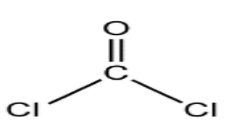
For the molecule ${{COC}}{{{l}}_{{2}}}$:
Hybridization of ${{C = s}}{{{p}}^{{2}}}$
Bonding: 1 sigma bond between each chlorine and carbon (${{sp}}$hybrid orbitals)
1 sigma bond between carbon and oxygen ( ${{s}}{{{p}}^{{2}}}$ hybrid orbitals)
1 pi bond between carbon and oxygen (p orbital)
The carbon atom is ${{s}}{{{p}}^{{2}}}$ hybridized. It has three ${{s}}{{{p}}^{{2}}}$ hybrid orbitals and one ${{2}}{{{p}}_{{z}}}$ orbital. It forms three sigma bonds with two chlorine and oxygen atoms using ${{s}}{{{p}}^{{2}}}$ hybrid orbitals.
${{COC}}{{{l}}_{{2}}} has {{ 4 + 6 + 2}}\left( {{7}} \right){{ = 24}}$ , valence electrons
Assuming all atoms are hybridized, the carbon and oxygen atoms are ${{s}}{{{p}}^{{2}}}$ hybridized, and the two chlorine atoms are ${{s}}{{{p}}^{{3}}}$ hybridized. The two ${{C - Cl \,\sigma }}$ bonds are formed from overlap of ${{s}}{{{p}}^{{2}}}$ hybrids from \[{{C}}\] with ${{s}}{{{p}}^{{3}}}$ hybrid orbitals from \[{{Cl}}\]. The double bond between the carbon and oxygen atoms consists of one σ and one \[{{\pi }}\] bond. The \[{{\sigma }}\] bond in the double bond is formed from head-to-head overlap of an ${{s}}{{{p}}^{{2}}}$ orbital from carbon with an ${{s}}{{{p}}^{{2}}}$ hybrid orbital from oxygen. The \[{{\pi }}\] bond is formed from parallel overlap of the unhybridized p atomic orbitals on each atom of \[{{C \, and \,O}}\].
Note:
Rules for hybridisation:
1. Two electrons is equal to one sigma bond.
2. Number of hybrid orbitals is equal to the number of hybridized orbitals.
3. Orbitals of one atom only will hybridise.
4. Orbitals of equal energy would hybridise.
Hybridisation influences molecular geometry and bonding properties. Hybridisation is an expansion of valence bond theory.
Complete step by step answer:
${{Cl - (C = O) - Cl}}$ contains one double bond on a carbon atom. Hence, its hybridization is ${{s}}{{{p}}^{{2}}}$ .
For the molecule ${{COC}}{{{l}}_{{2}}}$:
Hybridization of ${{C = s}}{{{p}}^{{2}}}$
Bonding: 1 sigma bond between each chlorine and carbon (${{sp}}$hybrid orbitals)
1 sigma bond between carbon and oxygen ( ${{s}}{{{p}}^{{2}}}$ hybrid orbitals)
1 pi bond between carbon and oxygen (p orbital)
The carbon atom is ${{s}}{{{p}}^{{2}}}$ hybridized. It has three ${{s}}{{{p}}^{{2}}}$ hybrid orbitals and one ${{2}}{{{p}}_{{z}}}$ orbital. It forms three sigma bonds with two chlorine and oxygen atoms using ${{s}}{{{p}}^{{2}}}$ hybrid orbitals.
${{COC}}{{{l}}_{{2}}} has {{ 4 + 6 + 2}}\left( {{7}} \right){{ = 24}}$ , valence electrons
Assuming all atoms are hybridized, the carbon and oxygen atoms are ${{s}}{{{p}}^{{2}}}$ hybridized, and the two chlorine atoms are ${{s}}{{{p}}^{{3}}}$ hybridized. The two ${{C - Cl \,\sigma }}$ bonds are formed from overlap of ${{s}}{{{p}}^{{2}}}$ hybrids from \[{{C}}\] with ${{s}}{{{p}}^{{3}}}$ hybrid orbitals from \[{{Cl}}\]. The double bond between the carbon and oxygen atoms consists of one σ and one \[{{\pi }}\] bond. The \[{{\sigma }}\] bond in the double bond is formed from head-to-head overlap of an ${{s}}{{{p}}^{{2}}}$ orbital from carbon with an ${{s}}{{{p}}^{{2}}}$ hybrid orbital from oxygen. The \[{{\pi }}\] bond is formed from parallel overlap of the unhybridized p atomic orbitals on each atom of \[{{C \, and \,O}}\].
Note:
Rules for hybridisation:
1. Two electrons is equal to one sigma bond.
2. Number of hybrid orbitals is equal to the number of hybridized orbitals.
3. Orbitals of one atom only will hybridise.
4. Orbitals of equal energy would hybridise.
Recently Updated Pages
Master Class 11 Social Science: Engaging Questions & Answers for Success

Master Class 11 English: Engaging Questions & Answers for Success
Master Class 11 Maths: Engaging Questions & Answers for Success
Master Class 11 Chemistry: Engaging Questions & Answers for Success
Master Class 11 Biology: Engaging Questions & Answers for Success
Master Class 11 Physics: Engaging Questions & Answers for Success
Trending doubts
One Metric ton is equal to kg A 10000 B 1000 C 100 class 11 physics CBSE
Difference Between Prokaryotic Cells and Eukaryotic Cells
Draw a diagram of a plant cell and label at least eight class 11 biology CBSE
Two of the body parts which do not appear in MRI are class 11 biology CBSE
Which gas is abundant in air class 11 chemistry CBSE
10 examples of friction in our daily life