




How would you describe a pond ecosystem?
Answer
 Verified
534.9k+ views
Hint: A pond ecosystem is a system of organisms that live together in a pond. It is a freshwater ecosystem on which the different organisms depend on each other. A pond ecosystem can be defined in two ways –
A closed community of organisms in a body of water.
An enclosed body of water that houses numerous different creatures.
Complete answer:
All ecosystems are divided into 2 parts – Aquatic and Terrestrial ecosystems. Terrestrial includes those ecosystems that occur in land like forest ecosystems.
Here, we shall only describe the pond ecosystem:
Type of ecosystem: Pond ecosystem comes under Aquatic ecosystem. It contains both biotic & abiotic factors.
Biotic factors: Biotic factors of the pond ecosystem are divided into 3 major divisions. They are – Producers, Consumers & Decomposers.
Producers are sub-divided into – Algae & Hydrophytic plants.
Consumers are subdivided into - Primary, Secondary and Tertiary. Primary consumers include – Protozoa, Crustacea. Secondary consumers include – Larvae, snakes, frogs, other amphibians, reptiles etc. Tertiary consumers include – fishes, sharks etc.
Decomposers are subdivided into Hydrophytic bacteria, Fungi & Microbes.
Abiotic Factors: The non- living things which help the pond ecosystem to survive are – Humus, Oxygen in water, Light, Heat & Minerals.
Food Chain: The food chain of the pond ecosystem is as follows –
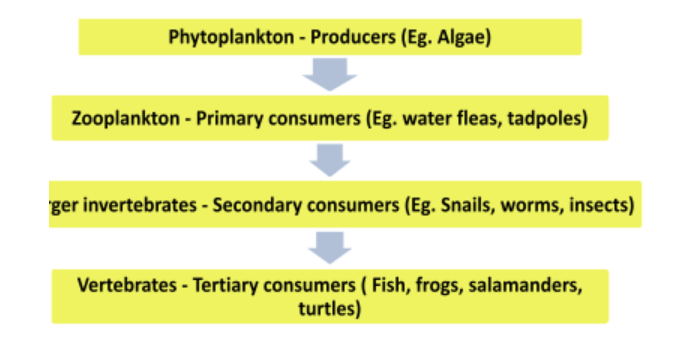
Note:
Ecosystem means ecological system i.e., a community in a particular location made up of living and non-living participants dependent on each other to survive as a whole. Pond ecosystem is one of the aquatic ecosystems made up of the hydrophytic participants and food chain.
A closed community of organisms in a body of water.
An enclosed body of water that houses numerous different creatures.
Complete answer:
All ecosystems are divided into 2 parts – Aquatic and Terrestrial ecosystems. Terrestrial includes those ecosystems that occur in land like forest ecosystems.
Here, we shall only describe the pond ecosystem:
Type of ecosystem: Pond ecosystem comes under Aquatic ecosystem. It contains both biotic & abiotic factors.
Biotic factors: Biotic factors of the pond ecosystem are divided into 3 major divisions. They are – Producers, Consumers & Decomposers.
Producers are sub-divided into – Algae & Hydrophytic plants.
Consumers are subdivided into - Primary, Secondary and Tertiary. Primary consumers include – Protozoa, Crustacea. Secondary consumers include – Larvae, snakes, frogs, other amphibians, reptiles etc. Tertiary consumers include – fishes, sharks etc.
Decomposers are subdivided into Hydrophytic bacteria, Fungi & Microbes.
Abiotic Factors: The non- living things which help the pond ecosystem to survive are – Humus, Oxygen in water, Light, Heat & Minerals.
Food Chain: The food chain of the pond ecosystem is as follows –
Note:
Ecosystem means ecological system i.e., a community in a particular location made up of living and non-living participants dependent on each other to survive as a whole. Pond ecosystem is one of the aquatic ecosystems made up of the hydrophytic participants and food chain.
Recently Updated Pages
Master Class 12 Economics: Engaging Questions & Answers for Success

Master Class 12 English: Engaging Questions & Answers for Success
Master Class 12 Social Science: Engaging Questions & Answers for Success
Master Class 12 Maths: Engaging Questions & Answers for Success
Master Class 12 Physics: Engaging Questions & Answers for Success
Master Class 9 General Knowledge: Engaging Questions & Answers for Success
Trending doubts
Explain the Treaty of Vienna of 1815 class 10 social science CBSE
Who Won 36 Oscar Awards? Record Holder Revealed
Why is it 530 pm in india when it is 1200 afternoon class 10 social science CBSE
Make a sketch of the human nerve cell What function class 10 biology CBSE
What is the full form of POSCO class 10 social science CBSE
Define Potential, Developed, Stock and Reserved resources