




How was benzene discovered$?$
Answer
 Verified
579k+ views
Hint: Benzene is an aromatic hydrocarbon having the molecular formula ${C_6}{H_6}$. The benzene molecule is composed of six $C$ atoms joined in a planar ring with one $H$ atom attached to each. It is the parent compound of numerous important aromatic compounds and is a colourless liquid with characteristic odour.
Complete step-by-step answer:The word benzene is derived from "gum benzoin" or benzoin resin, an aromatic resin which is known to European pharmacists and perfumers. Soon an acidic material was derived from benzoin by the process of sublimation, and named flowers of benzoin, or benzoic acid. The hydrocarbon thus derived from benzoic acid was named benzin, benzol, or benzene.
Michael Faraday first isolated and identified benzene in $1825$ from the oily residue derived from the production of illuminating gas, giving it the name bicarburet of hydrogen.
In $1834$ German chemist Eilhardt Mitscherlich heated benzoic acid with lime and produced benzene.
In $1845$ German chemist A.W. von Hofmann isolated benzene from coal tar.
German chemists Joseph Loschmidt in $1861$ and August Kekule von Stradonitz in $1866$ independently proposed a cyclic arrangement of six carbons with alternating single and double bonds. Kekule subsequently modified his structural formula to one in which oscillation of the double bonds gave two equivalent structures in rapid equilibrium.
In $1931$ American chemist Linus Pauling suggested that benzene had a single structure, which was a resonance hybrid of the two Kekule structures.
The structure of benzene can be represented as:
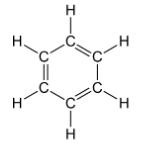
Note: It is used primarily as a precursor to the manufacture of chemicals with more complex structure, such as ethyl benzene and cumene, of which billions of kilograms are produced annually. It is highly toxic and is a known carcinogen; exposure to it may cause leukemia. As a result, there are strict controls on benzene emissions.
Complete step-by-step answer:The word benzene is derived from "gum benzoin" or benzoin resin, an aromatic resin which is known to European pharmacists and perfumers. Soon an acidic material was derived from benzoin by the process of sublimation, and named flowers of benzoin, or benzoic acid. The hydrocarbon thus derived from benzoic acid was named benzin, benzol, or benzene.
Michael Faraday first isolated and identified benzene in $1825$ from the oily residue derived from the production of illuminating gas, giving it the name bicarburet of hydrogen.
In $1834$ German chemist Eilhardt Mitscherlich heated benzoic acid with lime and produced benzene.
In $1845$ German chemist A.W. von Hofmann isolated benzene from coal tar.
German chemists Joseph Loschmidt in $1861$ and August Kekule von Stradonitz in $1866$ independently proposed a cyclic arrangement of six carbons with alternating single and double bonds. Kekule subsequently modified his structural formula to one in which oscillation of the double bonds gave two equivalent structures in rapid equilibrium.
In $1931$ American chemist Linus Pauling suggested that benzene had a single structure, which was a resonance hybrid of the two Kekule structures.
The structure of benzene can be represented as:
Note: It is used primarily as a precursor to the manufacture of chemicals with more complex structure, such as ethyl benzene and cumene, of which billions of kilograms are produced annually. It is highly toxic and is a known carcinogen; exposure to it may cause leukemia. As a result, there are strict controls on benzene emissions.
Recently Updated Pages
Master Class 12 Economics: Engaging Questions & Answers for Success

Master Class 12 English: Engaging Questions & Answers for Success
Master Class 12 Social Science: Engaging Questions & Answers for Success
Master Class 12 Maths: Engaging Questions & Answers for Success
Master Class 12 Physics: Engaging Questions & Answers for Success
Master Class 9 General Knowledge: Engaging Questions & Answers for Success
Trending doubts
1 ton equals to A 100 kg B 1000 kg C 10 kg D 10000 class 11 physics CBSE
Draw a diagram of nephron and explain its structur class 11 biology CBSE
Draw a diagram of a plant cell and label at least eight class 11 biology CBSE
Bond order ofO2 O2+ O2 and O22 is in order A O2 langle class 11 chemistry CBSE
How do I convert ms to kmh Give an example class 11 physics CBSE
Proton was discovered by A Thomson B Rutherford C Chadwick class 11 chemistry CBSE