



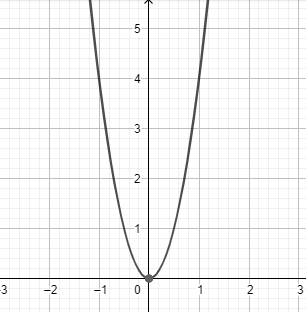
How to graph a parabola $y=4{{x}^{2}}$ ?
Answer
 Verified
579.3k+ views
Hint: We have been given the equation of a parabola to be plotted on the cartesian plane. The parent equation of this parabola is ${{x}^{2}}=4y$. We shall first find the vertex of the parabola. Then we shall find multiple points lying on the parabola so that they can be joined together to sketch our final graph.
Complete step by step solution:
Any quadratic equation is of the form $a{{x}^{2}}+bx+c=0$.
However, we are given the equation $y=4{{x}^{2}}$ which represents a parabola.
This equation can also be written as $\left( y-0 \right)=4{{\left( x-0 \right)}^{2}}$. This implies that the coordinates of the vertex of the parabola are $\left( 0,0 \right)$, that is the center of the cartesian plane.
We shall now calculate the points lying on this parabola and tabulate them as follows.
Dividing 4 from both sides of the equation, $y=4{{x}^{2}}$, we get
${{x}^{2}}=\dfrac{y}{4}$
From this equation, we identify that the given parabola is a vertical parabola.
Thus, plotting the points on the cartesian plane, we get our graph as:
Note:
We know that in order to sketch the graph of a straight-line, we require two points lying on it which can be joined together to draw that straight line. In the case of quadratic equations and curves, only two points cannot suffice and we need more points lying on the curve. Now, since it is mentioned that this curve is that of a parabola, therefore we do not need to find the maxima, minima and points of inflection of the curve.
Complete step by step solution:
Any quadratic equation is of the form $a{{x}^{2}}+bx+c=0$.
However, we are given the equation $y=4{{x}^{2}}$ which represents a parabola.
This equation can also be written as $\left( y-0 \right)=4{{\left( x-0 \right)}^{2}}$. This implies that the coordinates of the vertex of the parabola are $\left( 0,0 \right)$, that is the center of the cartesian plane.
We shall now calculate the points lying on this parabola and tabulate them as follows.
| $y=4{{x}^{2}}$ | ${{x}^{2}}$ | $x$ |
| 0 | $\dfrac{0}{4}$ | 0 |
| 1 | $\dfrac{1}{4}$ | $\pm \dfrac{1}{2}$ |
| 2 | $\dfrac{2}{4}$ | $\pm \dfrac{1}{\sqrt{2}}$ |
| 3 | $\dfrac{9}{4}$ | $\pm \dfrac{3}{2}$ |
| 4 | $\dfrac{16}{4}$ | $\pm 2$ |
| 5 | $\dfrac{25}{4}$ | $\pm \dfrac{5}{2}$ |
Dividing 4 from both sides of the equation, $y=4{{x}^{2}}$, we get
${{x}^{2}}=\dfrac{y}{4}$
From this equation, we identify that the given parabola is a vertical parabola.
Thus, plotting the points on the cartesian plane, we get our graph as:
Note:
We know that in order to sketch the graph of a straight-line, we require two points lying on it which can be joined together to draw that straight line. In the case of quadratic equations and curves, only two points cannot suffice and we need more points lying on the curve. Now, since it is mentioned that this curve is that of a parabola, therefore we do not need to find the maxima, minima and points of inflection of the curve.
Recently Updated Pages
Master Class 12 Business Studies: Engaging Questions & Answers for Success

Master Class 12 Biology: Engaging Questions & Answers for Success
Master Class 12 Chemistry: Engaging Questions & Answers for Success
Class 12 Question and Answer - Your Ultimate Solutions Guide
Master Class 11 Social Science: Engaging Questions & Answers for Success
Master Class 11 English: Engaging Questions & Answers for Success
Trending doubts
Which are the Top 10 Largest Countries of the World?
Draw a labelled sketch of the human eye class 12 physics CBSE
Name the crygenes that control cotton bollworm and class 12 biology CBSE
Differentiate between homogeneous and heterogeneous class 12 chemistry CBSE
Ribosomal RNA is actively synthesised in A Nucleoplasm class 12 biology CBSE
How many molecules of ATP and NADPH are required information class 12 biology CBSE