




How do you solve $\cos x = \dfrac{1}{2}$ ?
Answer
 Verified
577.8k+ views
Hint: In the given question, we have to solve for $x$ , usually cosine function is having positive values in first and the fourth quadrants, so we will get two values for $x$ , by taking inverse cosine on both side we can find the value of $x$ .
Complete step-by-step answer:
Since in the given question the cosine value is greater than zero the value of $x$ will be in the first or fourth quadrant. The quadrant details for cosine function is given as in the below diagram
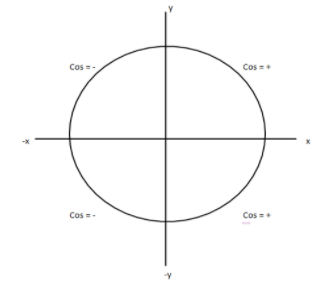
As they have not mentioned which quadrant values are to be determined we will find both the values.
Angle in first quadrant:
In order to find the value of $x$ take the cosine function to right hand side so that it will become inverse cosine function, which can be written as
$x = {\cos ^{ - 1}}\left( {\dfrac{1}{2}} \right)$
$ \Rightarrow x = \dfrac{\pi }{3}$ This is the value of $x$ with respect to the first quadrant.
In order to find the value of $x$ with respect to fourth quadrant we can write the value of $x$ as $360$ minus tita, here tita $(\theta )$ is nothing but the value of $x$ ,
Therefore, $x = \left( {2\pi - \dfrac{\pi }{3}} \right)$
Taking L.C.M we can write as
$ \Rightarrow x = \left( {\dfrac{{6\pi - \pi }}{3}} \right)$
Therefore on subtraction, we get the value of $x$ as
$ \Rightarrow x = \left( {\dfrac{{5\pi }}{3}} \right)$
Hence $x = \dfrac{\pi }{3},\dfrac{{5\pi }}{3}$.
Note: Whenever we have this type of problem you need to know about quadrants first, so that we can find the values according to the quadrants. Sometimes if they give values less than zero or negative values then the quadrant will change and you need to calculate the values according to that.
Complete step-by-step answer:
Since in the given question the cosine value is greater than zero the value of $x$ will be in the first or fourth quadrant. The quadrant details for cosine function is given as in the below diagram
As they have not mentioned which quadrant values are to be determined we will find both the values.
Angle in first quadrant:
In order to find the value of $x$ take the cosine function to right hand side so that it will become inverse cosine function, which can be written as
$x = {\cos ^{ - 1}}\left( {\dfrac{1}{2}} \right)$
$ \Rightarrow x = \dfrac{\pi }{3}$ This is the value of $x$ with respect to the first quadrant.
In order to find the value of $x$ with respect to fourth quadrant we can write the value of $x$ as $360$ minus tita, here tita $(\theta )$ is nothing but the value of $x$ ,
Therefore, $x = \left( {2\pi - \dfrac{\pi }{3}} \right)$
Taking L.C.M we can write as
$ \Rightarrow x = \left( {\dfrac{{6\pi - \pi }}{3}} \right)$
Therefore on subtraction, we get the value of $x$ as
$ \Rightarrow x = \left( {\dfrac{{5\pi }}{3}} \right)$
Hence $x = \dfrac{\pi }{3},\dfrac{{5\pi }}{3}$.
Note: Whenever we have this type of problem you need to know about quadrants first, so that we can find the values according to the quadrants. Sometimes if they give values less than zero or negative values then the quadrant will change and you need to calculate the values according to that.
Recently Updated Pages
Master Class 11 Social Science: Engaging Questions & Answers for Success

Master Class 11 Physics: Engaging Questions & Answers for Success
Master Class 11 Maths: Engaging Questions & Answers for Success
Master Class 11 Economics: Engaging Questions & Answers for Success
Master Class 11 Computer Science: Engaging Questions & Answers for Success
Master Class 11 Chemistry: Engaging Questions & Answers for Success
Trending doubts
One Metric ton is equal to kg A 10000 B 1000 C 100 class 11 physics CBSE
There are 720 permutations of the digits 1 2 3 4 5 class 11 maths CBSE
1 Quintal is equal to a 110 kg b 10 kg c 100kg d 1000 class 11 physics CBSE
State and prove Bernoullis theorem class 11 physics CBSE
Difference Between Prokaryotic Cells and Eukaryotic Cells
Discuss the various forms of bacteria class 11 biology CBSE