



How do you simplify $\sqrt {6889} $?
Answer
 Verified
545.4k+ views
Hint: First, place the bar over every pair of digits starting from the digit at one’s place. Next, find the largest number whose square is less than or equal to the number under the extreme left bar. Next, take this number as the divisor and quotient with the number under the extreme left bar as the dividend. Divide and get the remainder. Next, bring down the number under the next bar to the right of the remainder. Next, double the divisor and enter it with a blank on its right. Next, guess a largest possible digit to fill the blank which will also become the new digit in the quotient, such that when the new divisor is multiplied to the new quotient the product is less than or equal to the dividend. Next, repeat till all the pair of digits have been taken up. Finally, the quotient obtained is the required square root of the given number.
Complete step by step solution:
First, place the bar over every pair of digits starting from the digit at one’s place. If the number of digits in it is odd, then the left-most single digit too will have a bar.
After putting the bar, the number becomes $\overline {68} {\text{ }}\overline {89} $.
Now, find the largest number whose square is less than or equal to the number under the extreme
left bar.
Since, ${8^2} < 68 < {9^2}$
So, $8$ is the largest number whose square is less than $68$.
Now, take this number as the divisor and quotient with the number under the extreme left bar as the dividend. Divide and get the remainder.
So, the divisor is $8$ and the dividend is $68$.
Then,
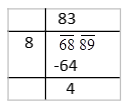
So, the remainder is $4$.
Now, bring down the number under the next bar to the right of the remainder.
i.e., Bring $89$ to the right of $4$.
So, the new dividend is 489.
Now, double the divisor and enter it with a blank on its right.
Double of divisor $8$ is $16$.
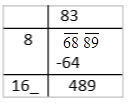
Now, we have to find the digit to fill the blank.
Guess a largest possible digit to fill the blank which will also become the new digit in the quotient, such that when the new divisor is multiplied to the new quotient the product is less than or equal to the dividend.
In this case, $163 \times 3 = 489$
So, we choose the new digit as $3$.
Now, Place 3 in the blank and complete the division.
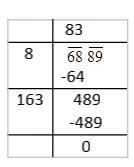
Since the remainder is 0 and no digits are left in the given number.
Therefore, $\sqrt {6689} = 83$
Therefore, $\sqrt {6689} = 83$.
Note: Steps for finding the square root of a number using Division Method:
Step 1: Place the bar over every pair of digits starting from the digit at one’s place. If the number of digits in it is odd, then the left-most single digit too will have a bar.
Step 2: Find the largest number whose square is less than or equal to the number under the extreme left bar. Take this number as the divisor and quotient with the number under the extreme left bar as the dividend. Divide and get the remainder.
Step 3: Bring down the number under the next bar to the right of the remainder.
Step 4: Double the divisor and enter it with a blank on its right.
Step 5: Guess a largest possible digit to fill the blank which will also become the new digit in the quotient, such that when the new divisor is multiplied to the new quotient the product is less than or equal to the dividend.
Step 6: Repeat steps (2), (3), (4) and (5) till all the pair of digits have been taken up.
The quotient obtained is the required square root of the given number.
Complete step by step solution:
First, place the bar over every pair of digits starting from the digit at one’s place. If the number of digits in it is odd, then the left-most single digit too will have a bar.
After putting the bar, the number becomes $\overline {68} {\text{ }}\overline {89} $.
Now, find the largest number whose square is less than or equal to the number under the extreme
left bar.
Since, ${8^2} < 68 < {9^2}$
So, $8$ is the largest number whose square is less than $68$.
Now, take this number as the divisor and quotient with the number under the extreme left bar as the dividend. Divide and get the remainder.
So, the divisor is $8$ and the dividend is $68$.
Then,
So, the remainder is $4$.
Now, bring down the number under the next bar to the right of the remainder.
i.e., Bring $89$ to the right of $4$.
So, the new dividend is 489.
Now, double the divisor and enter it with a blank on its right.
Double of divisor $8$ is $16$.
Now, we have to find the digit to fill the blank.
Guess a largest possible digit to fill the blank which will also become the new digit in the quotient, such that when the new divisor is multiplied to the new quotient the product is less than or equal to the dividend.
In this case, $163 \times 3 = 489$
So, we choose the new digit as $3$.
Now, Place 3 in the blank and complete the division.
Since the remainder is 0 and no digits are left in the given number.
Therefore, $\sqrt {6689} = 83$
Therefore, $\sqrt {6689} = 83$.
Note: Steps for finding the square root of a number using Division Method:
Step 1: Place the bar over every pair of digits starting from the digit at one’s place. If the number of digits in it is odd, then the left-most single digit too will have a bar.
Step 2: Find the largest number whose square is less than or equal to the number under the extreme left bar. Take this number as the divisor and quotient with the number under the extreme left bar as the dividend. Divide and get the remainder.
Step 3: Bring down the number under the next bar to the right of the remainder.
Step 4: Double the divisor and enter it with a blank on its right.
Step 5: Guess a largest possible digit to fill the blank which will also become the new digit in the quotient, such that when the new divisor is multiplied to the new quotient the product is less than or equal to the dividend.
Step 6: Repeat steps (2), (3), (4) and (5) till all the pair of digits have been taken up.
The quotient obtained is the required square root of the given number.

Recently Updated Pages
Master Class 9 General Knowledge: Engaging Questions & Answers for Success

Master Class 9 Social Science: Engaging Questions & Answers for Success
Master Class 9 English: Engaging Questions & Answers for Success
Master Class 9 Maths: Engaging Questions & Answers for Success
Master Class 9 Science: Engaging Questions & Answers for Success
Class 9 Question and Answer - Your Ultimate Solutions Guide
Trending doubts
Difference Between Plant Cell and Animal Cell
Fill the blanks with the suitable prepositions 1 The class 9 english CBSE
Who is eligible for RTE class 9 social science CBSE
Which places in India experience sunrise first and class 9 social science CBSE
What is pollution? How many types of pollution? Define it
Name 10 Living and Non living things class 9 biology CBSE