




How do you simplify \[\sec (\arctan (4x))\]?
Answer
 Verified
579k+ views
Hint: We will consider the inner function as an angle. Then we will eliminate the function \[\arctan \] from the resulting expression. Next, we will draw a right triangle based on the expression. Finally, we will find \[\sec \] of the angle we have considered.
Formula used:
\[\tan (\arctan (x)) = x\]
Complete step by step solution:
We are required to simplify the expression \[\sec (\arctan (4x))\].
Let us begin by denoting the innermost function, which is \[\arctan (4x)\] as an angle \[\theta \]. We get
\[\theta = \arctan (4x)\] ………\[(1)\]
Let us try to eliminate the function \[\arctan \] from equation \[(1)\] by taking \[\tan \] on both sides of equation \[(1)\]. This gives us
\[\tan \theta = \tan (\arctan (4x))\] ………..\[(2)\]
We will use the property \[\tan (\arctan (x)) = x\] on the RHS of equation \[(2)\] to get the following expression:
\[\tan \theta = 4x\] ………\[(3)\]
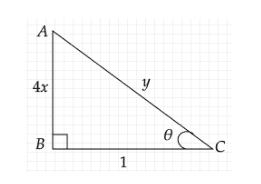
Let us consider a right triangle ABC with right-angle \[\angle B\] as in the figure. Let us take \[\theta \] as the angle between the sides \[AC\] and \[BC\].
Now, from equation \[(3)\], we can write
\[\tan \theta = \dfrac{{4x}}{1}\]
We know that in a right-triangle ABC,
\[\tan \theta = \dfrac{{{\rm{opp}}{\rm{. side}}}}{{{\rm{adj}}{\rm{. side}}}}\]. Compared with the above equation, we can take the opposite side of the right-triangle as \[4x\] units and the adjacent side as \[1\] unit.
Now, we have to find the hypotenuse of the right triangle with sides \[4x\] units and \[1\] units.
By Pythagoras theorem, we have \[A{C^2} = A{B^2} + B{C^2}\]. Substituting \[AC = y,AB = 4x\] and \[BC = 1\], we get
\[{y^2} = {(4x)^2} + {1^2}\]
Taking square root on both sides of the above expression, we get
\[y = \sqrt {16{x^2} + 1} \] ……..\[(4)\]
We are supposed to find the value of \[\sec (\arctan (4x))\], which from equation \[(1)\] is the same as \[\sec \theta \].
We know that \[\sec \theta = \dfrac{{{\rm{hypotenuse}}}}{{{\rm{adj}}{\rm{. side}}}}\]. So, from triangle ABC and equation \[(4)\], we get
\[\sec \theta = \dfrac{{\sqrt {16{x^2} + 1} }}{1} = \sqrt {16{x^2} + 1} \]
Note:
The functions \[\tan \] and \[\arctan \] are inverse functions. We have used the property \[\tan (\arctan (x)) = x\] to eliminate the function \[\arctan \], since we cannot use that function in a right-angled triangle. Similarly, we have properties \[\sin (\arcsin (x)) = x\] and \[\cos (\arccos (x)) = x\].
Formula used:
\[\tan (\arctan (x)) = x\]
Complete step by step solution:
We are required to simplify the expression \[\sec (\arctan (4x))\].
Let us begin by denoting the innermost function, which is \[\arctan (4x)\] as an angle \[\theta \]. We get
\[\theta = \arctan (4x)\] ………\[(1)\]
Let us try to eliminate the function \[\arctan \] from equation \[(1)\] by taking \[\tan \] on both sides of equation \[(1)\]. This gives us
\[\tan \theta = \tan (\arctan (4x))\] ………..\[(2)\]
We will use the property \[\tan (\arctan (x)) = x\] on the RHS of equation \[(2)\] to get the following expression:
\[\tan \theta = 4x\] ………\[(3)\]
Let us consider a right triangle ABC with right-angle \[\angle B\] as in the figure. Let us take \[\theta \] as the angle between the sides \[AC\] and \[BC\].
Now, from equation \[(3)\], we can write
\[\tan \theta = \dfrac{{4x}}{1}\]
We know that in a right-triangle ABC,
\[\tan \theta = \dfrac{{{\rm{opp}}{\rm{. side}}}}{{{\rm{adj}}{\rm{. side}}}}\]. Compared with the above equation, we can take the opposite side of the right-triangle as \[4x\] units and the adjacent side as \[1\] unit.
Now, we have to find the hypotenuse of the right triangle with sides \[4x\] units and \[1\] units.
By Pythagoras theorem, we have \[A{C^2} = A{B^2} + B{C^2}\]. Substituting \[AC = y,AB = 4x\] and \[BC = 1\], we get
\[{y^2} = {(4x)^2} + {1^2}\]
Taking square root on both sides of the above expression, we get
\[y = \sqrt {16{x^2} + 1} \] ……..\[(4)\]
We are supposed to find the value of \[\sec (\arctan (4x))\], which from equation \[(1)\] is the same as \[\sec \theta \].
We know that \[\sec \theta = \dfrac{{{\rm{hypotenuse}}}}{{{\rm{adj}}{\rm{. side}}}}\]. So, from triangle ABC and equation \[(4)\], we get
\[\sec \theta = \dfrac{{\sqrt {16{x^2} + 1} }}{1} = \sqrt {16{x^2} + 1} \]
Note:
The functions \[\tan \] and \[\arctan \] are inverse functions. We have used the property \[\tan (\arctan (x)) = x\] to eliminate the function \[\arctan \], since we cannot use that function in a right-angled triangle. Similarly, we have properties \[\sin (\arcsin (x)) = x\] and \[\cos (\arccos (x)) = x\].
Recently Updated Pages
Master Class 11 English: Engaging Questions & Answers for Success

Master Class 11 Maths: Engaging Questions & Answers for Success
Class 11 Question and Answer - Your Ultimate Solutions Guide
Master Class 11 Biology: Engaging Questions & Answers for Success
Master Class 11 Physics: Engaging Questions & Answers for Success
Master Class 11 Accountancy: Engaging Questions & Answers for Success
Trending doubts
Differentiate between an exothermic and an endothermic class 11 chemistry CBSE
One Metric ton is equal to kg A 10000 B 1000 C 100 class 11 physics CBSE
In what year Guru Nanak Dev ji was born A15 April 1469 class 11 social science CBSE
Difference Between Prokaryotic Cells and Eukaryotic Cells
There are 720 permutations of the digits 1 2 3 4 5 class 11 maths CBSE
Draw a diagram of a plant cell and label at least eight class 11 biology CBSE