



How do you graph $y=5x-5$ ?
Answer
 Verified
579.6k+ views
Hint: We are asked to draw the graph of the equation $y=5x-5$. The degree of an equation is the highest power of the variable present in it. So, as for this equation, the highest power present \[x\] is 1, the degree is also 1. From this, it can be said that this is a linear equation. The graph of a linear equation represents a straight line.
Complete step by step answer:
The general equation of a straight line is \[ax+by+c=0\], where \[a,b,c\] are any real numbers. The given equation is $y=5x-5$, the equation can also be written as \[5x-y-5=0\], comparing with the general equation of straight line, we get \[a=5,\,b=-1\And c=-5\].
To plot the graph of an equation of the straight line, we should know at least two points, through which the line passes.
To make things simple, let’s take the X-intercept and Y-intercept as the two points. X-intercept is the point where the line crosses X-axis, this means that the Y-coordinate will be \[0\], similarly Y-intercept is the point where the line crosses Y-axis, so X-coordinate will be \[0\]. We will use this property now.
We substitute \[y=0\] in the equation \[5x-y-5=0\], we get
\[\begin{align}
& \Rightarrow 5x-(0)-5=0 \\
& \Rightarrow 5x-5=0 \\
& \Rightarrow 5x=5 \\
\end{align}\]
We divide both sides by 5, we get
\[\begin{align}
& \Rightarrow \dfrac{5x}{5}=\dfrac{5}{5} \\
& \therefore x=1 \\
\end{align}\]
So, the coordinates of the X-intercept are \[(1,0)\].
Similarly, now we substitute \[x=0\] in the equation \[5x-y-5=0\], we get
\[\Rightarrow 5\times 0-y-5=0\]
Adding \[y\] to both sides of the equation, we get
\[\begin{align}
& \Rightarrow -y-5+y=y \\
& \therefore y=-5 \\
\end{align}\]
So, the coordinates of the Y-intercept are \[(0,-5)\].
Using these two points we can plot the graph of the equation as follows:
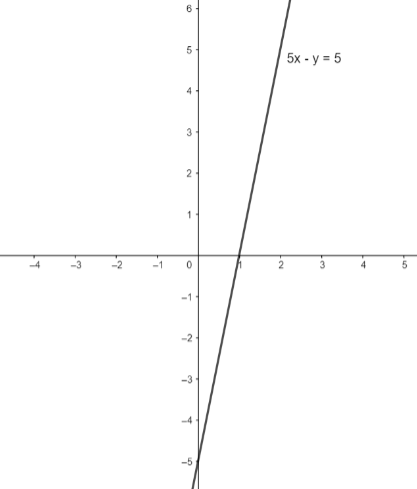
Note: Here, we found the two points which are X-intercept and Y-intercept by substituting either-or \[y\], one at a time. We can also find these values by converting the straight-line equation to the equation in intercept form which is, \[\dfrac{x}{a}+\dfrac{y}{b}=1\]. Here, \[a\And b\] are X-intercept and Y-intercept respectively.
Complete step by step answer:
The general equation of a straight line is \[ax+by+c=0\], where \[a,b,c\] are any real numbers. The given equation is $y=5x-5$, the equation can also be written as \[5x-y-5=0\], comparing with the general equation of straight line, we get \[a=5,\,b=-1\And c=-5\].
To plot the graph of an equation of the straight line, we should know at least two points, through which the line passes.
To make things simple, let’s take the X-intercept and Y-intercept as the two points. X-intercept is the point where the line crosses X-axis, this means that the Y-coordinate will be \[0\], similarly Y-intercept is the point where the line crosses Y-axis, so X-coordinate will be \[0\]. We will use this property now.
We substitute \[y=0\] in the equation \[5x-y-5=0\], we get
\[\begin{align}
& \Rightarrow 5x-(0)-5=0 \\
& \Rightarrow 5x-5=0 \\
& \Rightarrow 5x=5 \\
\end{align}\]
We divide both sides by 5, we get
\[\begin{align}
& \Rightarrow \dfrac{5x}{5}=\dfrac{5}{5} \\
& \therefore x=1 \\
\end{align}\]
So, the coordinates of the X-intercept are \[(1,0)\].
Similarly, now we substitute \[x=0\] in the equation \[5x-y-5=0\], we get
\[\Rightarrow 5\times 0-y-5=0\]
Adding \[y\] to both sides of the equation, we get
\[\begin{align}
& \Rightarrow -y-5+y=y \\
& \therefore y=-5 \\
\end{align}\]
So, the coordinates of the Y-intercept are \[(0,-5)\].
Using these two points we can plot the graph of the equation as follows:
Note: Here, we found the two points which are X-intercept and Y-intercept by substituting either-or \[y\], one at a time. We can also find these values by converting the straight-line equation to the equation in intercept form which is, \[\dfrac{x}{a}+\dfrac{y}{b}=1\]. Here, \[a\And b\] are X-intercept and Y-intercept respectively.
Recently Updated Pages
Master Class 9 Social Science: Engaging Questions & Answers for Success

Master Class 9 Science: Engaging Questions & Answers for Success
Master Class 9 Maths: Engaging Questions & Answers for Success
Master Class 9 General Knowledge: Engaging Questions & Answers for Success
Class 9 Question and Answer - Your Ultimate Solutions Guide
Master Class 8 Social Science: Engaging Questions & Answers for Success
Trending doubts
Find the sum of series 1 + 2 + 3 + 4 + 5 + + 100 class 9 maths CBSE
What is the Full Form of ISI and RAW
Fill the blanks with the suitable prepositions 1 The class 9 english CBSE
Difference Between Plant Cell and Animal Cell
Who is eligible for RTE class 9 social science CBSE
What is pollution? How many types of pollution? Define it