




How do you graph $y = \sin x + x$
Answer
 Verified
590.4k+ views
Hint: First, find the derivative of the trigonometric function. Then determine the possible values of $x$ at which the function is equal to zero. We will find the value of the function when $x$ reaches to infinity.
Complete step-by-step answer:
We know that the graph of a function is defined for all $x$ which belong to real number. First, determine the value of the derivative of the function.
$ \Rightarrow y' = {\left( {\sin x} \right)^\prime } + x'$
Find the derivative of the expression.
$ \Rightarrow y' = \cos x + 1$
The range of $\cos x = \left[ { - 1,1} \right]$. Equate the differentiation of the function to zero to compute the value of $x$.
$ \Rightarrow y' = 0$
$ \Rightarrow \cos x + 1 = 0$
$ \Rightarrow \cos x = - 1$
Now we will apply the general solution of $\cos x = \cos \alpha $
Therefore, the value of $\cos x = - 1$when $x = n\pi $
Now, apply the limits to the function.
$ \Rightarrow \mathop {\lim }\limits_{x \to - \infty } y = - \infty $
And
$ \Rightarrow \mathop {\lim }\limits_{x \to \infty } y = \infty $
Now find the second derivative of the function by again differentiating the equation.
$ \Rightarrow y'' = {\left( {\cos x} \right)^\prime } + {\left( 1 \right)^\prime }$
$ \Rightarrow y'' = - \sin x$
Now, equate the second derivative of the function to zero to compute the value of $x$.
$ \Rightarrow - \sin x = 0$
Now we will apply the general solution of $\sin x = 0$
Therefore, the value of $\sin x = 0$ when $x = n\pi $
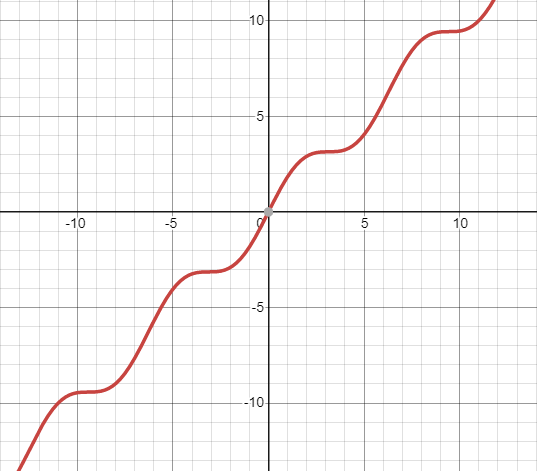
Here, the inflection points for $x$ is equal to $n\pi $. Therefore, the graph of the function $y = \sin x + x$ shows that $y \to x$ as the value of $\left| x \right|$increases.
The graph of the function is shown below:
Note:
The graph of the trigonometric function is obtained by finding the second derivative of the function. First, equate the first derivative of the function to obtain the value of x and then equate the second derivative of the function to zero to obtain the value of x. In such types of questions, students made mistakes to obtain the inflection points of the function which is further used to obtain the graph of the function.
Complete step-by-step answer:
We know that the graph of a function is defined for all $x$ which belong to real number. First, determine the value of the derivative of the function.
$ \Rightarrow y' = {\left( {\sin x} \right)^\prime } + x'$
Find the derivative of the expression.
$ \Rightarrow y' = \cos x + 1$
The range of $\cos x = \left[ { - 1,1} \right]$. Equate the differentiation of the function to zero to compute the value of $x$.
$ \Rightarrow y' = 0$
$ \Rightarrow \cos x + 1 = 0$
$ \Rightarrow \cos x = - 1$
Now we will apply the general solution of $\cos x = \cos \alpha $
Therefore, the value of $\cos x = - 1$when $x = n\pi $
Now, apply the limits to the function.
$ \Rightarrow \mathop {\lim }\limits_{x \to - \infty } y = - \infty $
And
$ \Rightarrow \mathop {\lim }\limits_{x \to \infty } y = \infty $
Now find the second derivative of the function by again differentiating the equation.
$ \Rightarrow y'' = {\left( {\cos x} \right)^\prime } + {\left( 1 \right)^\prime }$
$ \Rightarrow y'' = - \sin x$
Now, equate the second derivative of the function to zero to compute the value of $x$.
$ \Rightarrow - \sin x = 0$
Now we will apply the general solution of $\sin x = 0$
Therefore, the value of $\sin x = 0$ when $x = n\pi $
Here, the inflection points for $x$ is equal to $n\pi $. Therefore, the graph of the function $y = \sin x + x$ shows that $y \to x$ as the value of $\left| x \right|$increases.
The graph of the function is shown below:
Note:
The graph of the trigonometric function is obtained by finding the second derivative of the function. First, equate the first derivative of the function to obtain the value of x and then equate the second derivative of the function to zero to obtain the value of x. In such types of questions, students made mistakes to obtain the inflection points of the function which is further used to obtain the graph of the function.
Recently Updated Pages
Master Class 11 Social Science: Engaging Questions & Answers for Success

Master Class 11 Chemistry: Engaging Questions & Answers for Success
Master Class 9 General Knowledge: Engaging Questions & Answers for Success
Master Class 9 Maths: Engaging Questions & Answers for Success
Master Class 9 Science: Engaging Questions & Answers for Success
Master Class 9 English: Engaging Questions & Answers for Success
Trending doubts
One Metric ton is equal to kg A 10000 B 1000 C 100 class 11 physics CBSE
Difference Between Prokaryotic Cells and Eukaryotic Cells
Two of the body parts which do not appear in MRI are class 11 biology CBSE
1 ton equals to A 100 kg B 1000 kg C 10 kg D 10000 class 11 physics CBSE
Explain zero factorial class 11 maths CBSE
10 examples of friction in our daily life