




How do you graph \[y = 2 - 2x\]?
Answer
 Verified
576.9k+ views
Hint: Here, we will substitute different values of \[x\] in the given equation to find corresponding values of \[y\]. This will help us find different coordinate points. We will use these points to draw the graph of the given equation.
Complete step by step solution:
The given equation is \[y = 2 - 2x\].
We observe from this equation that the powers of both \[x\] and \[y\] are 1.
So, the given equation is a linear equation. The graph of a linear equation is always a straight line.
Let us find two points lying on the graph of the given linear equation. The two points to be found are those that satisfy the linear equation.
Let us rewrite the given equation as \[2x + y = 2\].
Let us substitute \[x = 0\] in the given equation and find the value of \[y\].
\[2\left( 0 \right) + y = 2\]
Simplifying the equation, we get
\[ \Rightarrow y = 2\]
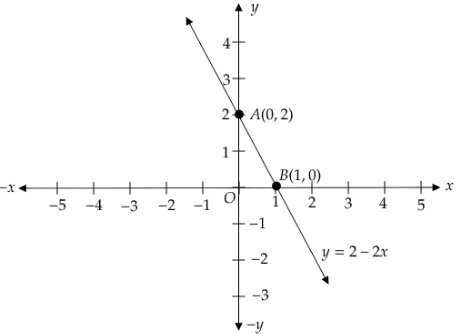
We see that when \[x = 0\], we get \[y = 2\]. So, one point is \[A(0,2)\].
To find another point, we will put \[y = 0\] in the given equation. Therefore, we get
\[\begin{array}{l}2x + \left( 0 \right) = 2\\ \Rightarrow 2x = 2\end{array}\]
Dividing both sides by 2, we get
\[ \Rightarrow x = 1\]
In this case, we get \[x = 1\]. So, the second point is \[B(1,0)\].
Using these points, we will draw the graph of \[2x + y = 2\].
The point \[A(0,2)\] will lie on the \[y\]-axis, since the \[x \] -coordinate is zero. The point \[B(1,0)\] will lie on the \[x \] -axis since the \[y\]- coordinate is zero.
Therefore, we get the graph as follows:
Note:
Another method to draw the graph is by slope-intercept form. We will compare the given linear equation to the slope-intercept form of a linear equation which is \[y = mx + c\], where \[m\] is the slope of the line and \[c\] is the \[y - \] intercept, i.e., the point where the graph cuts the \[y - \]axis.
Comparing the equation \[y = 2 - 2x\] with \[y = mx + c\], we get \[m = - 2\] and \[c = 2\]. Here the slope is \[ - 2\] and the \[y - \] intercept is \[2\]. First, we have to mark the \[y - \] intercept. Since, the \[y - \] intercept is positive, i.e., \[2\], it will lie on the \[ + y\] axis. So we got the point as \[A\left( {0,2} \right)\].
Now, the slope is \[ - 2\] , which can be written as \[ - 2 = \dfrac{{ - 2}}{1}\]. Here the numerator \[ - 2\] means we have to go 2 units down the point \[2\] and the denominator 1 means we have to go right by 1 unit. So, the point we reach is \[B(1,0)\]. We get the same graph as above.
Complete step by step solution:
The given equation is \[y = 2 - 2x\].
We observe from this equation that the powers of both \[x\] and \[y\] are 1.
So, the given equation is a linear equation. The graph of a linear equation is always a straight line.
Let us find two points lying on the graph of the given linear equation. The two points to be found are those that satisfy the linear equation.
Let us rewrite the given equation as \[2x + y = 2\].
Let us substitute \[x = 0\] in the given equation and find the value of \[y\].
\[2\left( 0 \right) + y = 2\]
Simplifying the equation, we get
\[ \Rightarrow y = 2\]
We see that when \[x = 0\], we get \[y = 2\]. So, one point is \[A(0,2)\].
To find another point, we will put \[y = 0\] in the given equation. Therefore, we get
\[\begin{array}{l}2x + \left( 0 \right) = 2\\ \Rightarrow 2x = 2\end{array}\]
Dividing both sides by 2, we get
\[ \Rightarrow x = 1\]
In this case, we get \[x = 1\]. So, the second point is \[B(1,0)\].
Using these points, we will draw the graph of \[2x + y = 2\].
The point \[A(0,2)\] will lie on the \[y\]-axis, since the \[x \] -coordinate is zero. The point \[B(1,0)\] will lie on the \[x \] -axis since the \[y\]- coordinate is zero.
Therefore, we get the graph as follows:
Note:
Another method to draw the graph is by slope-intercept form. We will compare the given linear equation to the slope-intercept form of a linear equation which is \[y = mx + c\], where \[m\] is the slope of the line and \[c\] is the \[y - \] intercept, i.e., the point where the graph cuts the \[y - \]axis.
Comparing the equation \[y = 2 - 2x\] with \[y = mx + c\], we get \[m = - 2\] and \[c = 2\]. Here the slope is \[ - 2\] and the \[y - \] intercept is \[2\]. First, we have to mark the \[y - \] intercept. Since, the \[y - \] intercept is positive, i.e., \[2\], it will lie on the \[ + y\] axis. So we got the point as \[A\left( {0,2} \right)\].
Now, the slope is \[ - 2\] , which can be written as \[ - 2 = \dfrac{{ - 2}}{1}\]. Here the numerator \[ - 2\] means we have to go 2 units down the point \[2\] and the denominator 1 means we have to go right by 1 unit. So, the point we reach is \[B(1,0)\]. We get the same graph as above.
Recently Updated Pages
Three beakers labelled as A B and C each containing 25 mL of water were taken A small amount of NaOH anhydrous CuSO4 and NaCl were added to the beakers A B and C respectively It was observed that there was an increase in the temperature of the solutions contained in beakers A and B whereas in case of beaker C the temperature of the solution falls Which one of the following statements isarecorrect i In beakers A and B exothermic process has occurred ii In beakers A and B endothermic process has occurred iii In beaker C exothermic process has occurred iv In beaker C endothermic process has occurred

Master Class 11 Social Science: Engaging Questions & Answers for Success
Master Class 11 Physics: Engaging Questions & Answers for Success
Master Class 11 Maths: Engaging Questions & Answers for Success
Master Class 11 Economics: Engaging Questions & Answers for Success
Master Class 11 Computer Science: Engaging Questions & Answers for Success
Three beakers labelled as A B and C each containing 25 mL of water were taken A small amount of NaOH anhydrous CuSO4 and NaCl were added to the beakers A B and C respectively It was observed that there was an increase in the temperature of the solutions contained in beakers A and B whereas in case of beaker C the temperature of the solution falls Which one of the following statements isarecorrect i In beakers A and B exothermic process has occurred ii In beakers A and B endothermic process has occurred iii In beaker C exothermic process has occurred iv In beaker C endothermic process has occurred
Master Class 11 Social Science: Engaging Questions & Answers for Success
Master Class 11 Physics: Engaging Questions & Answers for Success
Trending doubts
One Metric ton is equal to kg A 10000 B 1000 C 100 class 11 physics CBSE
There are 720 permutations of the digits 1 2 3 4 5 class 11 maths CBSE
State and prove Bernoullis theorem class 11 physics CBSE
Draw a diagram of a plant cell and label at least eight class 11 biology CBSE
Difference Between Prokaryotic Cells and Eukaryotic Cells
Discuss the various forms of bacteria class 11 biology CBSE