




How do you graph \[{x^2} + {y^2} = 16\] ?
Answer
 Verified
609.9k+ views
Hint: To solve this we need to give the values of ‘x’ and we can find the values of ‘y’. Otherwise we can find the coordinate of the given equation lying on the line of x- axis, we can find this by substituting the value of ‘y’ is equal to zero (x-intercept). Similarly we can find the coordinate of the equation lying on the line of y- axis, we can find this by substituting the value of ‘x’ equal to zero (y-intercept).
Complete step by step solution:
Given, \[{x^2} + {y^2} = 16\] .
To find the x-intercept. That is the value of ‘x’ at \[y = 0\] . Substituting this in the given equation. We have,
\[{x^2} + {0^2} = 16\]
\[{x^2} = 16\]
Taking square root on both sides we have,
\[x = \pm \sqrt {16} \]
\[x = \pm 4\]
Thus we have a coordinate of the equation which lies on the line of x-axis. The coordinate points are \[(4,0)\] and \[( - 4,0)\] .
To find the y-intercept. That is the value of ‘y’ at \[x = 0\] . Substituting this in the given equation we have,
\[{0^2} + {y^2} = 16\]
\[{y^2} = 16\]
Taking square root on both sides we have,
\[y = \pm \sqrt {16} \]
\[y = \pm 4\]
Thus we have a coordinate of the equation which lies on the line of the y-axis. The coordinate points are \[(0,4)\] and \[(0, - 4)\] .
We can see that the given equation \[{x^2} + {y^2} = 16\] is a circle equation centre at origin and radius 4.
We have \[(4,0)\] , \[( - 4,0)\] , \[(0,4)\] and \[(0, - 4)\] . We point these coordinates and join them with a curve we will obtain a circle.
Let’s plot a graph for this coordinates,
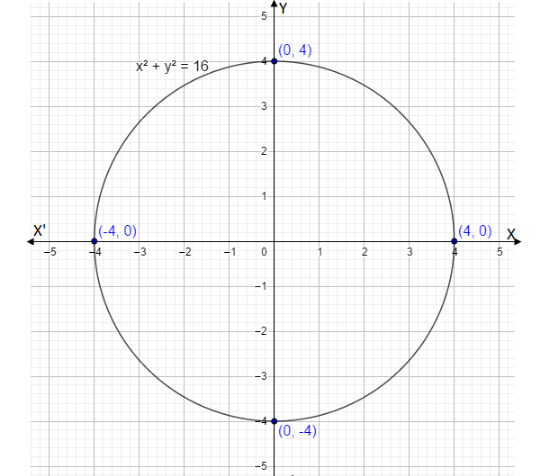
Note: A graph shows the relation between two variable quantities, it contains two axes perpendicular to each other namely the x-axis and the y-axis. Each variable is measured along one of the axes. In the question, we are given one linear equation containing two variables namely x and y, x is measured along the x-axis and y is measured along the y-axis while tracing the given equations.
Complete step by step solution:
Given, \[{x^2} + {y^2} = 16\] .
To find the x-intercept. That is the value of ‘x’ at \[y = 0\] . Substituting this in the given equation. We have,
\[{x^2} + {0^2} = 16\]
\[{x^2} = 16\]
Taking square root on both sides we have,
\[x = \pm \sqrt {16} \]
\[x = \pm 4\]
Thus we have a coordinate of the equation which lies on the line of x-axis. The coordinate points are \[(4,0)\] and \[( - 4,0)\] .
To find the y-intercept. That is the value of ‘y’ at \[x = 0\] . Substituting this in the given equation we have,
\[{0^2} + {y^2} = 16\]
\[{y^2} = 16\]
Taking square root on both sides we have,
\[y = \pm \sqrt {16} \]
\[y = \pm 4\]
Thus we have a coordinate of the equation which lies on the line of the y-axis. The coordinate points are \[(0,4)\] and \[(0, - 4)\] .
We can see that the given equation \[{x^2} + {y^2} = 16\] is a circle equation centre at origin and radius 4.
We have \[(4,0)\] , \[( - 4,0)\] , \[(0,4)\] and \[(0, - 4)\] . We point these coordinates and join them with a curve we will obtain a circle.
Let’s plot a graph for this coordinates,
Note: A graph shows the relation between two variable quantities, it contains two axes perpendicular to each other namely the x-axis and the y-axis. Each variable is measured along one of the axes. In the question, we are given one linear equation containing two variables namely x and y, x is measured along the x-axis and y is measured along the y-axis while tracing the given equations.
Recently Updated Pages
If x a + bt + ct2 where x is in meters and t is in class 11 physics CBSE

A car covers the first half distance between two places class 11 physics CBSE
The resultant of two vectors overrightarrow P and overrightarrow class 11 physics CBSE
Find the value of cos 135 class 11 maths CBSE
A mass M is held in place by an applied force F and class 11 physics CBSE
A solution of glucose in water is labelled as 10 dfracwv class 11 chemistry CBSE
Trending doubts
One Metric ton is equal to kg A 10000 B 1000 C 100 class 11 physics CBSE
Find the value of the expression given below sin 30circ class 11 maths CBSE
Draw a diagram of nephron and explain its structur class 11 biology CBSE
10 examples of friction in our daily life
Proton was discovered by A Thomson B Rutherford C Chadwick class 11 chemistry CBSE
Bond order ofO2 O2+ O2 and O22 is in order A O2 langle class 11 chemistry CBSE