




How do you graph \[{{x}^{2}}+{{y}^{2}}+2x-3=0\]?
Answer
 Verified
556.5k+ views
Hint: Consider the given equation as the equation of the circle and compare it with the general equation of the circle given as: - \[{{x}^{2}}+{{y}^{2}}+2gx+2fy+c=0\]. First find the centre of the circle given by the coordinates \[\left( -g,-f \right)\]. Now, find the points on the coordinate axes where this circle will cut them. To find the points on x – axis, substitute y = 0 and solve the quadratic equation. Similarly, to find the points on the y – axis, substitute x = 0 and solve the quadratic equation. Finally, draw the circle passing through the obtained four points.
Complete step-by-step solution:
Here, we have been provided with the equation \[{{x}^{2}}+{{y}^{2}}+2x-3=0\] and we are asked to draw its graph.
Now, we can see that the given equation is similar to the equation \[{{x}^{2}}+{{y}^{2}}+2gx+2fy+c=0\] which is the general equation of a circle. To draw the graph first we need to determine the centre of this circle and find the points where it will cut both the axes.
We know that the centre of the circle \[{{x}^{2}}+{{y}^{2}}+2gx+2fy+c=0\] is given as \[\left( -g,-f \right)\]. On comparing \[{{x}^{2}}+{{y}^{2}}+2x-3=0\] with the general equation of the circle, we have,
\[\begin{align}
& \Rightarrow 2g=2\Rightarrow g=1 \\
& \Rightarrow 2f=0\Rightarrow f=0 \\
& \Rightarrow c=-3 \\
\end{align}\]
So, the centre of the circle given by the equation \[{{x}^{2}}+{{y}^{2}}+2x-3=0\] is \[\left( -g,-f \right)=\left( -1,0 \right)\].
Now, let us determine the points where this circle cuts both the axes. So, we have,
(i) For the points on x – axis we must have the y – coordinates equal to 0. So, substituting y = 0 in the given equation, we have,
\[\Rightarrow {{x}^{2}}+{{y}^{2}}+2x-3=0\]
Using the middle term split method, we have,
\[\begin{align}
& \Rightarrow {{x}^{2}}+3x-x-3=0 \\
& \Rightarrow x\left( x+3 \right)-1\left( x+3 \right)=0 \\
& \Rightarrow \left( x+3 \right)\left( x-1 \right)=0 \\
\end{align}\]
\[\Rightarrow x=1\] or \[-3\]
Therefore, the points where the circle will cut the x – axis are: - A (1, 0) and B (-3, 0).
(ii) For the points on y – axis we must have the x – coordinates equal to 0. So, substituting x = 0 in the given equation, we have,
\[\begin{align}
& \Rightarrow {{y}^{2}}-3=0 \\
& \Rightarrow {{y}^{2}}=3 \\
\end{align}\]
Taking square root both the sides, we get,
\[\Rightarrow y=\pm \sqrt{3}\]
Therefore, the points where the circle will cut the y – axis are: - C \[\left( \sqrt{3},0 \right)\] and D \[\left( -\sqrt{3},0 \right)\].
Now, marking these points on the graph and constructing a circle, we have,
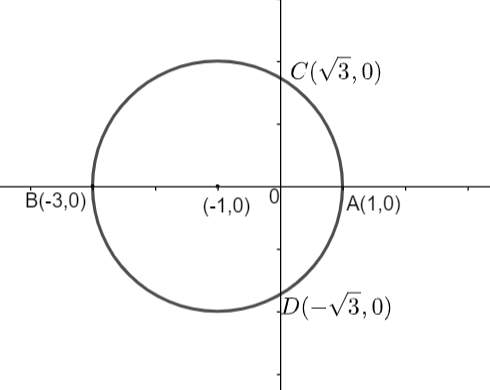
Note: One may note that here we can easily determine the radius of the circle by using the formula: - \[r=\sqrt{{{g}^{2}}+{{f}^{2}}-c}\], where r = radius. It can also be verified using the above drawn graph by finding the distance of the center (-1, 0) from points A, B, C or D. It is necessary to mark all the important points on the graph such that we can get every information from it. You must remember the general equations of all the curves like: - parabola, ellipse, circle, hyperbola etc.
Complete step-by-step solution:
Here, we have been provided with the equation \[{{x}^{2}}+{{y}^{2}}+2x-3=0\] and we are asked to draw its graph.
Now, we can see that the given equation is similar to the equation \[{{x}^{2}}+{{y}^{2}}+2gx+2fy+c=0\] which is the general equation of a circle. To draw the graph first we need to determine the centre of this circle and find the points where it will cut both the axes.
We know that the centre of the circle \[{{x}^{2}}+{{y}^{2}}+2gx+2fy+c=0\] is given as \[\left( -g,-f \right)\]. On comparing \[{{x}^{2}}+{{y}^{2}}+2x-3=0\] with the general equation of the circle, we have,
\[\begin{align}
& \Rightarrow 2g=2\Rightarrow g=1 \\
& \Rightarrow 2f=0\Rightarrow f=0 \\
& \Rightarrow c=-3 \\
\end{align}\]
So, the centre of the circle given by the equation \[{{x}^{2}}+{{y}^{2}}+2x-3=0\] is \[\left( -g,-f \right)=\left( -1,0 \right)\].
Now, let us determine the points where this circle cuts both the axes. So, we have,
(i) For the points on x – axis we must have the y – coordinates equal to 0. So, substituting y = 0 in the given equation, we have,
\[\Rightarrow {{x}^{2}}+{{y}^{2}}+2x-3=0\]
Using the middle term split method, we have,
\[\begin{align}
& \Rightarrow {{x}^{2}}+3x-x-3=0 \\
& \Rightarrow x\left( x+3 \right)-1\left( x+3 \right)=0 \\
& \Rightarrow \left( x+3 \right)\left( x-1 \right)=0 \\
\end{align}\]
\[\Rightarrow x=1\] or \[-3\]
Therefore, the points where the circle will cut the x – axis are: - A (1, 0) and B (-3, 0).
(ii) For the points on y – axis we must have the x – coordinates equal to 0. So, substituting x = 0 in the given equation, we have,
\[\begin{align}
& \Rightarrow {{y}^{2}}-3=0 \\
& \Rightarrow {{y}^{2}}=3 \\
\end{align}\]
Taking square root both the sides, we get,
\[\Rightarrow y=\pm \sqrt{3}\]
Therefore, the points where the circle will cut the y – axis are: - C \[\left( \sqrt{3},0 \right)\] and D \[\left( -\sqrt{3},0 \right)\].
Now, marking these points on the graph and constructing a circle, we have,
Note: One may note that here we can easily determine the radius of the circle by using the formula: - \[r=\sqrt{{{g}^{2}}+{{f}^{2}}-c}\], where r = radius. It can also be verified using the above drawn graph by finding the distance of the center (-1, 0) from points A, B, C or D. It is necessary to mark all the important points on the graph such that we can get every information from it. You must remember the general equations of all the curves like: - parabola, ellipse, circle, hyperbola etc.
Recently Updated Pages
Master Class 11 Computer Science: Engaging Questions & Answers for Success

Master Class 11 Business Studies: Engaging Questions & Answers for Success
Master Class 11 Economics: Engaging Questions & Answers for Success
Master Class 11 English: Engaging Questions & Answers for Success
Master Class 11 Maths: Engaging Questions & Answers for Success
Master Class 11 Biology: Engaging Questions & Answers for Success
Trending doubts
One Metric ton is equal to kg A 10000 B 1000 C 100 class 11 physics CBSE
There are 720 permutations of the digits 1 2 3 4 5 class 11 maths CBSE
Discuss the various forms of bacteria class 11 biology CBSE
Draw a diagram of a plant cell and label at least eight class 11 biology CBSE
State the laws of reflection of light
Explain zero factorial class 11 maths CBSE