




How do you graph \[x - 2y = 3\]?
Answer
 Verified
592.2k+ views
Hint: We will use intercept form to determine the points of the given equation. And, we will also solve this question by assuming the value of $ x = 0 $ , by applying the value of $ x $ , we will get the coordinate of $ y $ . Then, we will assume the value of $ y = 0 $ , by which we will get the $ x $ coordinate. Finally, we will plot the points in the graph.
Complete step-by-step answer:
Here, we will graph \[x - 2y = 3\].
Now, we will write the equation in the slope- intercept form i.e., $ y = mx + b $ $ \to \left( 1 \right) $
Where the $ m $ is the slope
$ b $ is the $ y $ - intercept
Then, we have $ - 2y = 3 - x $
$ y = \dfrac{{3 - x}}{{ - 2}} $
$ y = \dfrac{{ - 3}}{2} + \dfrac{x}{2} $
$ y = \dfrac{1}{2}x - \dfrac{3}{2} $ $ \to \left( 2 \right) $
By comparing equation $ \left( 1 \right) $ and $ \left( 2 \right) $ , we have
$ m = \dfrac{1}{2} $ i.e., the slope of the equation
$ b = - \dfrac{3}{2} $ i.e., the $ y $ - intercept
The $ y $ - intercept is the point where the line intersects the $ y $ -axis.
Therefore, the point is $ \left( {0, - \dfrac{3}{2}} \right) $ .
Slope is the ‘steepness’ of the line, also commonly known as rise over run i.e., $ \dfrac{{rise}}{{run}} $ . Here, $ m = \dfrac{1}{2} $ therefore, we can say that the graph “rise” $ 1 $ point upwards and “runs” $ 2 $ points to the right from the $ y $ - intercept.
Now, we know the slope and the $ y $ - intercept, thus we also know that $ \left( {0 + 2, - \dfrac{3}{2} + 1} \right) = \left( {2, - \dfrac{1}{2}} \right) $ which will also be on the line.
Now, we know two points of the equation i.e., $ \left( {0, - \dfrac{3}{2}} \right) $ and $ \left( {2, - \dfrac{1}{2}} \right) $ .
Let us plot these points graphically,
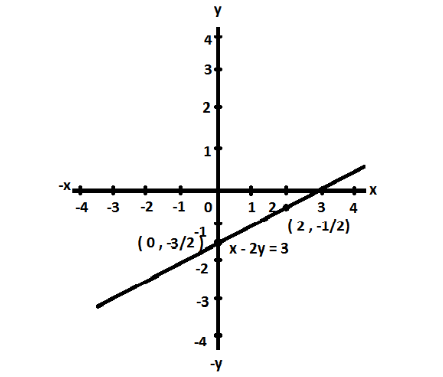
Note: Equation of straight line is usually written in the slope-intercept form. When we are given an equation in slope- intercept form, we can use the $ y $ - intercept as the point, then out the slope from there. When an equation of a line is not given in slope-intercept form, our first step will be to solve the equation for $ y $ . Sometimes the slope intercept form will be called as $ y $ -form.
Complete step-by-step answer:
Here, we will graph \[x - 2y = 3\].
Now, we will write the equation in the slope- intercept form i.e., $ y = mx + b $ $ \to \left( 1 \right) $
Where the $ m $ is the slope
$ b $ is the $ y $ - intercept
Then, we have $ - 2y = 3 - x $
$ y = \dfrac{{3 - x}}{{ - 2}} $
$ y = \dfrac{{ - 3}}{2} + \dfrac{x}{2} $
$ y = \dfrac{1}{2}x - \dfrac{3}{2} $ $ \to \left( 2 \right) $
By comparing equation $ \left( 1 \right) $ and $ \left( 2 \right) $ , we have
$ m = \dfrac{1}{2} $ i.e., the slope of the equation
$ b = - \dfrac{3}{2} $ i.e., the $ y $ - intercept
The $ y $ - intercept is the point where the line intersects the $ y $ -axis.
Therefore, the point is $ \left( {0, - \dfrac{3}{2}} \right) $ .
Slope is the ‘steepness’ of the line, also commonly known as rise over run i.e., $ \dfrac{{rise}}{{run}} $ . Here, $ m = \dfrac{1}{2} $ therefore, we can say that the graph “rise” $ 1 $ point upwards and “runs” $ 2 $ points to the right from the $ y $ - intercept.
Now, we know the slope and the $ y $ - intercept, thus we also know that $ \left( {0 + 2, - \dfrac{3}{2} + 1} \right) = \left( {2, - \dfrac{1}{2}} \right) $ which will also be on the line.
Now, we know two points of the equation i.e., $ \left( {0, - \dfrac{3}{2}} \right) $ and $ \left( {2, - \dfrac{1}{2}} \right) $ .
Let us plot these points graphically,
Note: Equation of straight line is usually written in the slope-intercept form. When we are given an equation in slope- intercept form, we can use the $ y $ - intercept as the point, then out the slope from there. When an equation of a line is not given in slope-intercept form, our first step will be to solve the equation for $ y $ . Sometimes the slope intercept form will be called as $ y $ -form.
Recently Updated Pages
Master Class 12 Economics: Engaging Questions & Answers for Success

Master Class 12 English: Engaging Questions & Answers for Success
Master Class 12 Social Science: Engaging Questions & Answers for Success
Master Class 12 Maths: Engaging Questions & Answers for Success
Master Class 12 Physics: Engaging Questions & Answers for Success
Master Class 9 General Knowledge: Engaging Questions & Answers for Success
Trending doubts
One Metric ton is equal to kg A 10000 B 1000 C 100 class 11 physics CBSE
Difference Between Prokaryotic Cells and Eukaryotic Cells
Two of the body parts which do not appear in MRI are class 11 biology CBSE
1 ton equals to A 100 kg B 1000 kg C 10 kg D 10000 class 11 physics CBSE
Draw a diagram of nephron and explain its structur class 11 biology CBSE
10 examples of friction in our daily life