




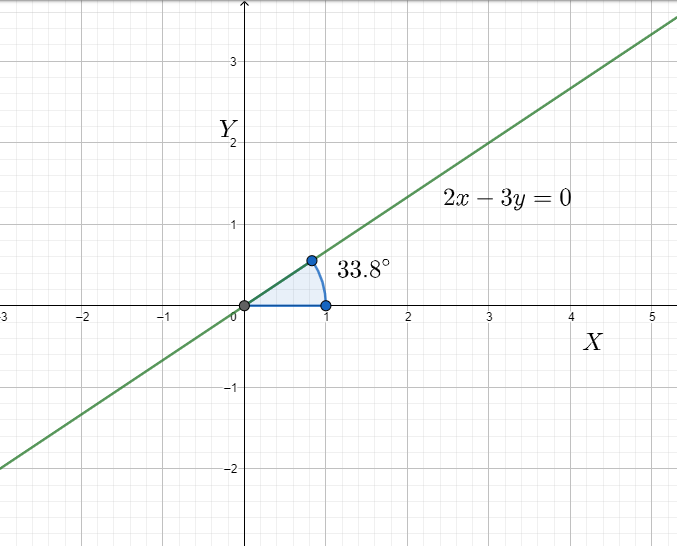
How do you graph the line $2x-3y=0$ ?
Answer
 Verified
623.4k+ views
Hint: We compare the given line with the general equation of a straight line, which is $y=mx+c$ . Upon comparing the given line with this general form, we get the slope and the \[y\] -intercept, which is zero. Knowing these two parameters, we can draw the line.
Complete step-by-step answer:
The general slope-intercept form of a straight line is
$y=mx+c$
Where, $m$ is the slope of the line and $c$ is its $y$ -intercept.
And the given equation is
$2x-3y=0$
We now rewrite the above equation as $\Rightarrow y=\dfrac{2}{3}x$
First of all, we recognize that this is a linear equation, so it is an equation of a straight line. Comparing the given equation with that of the general slope-intercept form, we get
Slope, $m=\dfrac{2}{3}$ and $y$ -intercept, $c=0$
$y$ -intercept $0$ means that the point where the line intersects the $y$ -axis, is $\left( 0,0 \right)$ . Therefore, this point is nothing but the origin itself.
Slope of a line means the tangent of the angle that the line makes with the positive $x$ -axis in an anticlockwise direction. If we are given the slope, we can find the angle which the line makes by the equation,
$\theta ={{\tan }^{-1}}m$
The angle made by this line with the $x$ -axis then, will be
$\Rightarrow \theta ={{\tan }^{-1}}\dfrac{2}{3}$
$\Rightarrow \theta ={{33.8}^{\circ }}$
Then, we draw a line at origin which makes this $\theta $ angle with the positive $x-axis$ in the anticlockwise direction.
Therefore, we can conclude that the last line that we have drawn is nothing but our required line.
Note: This method of graphing requires the use of various geometrical apparatus like scale and protractor, so we must know the use of them. For the worst case scenario considering that we do not know the use of geometrical tools, we can use a simple intuition. We observe that there is no constant term in the equation, which means that the line passes through the origin. We need to find another point which lies on the line and then join the origin and this point to get the required line.
Complete step-by-step answer:
The general slope-intercept form of a straight line is
$y=mx+c$
Where, $m$ is the slope of the line and $c$ is its $y$ -intercept.
And the given equation is
$2x-3y=0$
We now rewrite the above equation as $\Rightarrow y=\dfrac{2}{3}x$
First of all, we recognize that this is a linear equation, so it is an equation of a straight line. Comparing the given equation with that of the general slope-intercept form, we get
Slope, $m=\dfrac{2}{3}$ and $y$ -intercept, $c=0$
$y$ -intercept $0$ means that the point where the line intersects the $y$ -axis, is $\left( 0,0 \right)$ . Therefore, this point is nothing but the origin itself.
Slope of a line means the tangent of the angle that the line makes with the positive $x$ -axis in an anticlockwise direction. If we are given the slope, we can find the angle which the line makes by the equation,
$\theta ={{\tan }^{-1}}m$
The angle made by this line with the $x$ -axis then, will be
$\Rightarrow \theta ={{\tan }^{-1}}\dfrac{2}{3}$
$\Rightarrow \theta ={{33.8}^{\circ }}$
Then, we draw a line at origin which makes this $\theta $ angle with the positive $x-axis$ in the anticlockwise direction.
Therefore, we can conclude that the last line that we have drawn is nothing but our required line.
Note: This method of graphing requires the use of various geometrical apparatus like scale and protractor, so we must know the use of them. For the worst case scenario considering that we do not know the use of geometrical tools, we can use a simple intuition. We observe that there is no constant term in the equation, which means that the line passes through the origin. We need to find another point which lies on the line and then join the origin and this point to get the required line.
Recently Updated Pages
A Paragraph on Pollution in about 100-150 Words

What is BLO What is the full form of BLO class 8 social science CBSE
10 examples of friction in our daily life
Draw a diagram of nephron and explain its structur class 11 biology CBSE
Write structures of the following compounds i 2 Chloro3methylpentane class 11 chemistry CBSE
XIX+XXX A 49 B 51 C 55 D 44 class 5 maths CBSE
Trending doubts
Explain the Treaty of Vienna of 1815 class 10 social science CBSE
1 GB equals how many MB?
10 examples of evaporation in daily life with explanations
What is the full form of POSCO class 10 social science CBSE
Which is the hottest planet in the Solar system A Earth class 10 social science CBSE
Name any four life processes in living things class 10 biology CBSE