




How do you graph ${{r}^{2}}=-\cos \theta $ ?
Answer
 Verified
562.2k+ views
Hint: We will first convert the following equation in polar coordinate equation format and solve it accordingly and plot it in graph.
First we will consider a function of the type:
\[r=f\left( \theta \right)\]
So we will give values of the angle $\theta $ and the function gives you values of $r$.
To graph polar functions, we have to find points that lie at a distance $r$ from the origin and form (the segment $r$) an angle $\theta $ with the x-axis.
Complete step by step solution:
Now first let us consider a function of the type:
\[r=f\left( \theta \right)\]
So we will give values of the angle $\theta $ and the function gives you values of $r$.
Now to graph polar function, we will have to find points that lie at a distance $r$ from the origin and form (the segment $r$) an angle $\theta $ with the x-axis.
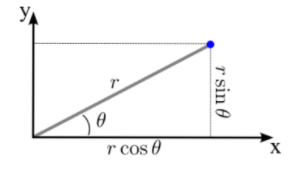
We can calculate Cartesian coordinates of a point with polar coordinates \[(r,\theta )\] by forming the right triangle. The hypotenuse is the line segment from the origin to the point, and its length is \[r\]. The projection of this line segment on the x-axis is the leg of the triangle adjacent to the angle \[\theta \], so \[x=rcos\theta \]. The y-component is determined by the other leg, so \[x=rcos\theta \] .
Our conversion formula is:
$\begin{align}
& x=r\cos \theta \\
& y=r\sin \theta \\
\end{align}$
So now coming to our question, we have:
${{r}^{2}}=-\cos \theta $
Now here we will shift the root on the right hand side, we get:
$r=\sqrt{-\cos \theta }$
Now from this we can see that radius is having a negative number, as such the square of the radius cannot equal a negative number, therefore we must add the following restriction:
\[{{r}^{2}}=-\cos \left( \theta \right);\dfrac{\pi }{2}\le \theta \le \dfrac{3\pi }{2}\]
Now this, this allows us to take the square root of both sides of the equation without being concerned with the negative values.
So we get:
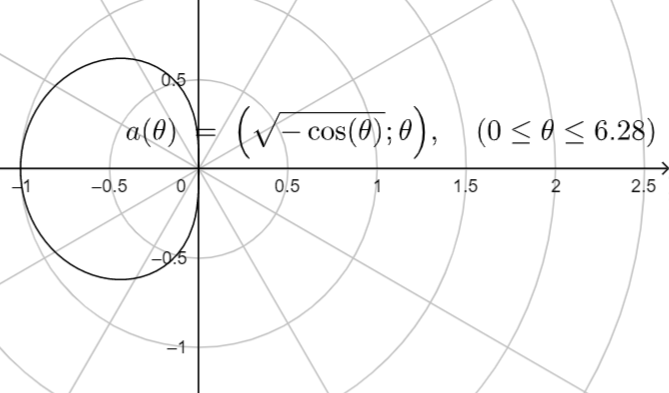
\[r=\sqrt{-\cos \left( \theta \right)};\dfrac{\pi }{2}\le \theta \le \dfrac{3\pi }{2}\]
Now using this we will get a graph of equation as follows:
Note: A polar equation is any equation that describes a relation between \[r\] and $\theta $, where \[r\] represents the distance from the pole (origin) to a point on a curve, and $\theta $ represents the counterclockwise angle made by a point on a curve, the pole, and the positive x-axis.
First we will consider a function of the type:
\[r=f\left( \theta \right)\]
So we will give values of the angle $\theta $ and the function gives you values of $r$.
To graph polar functions, we have to find points that lie at a distance $r$ from the origin and form (the segment $r$) an angle $\theta $ with the x-axis.
Complete step by step solution:
Now first let us consider a function of the type:
\[r=f\left( \theta \right)\]
So we will give values of the angle $\theta $ and the function gives you values of $r$.
Now to graph polar function, we will have to find points that lie at a distance $r$ from the origin and form (the segment $r$) an angle $\theta $ with the x-axis.
We can calculate Cartesian coordinates of a point with polar coordinates \[(r,\theta )\] by forming the right triangle. The hypotenuse is the line segment from the origin to the point, and its length is \[r\]. The projection of this line segment on the x-axis is the leg of the triangle adjacent to the angle \[\theta \], so \[x=rcos\theta \]. The y-component is determined by the other leg, so \[x=rcos\theta \] .
Our conversion formula is:
$\begin{align}
& x=r\cos \theta \\
& y=r\sin \theta \\
\end{align}$
So now coming to our question, we have:
${{r}^{2}}=-\cos \theta $
Now here we will shift the root on the right hand side, we get:
$r=\sqrt{-\cos \theta }$
Now from this we can see that radius is having a negative number, as such the square of the radius cannot equal a negative number, therefore we must add the following restriction:
\[{{r}^{2}}=-\cos \left( \theta \right);\dfrac{\pi }{2}\le \theta \le \dfrac{3\pi }{2}\]
Now this, this allows us to take the square root of both sides of the equation without being concerned with the negative values.
So we get:
\[r=\sqrt{-\cos \left( \theta \right)};\dfrac{\pi }{2}\le \theta \le \dfrac{3\pi }{2}\]
Now using this we will get a graph of equation as follows:
Note: A polar equation is any equation that describes a relation between \[r\] and $\theta $, where \[r\] represents the distance from the pole (origin) to a point on a curve, and $\theta $ represents the counterclockwise angle made by a point on a curve, the pole, and the positive x-axis.
Recently Updated Pages
Master Class 11 Social Science: Engaging Questions & Answers for Success

Master Class 11 Physics: Engaging Questions & Answers for Success
Master Class 11 Maths: Engaging Questions & Answers for Success
Master Class 11 Economics: Engaging Questions & Answers for Success
Master Class 11 Computer Science: Engaging Questions & Answers for Success
Master Class 11 Chemistry: Engaging Questions & Answers for Success
Trending doubts
One Metric ton is equal to kg A 10000 B 1000 C 100 class 11 physics CBSE
There are 720 permutations of the digits 1 2 3 4 5 class 11 maths CBSE
1 Quintal is equal to a 110 kg b 10 kg c 100kg d 1000 class 11 physics CBSE
State and prove Bernoullis theorem class 11 physics CBSE
Difference Between Prokaryotic Cells and Eukaryotic Cells
Discuss the various forms of bacteria class 11 biology CBSE