




How do you graph $\dfrac{\cos x}{x}$?
Answer
 Verified
548.1k+ views
Hint: To draw the graph of the given function we will first analyze the function on different points. Hence we will find the endpoint behavior and the points on which the function is not defined. Also we will check the roots of the function. Hence we will try to draw the graph of the function.
Complete step-by-step solution:
Let us first consider the given function.
Now the given function is nothing but $f\left( x \right)=\cos x\times \dfrac{1}{x}$. Hence the function will be a hybrid of both the functions $\cos x$ and $\dfrac{1}{x}$.
Now first we know that the function $f\left( x \right)=\cos x\times \dfrac{1}{x}$ will not be defined at x = 0 since the denominator can never be 0.
Hence as x tends to zero the value of the function tends to infinity.
Also since $\cos \left( 0 \right)=1>0$ we can say x tends to zero from the positive side we will get positive infinity and as x tends to 0 from the negative side we will get negative infinity.
Now note that also as x tends to infinity the function approaches the value of 0.
Now the roots of the function $f\left( x \right)=\cos x\times \dfrac{1}{x}$ will be same as the roots of the function $\cos x$
Hence we will have multiple roots of the given function.
Now we know that $-1\le \cos x\le 1$.
Hence we have $\dfrac{-1}{x}\le \dfrac{\cos x}{x}\le \dfrac{1}{x}$
Hence we can say that the value of the function will be greater than 1 for x less than 1 and the value of the function will be less than 1 for x greater than 1.
Hence the given function will look like,
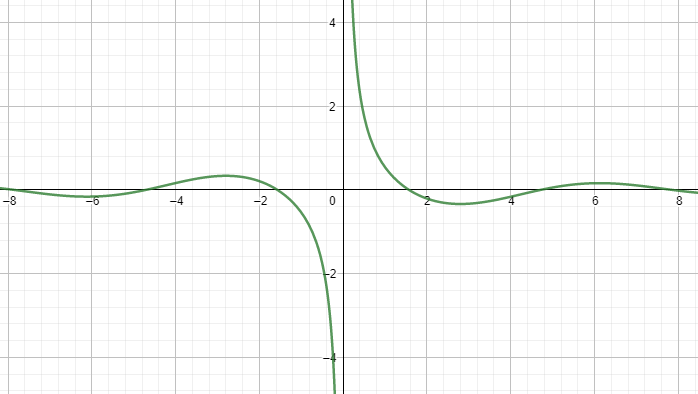
Note: Now note that here the function $\dfrac{\cos x}{x}$ looks a lot like the function $\dfrac{1}{x}$. Though this is not always true. The resultant graph of a product of two functions can be a completely new graph itself. Also note that cosx is an even function and $\dfrac{1}{x}$ is an odd function and the multiplication gives us an odd function.
Complete step-by-step solution:
Let us first consider the given function.
Now the given function is nothing but $f\left( x \right)=\cos x\times \dfrac{1}{x}$. Hence the function will be a hybrid of both the functions $\cos x$ and $\dfrac{1}{x}$.
Now first we know that the function $f\left( x \right)=\cos x\times \dfrac{1}{x}$ will not be defined at x = 0 since the denominator can never be 0.
Hence as x tends to zero the value of the function tends to infinity.
Also since $\cos \left( 0 \right)=1>0$ we can say x tends to zero from the positive side we will get positive infinity and as x tends to 0 from the negative side we will get negative infinity.
Now note that also as x tends to infinity the function approaches the value of 0.
Now the roots of the function $f\left( x \right)=\cos x\times \dfrac{1}{x}$ will be same as the roots of the function $\cos x$
Hence we will have multiple roots of the given function.
Now we know that $-1\le \cos x\le 1$.
Hence we have $\dfrac{-1}{x}\le \dfrac{\cos x}{x}\le \dfrac{1}{x}$
Hence we can say that the value of the function will be greater than 1 for x less than 1 and the value of the function will be less than 1 for x greater than 1.
Hence the given function will look like,
Note: Now note that here the function $\dfrac{\cos x}{x}$ looks a lot like the function $\dfrac{1}{x}$. Though this is not always true. The resultant graph of a product of two functions can be a completely new graph itself. Also note that cosx is an even function and $\dfrac{1}{x}$ is an odd function and the multiplication gives us an odd function.
Recently Updated Pages
Master Class 11 Social Science: Engaging Questions & Answers for Success

Master Class 11 Physics: Engaging Questions & Answers for Success
Master Class 11 Maths: Engaging Questions & Answers for Success
Master Class 11 Economics: Engaging Questions & Answers for Success
Master Class 11 Computer Science: Engaging Questions & Answers for Success
Master Class 11 Chemistry: Engaging Questions & Answers for Success
Trending doubts
One Metric ton is equal to kg A 10000 B 1000 C 100 class 11 physics CBSE
There are 720 permutations of the digits 1 2 3 4 5 class 11 maths CBSE
1 Quintal is equal to a 110 kg b 10 kg c 100kg d 1000 class 11 physics CBSE
State and prove Bernoullis theorem class 11 physics CBSE
Difference Between Prokaryotic Cells and Eukaryotic Cells
Which among the following are examples of coming together class 11 social science CBSE