




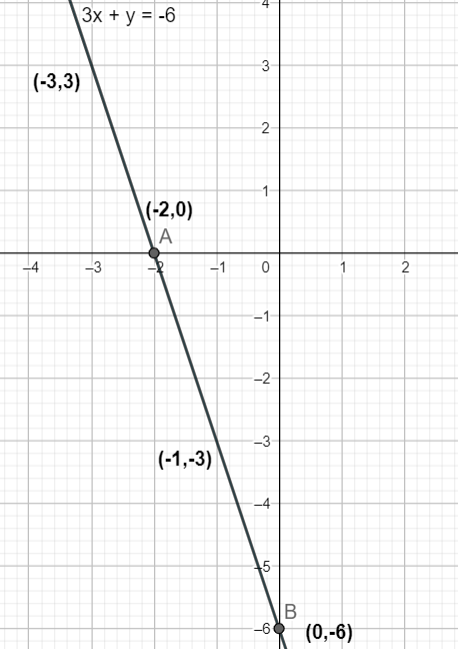
How do you graph \[3x+y=-6\] ?
Answer
 Verified
621.6k+ views
Hint: We can draw this graph using the concept of slope intercept form. First we have to find the x and y intercepts of the equation. We can draw using these points but for more accuracy we will find the gradient between the points and we will draw the graph.
Complete step by step answer:
Let us know how to find the gradient.
We have to choose two points on the line and we have to subtract the ordinates of two points and will divide with value obtained by subtracting abscissas of the points. The formula looks like
If the points are \[\left( {{x}_{1}},{{y}_{1}} \right)\left( {{x}_{2}},{{y}_{2}} \right)\] then the gradient will be
\[gradient=\dfrac{{{y}_{2}}-{{y}_{1}}}{{{x}_{2}}-{{x}_{1}}}\]
Using the gradient we will find the x and y coordinates the numerator is y coordinate and denominator is x coordinate.
First we have to find x and y coordinates.
To find the x intercept we have to substitute the y value as \[0\].
We will get
\[\Rightarrow 3x+0=-6\]
\[\Rightarrow 3x=-6\]
Now we have divide the equation with 3 on both sides
\[\Rightarrow \dfrac{3x}{3}=\dfrac{-6}{3}\]
We will get
\[\Rightarrow x=-2\]
Now the coordinate is \[\left( -2,0 \right)\].
Now we will find the y intercept we have to substitute x value as \[0\]
We will get
\[\Rightarrow 3\times 0+y=-6\]
\[\Rightarrow y=-6\]
So the point we will get is \[\left( 0,-6 \right)\]
These two are enough to draw the graph.
But for better understanding we will derive some more points using gradients.
We have two points \[\left( -2,0 \right)\] and \[\left( 0,-6 \right)\]
From this the gradient we will obtain is
\[gradient=\dfrac{-6-0}{0-\left( -2 \right)}\]
By simplifying we will get
\[\Rightarrow gradient=\dfrac{-6}{2}\]
We will get
\[\Rightarrow gradient=-\dfrac{3}{1}\]
So from this we will get the point as \[\left( -1,-3 \right)\]
Using these points we will draw the graph.
We will get
Note:
We can repeat the gradient technique to find different other points to plot the graph. The sign of the gradient will help you to know whether the graph will go upwards or downwards. Positive sign will indicate upwards and negative sign downwards.
Complete step by step answer:
Let us know how to find the gradient.
We have to choose two points on the line and we have to subtract the ordinates of two points and will divide with value obtained by subtracting abscissas of the points. The formula looks like
If the points are \[\left( {{x}_{1}},{{y}_{1}} \right)\left( {{x}_{2}},{{y}_{2}} \right)\] then the gradient will be
\[gradient=\dfrac{{{y}_{2}}-{{y}_{1}}}{{{x}_{2}}-{{x}_{1}}}\]
Using the gradient we will find the x and y coordinates the numerator is y coordinate and denominator is x coordinate.
First we have to find x and y coordinates.
To find the x intercept we have to substitute the y value as \[0\].
We will get
\[\Rightarrow 3x+0=-6\]
\[\Rightarrow 3x=-6\]
Now we have divide the equation with 3 on both sides
\[\Rightarrow \dfrac{3x}{3}=\dfrac{-6}{3}\]
We will get
\[\Rightarrow x=-2\]
Now the coordinate is \[\left( -2,0 \right)\].
Now we will find the y intercept we have to substitute x value as \[0\]
We will get
\[\Rightarrow 3\times 0+y=-6\]
\[\Rightarrow y=-6\]
So the point we will get is \[\left( 0,-6 \right)\]
These two are enough to draw the graph.
But for better understanding we will derive some more points using gradients.
We have two points \[\left( -2,0 \right)\] and \[\left( 0,-6 \right)\]
From this the gradient we will obtain is
\[gradient=\dfrac{-6-0}{0-\left( -2 \right)}\]
By simplifying we will get
\[\Rightarrow gradient=\dfrac{-6}{2}\]
We will get
\[\Rightarrow gradient=-\dfrac{3}{1}\]
So from this we will get the point as \[\left( -1,-3 \right)\]
Using these points we will draw the graph.
We will get
Note:
We can repeat the gradient technique to find different other points to plot the graph. The sign of the gradient will help you to know whether the graph will go upwards or downwards. Positive sign will indicate upwards and negative sign downwards.
Recently Updated Pages
If x a + bt + ct2 where x is in meters and t is in class 11 physics CBSE

A car covers the first half distance between two places class 11 physics CBSE
The resultant of two vectors overrightarrow P and overrightarrow class 11 physics CBSE
Find the value of cos 135 class 11 maths CBSE
A mass M is held in place by an applied force F and class 11 physics CBSE
A solution of glucose in water is labelled as 10 dfracwv class 11 chemistry CBSE
Trending doubts
Find the value of the expression given below sin 30circ class 11 maths CBSE
What is the maximum height of a projectile class 11 physics CBSE
Derive an expression for maximum height and range of class 11 physics CBSE
Describe various types of epithelial tissues with the class 11 biology CBSE
Lysosomes are known as suicidal bags of cell why class 11 biology CBSE
State and derive law of conservation of momentum class 11 physics CBSE