




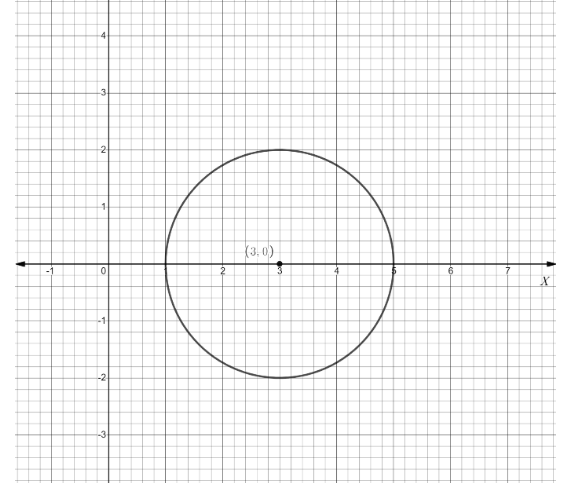
How do you graph $ 2{(x - 3)^2} + 2{y^2} = 8 $ ?
Answer
 Verified
540.6k+ views
Hint: We have given an equation as $ 2{(x - 3)^2} + 2{y^2} = 8 $ , we have to reduce it into the standard form of circle. A standard form of circle represented as $ {(y - a)^2} + {(x - b)^2} = {r^2} $ , This also represents the locus that is moving at a constant distance ‘r’ from the centre, where $ r $ is the length of the radius of the circle and $ (a,b) $ is the point which represent the centre of the circle.
Complete step-by-step answer:
It is given that ,
$ 2{(x - 3)^2} + 2{y^2} = 8 $
We have to reduce this into is standard form ,
Therefore, divide by $ 2 $ both the side of the equation, we will get the following result,
$ {(x - 3)^2} + {y^2} = 4 $
We can also express the above equation as ,
$ {(x - 3)^2} + {y^2} = {2^2}..........(1) $
Now, compare $ (1) $ with the standard form of circle represented as $ {(y - a)^2} + {(x - b)^2} = {r^2} $ where $ r $ is the length of the radius of the circle and $ (a,b) $ is the point which represent the centre of the circle. This also represents the locus that is moving at a constant distance ‘r’ from the centre.
Therefore , we get the following result,
We get the radius of the circle , $ r = 2 $ and
The coordinate of the circle , $ (a,b) = (3,0) $ .
With the help of above data, we can easily draw the required graph as follows
Note: Sometimes the circle equations are given as \[a{x^2} + b{y^2} + cx + dy + e = {\text{ }}0\] (in the general form), whenever we have general equation instead of standard one we try to convert the equation in its standard form. So that we can easily get the radius and the respective centre. We can convert it by completing the square rule.
Complete step-by-step answer:
It is given that ,
$ 2{(x - 3)^2} + 2{y^2} = 8 $
We have to reduce this into is standard form ,
Therefore, divide by $ 2 $ both the side of the equation, we will get the following result,
$ {(x - 3)^2} + {y^2} = 4 $
We can also express the above equation as ,
$ {(x - 3)^2} + {y^2} = {2^2}..........(1) $
Now, compare $ (1) $ with the standard form of circle represented as $ {(y - a)^2} + {(x - b)^2} = {r^2} $ where $ r $ is the length of the radius of the circle and $ (a,b) $ is the point which represent the centre of the circle. This also represents the locus that is moving at a constant distance ‘r’ from the centre.
Therefore , we get the following result,
We get the radius of the circle , $ r = 2 $ and
The coordinate of the circle , $ (a,b) = (3,0) $ .
With the help of above data, we can easily draw the required graph as follows
Note: Sometimes the circle equations are given as \[a{x^2} + b{y^2} + cx + dy + e = {\text{ }}0\] (in the general form), whenever we have general equation instead of standard one we try to convert the equation in its standard form. So that we can easily get the radius and the respective centre. We can convert it by completing the square rule.
Recently Updated Pages
Master Class 11 Computer Science: Engaging Questions & Answers for Success

Master Class 11 Business Studies: Engaging Questions & Answers for Success
Master Class 11 Economics: Engaging Questions & Answers for Success
Master Class 11 English: Engaging Questions & Answers for Success
Master Class 11 Maths: Engaging Questions & Answers for Success
Master Class 11 Biology: Engaging Questions & Answers for Success
Trending doubts
One Metric ton is equal to kg A 10000 B 1000 C 100 class 11 physics CBSE
There are 720 permutations of the digits 1 2 3 4 5 class 11 maths CBSE
Discuss the various forms of bacteria class 11 biology CBSE
Draw a diagram of a plant cell and label at least eight class 11 biology CBSE
State the laws of reflection of light
Explain zero factorial class 11 maths CBSE