




How do you find the value of \[\csc ( - 210)?\]
Answer
 Verified
491.4k+ views
Hint: We know that $\cos ec( - x) = - \cos ecx$ .
Again the function $y = \cos ecx$ has a period of $2\pi $ or ${360^ \circ }$ , i.e., the value of $\cos ecx$ repeats after an interval of $2\pi $ or ${360^ \circ }$ . Therefore we calculate the given period using the intervals. After that we use the trigonometric formulas and we get the required value.
Complete step by step answer:
We know that the function $y = \cos ecx$ has a period of $2\pi $ or ${360^ \circ }$ , i.e., the value of $\cos ecx$ repeats after an interval of $2\pi $ or ${360^ \circ }$ .
First we draw the graph of $y = \cos ecx$
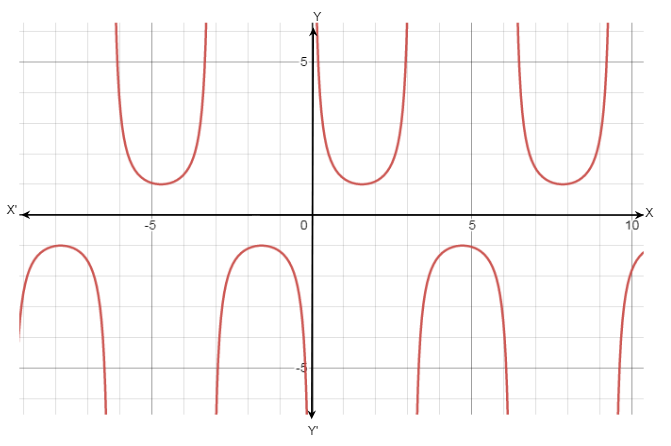
Now the given data ${120^ \circ } = {90^ \circ } + {30^ \circ }$
Therefore $\csc ( - 120)$
Using the property $\csc ( - x) = - \csc x$ , we get
$ - \csc (120)$
We can write the above statement as,
$ = - \csc (90 + 30)$
We know that $\csc x = \dfrac{1}{{\sin x}}$ , use this property and we get
$ = - \dfrac{1}{{\sin (90 + 30)}}$
We know that the property of trigonometric that is $\sin (90 + x) = \cos x$
Use this in the above function and we get
$ = - \dfrac{1}{{\cos 30}}$
From the value table we know the value of $\cos 30 = \dfrac{{\sqrt 3 }}{2} = \sin 60$ , put this in above equation and we get
$ = - \dfrac{1}{{\tfrac{{\sqrt 3 }}{2}}}$
Simplifying and we get
$ = - \dfrac{2}{{\sqrt 3 }}$
Therefore our required answer is $\csc ( - 120) = - \dfrac{2}{{\sqrt 3 }}$ .
Note:Note that formulas which is very important and try to remember all the times
$1.\sin x = \dfrac{1}{{\csc x}},\cos x = \dfrac{1}{{\sec x}},\tan x = \dfrac{1}{{\cot x}}$
$2.{\sin ^2}x + {\cos ^2}x = 1$
$3.{\sec ^2}x - {\tan ^2}x = 1$
$4.{\csc ^2}x - {\cot ^2}x = 1$
$5.\sin ( - x) = - \sin x$
$6.\cos ( - x) = \cos x$
$7.\tan ( - x) = - \tan x$
$8.\sin (2n\pi \pm x) = \sin x$ , period $2\pi $
$9.\cos (2n\pi \pm x) = \cos x$ , period $2\pi $
$10.\tan (n\pi \pm x) = \tan x$ , period $\pi $
WE also have to know about the sign conversion ,
In the first quadrant we know all the trigonometric functions are positive. In the second quadrant sine function is positive and others are negative. The third quadrant tangent is positive and in the fourth quadrant cos is positive. At least we must know about the trigonometric function value table. We have all the basic values of all trigonometric functions.
Again the function $y = \cos ecx$ has a period of $2\pi $ or ${360^ \circ }$ , i.e., the value of $\cos ecx$ repeats after an interval of $2\pi $ or ${360^ \circ }$ . Therefore we calculate the given period using the intervals. After that we use the trigonometric formulas and we get the required value.
Complete step by step answer:
We know that the function $y = \cos ecx$ has a period of $2\pi $ or ${360^ \circ }$ , i.e., the value of $\cos ecx$ repeats after an interval of $2\pi $ or ${360^ \circ }$ .
First we draw the graph of $y = \cos ecx$
Now the given data ${120^ \circ } = {90^ \circ } + {30^ \circ }$
Therefore $\csc ( - 120)$
Using the property $\csc ( - x) = - \csc x$ , we get
$ - \csc (120)$
We can write the above statement as,
$ = - \csc (90 + 30)$
We know that $\csc x = \dfrac{1}{{\sin x}}$ , use this property and we get
$ = - \dfrac{1}{{\sin (90 + 30)}}$
We know that the property of trigonometric that is $\sin (90 + x) = \cos x$
Use this in the above function and we get
$ = - \dfrac{1}{{\cos 30}}$
From the value table we know the value of $\cos 30 = \dfrac{{\sqrt 3 }}{2} = \sin 60$ , put this in above equation and we get
$ = - \dfrac{1}{{\tfrac{{\sqrt 3 }}{2}}}$
Simplifying and we get
$ = - \dfrac{2}{{\sqrt 3 }}$
Therefore our required answer is $\csc ( - 120) = - \dfrac{2}{{\sqrt 3 }}$ .
Note:Note that formulas which is very important and try to remember all the times
$1.\sin x = \dfrac{1}{{\csc x}},\cos x = \dfrac{1}{{\sec x}},\tan x = \dfrac{1}{{\cot x}}$
$2.{\sin ^2}x + {\cos ^2}x = 1$
$3.{\sec ^2}x - {\tan ^2}x = 1$
$4.{\csc ^2}x - {\cot ^2}x = 1$
$5.\sin ( - x) = - \sin x$
$6.\cos ( - x) = \cos x$
$7.\tan ( - x) = - \tan x$
$8.\sin (2n\pi \pm x) = \sin x$ , period $2\pi $
$9.\cos (2n\pi \pm x) = \cos x$ , period $2\pi $
$10.\tan (n\pi \pm x) = \tan x$ , period $\pi $
WE also have to know about the sign conversion ,
In the first quadrant we know all the trigonometric functions are positive. In the second quadrant sine function is positive and others are negative. The third quadrant tangent is positive and in the fourth quadrant cos is positive. At least we must know about the trigonometric function value table. We have all the basic values of all trigonometric functions.
Recently Updated Pages
Master Class 11 English: Engaging Questions & Answers for Success

Master Class 11 Maths: Engaging Questions & Answers for Success
Master Class 11 Biology: Engaging Questions & Answers for Success
Master Class 11 Social Science: Engaging Questions & Answers for Success
Master Class 11 Physics: Engaging Questions & Answers for Success
Master Class 11 Accountancy: Engaging Questions & Answers for Success
Trending doubts
One Metric ton is equal to kg A 10000 B 1000 C 100 class 11 physics CBSE
There are 720 permutations of the digits 1 2 3 4 5 class 11 maths CBSE
Discuss the various forms of bacteria class 11 biology CBSE
Draw a diagram of a plant cell and label at least eight class 11 biology CBSE
State the laws of reflection of light
Explain zero factorial class 11 maths CBSE