




How do you find the value of ${\cos ^{ - 1}}( - 1)$?
Answer
 Verified
561.3k+ views
Hint: In trigonometry, cosine or simply cos is defined by the ratio of length of the adjacent and the length of the hypotenuse.
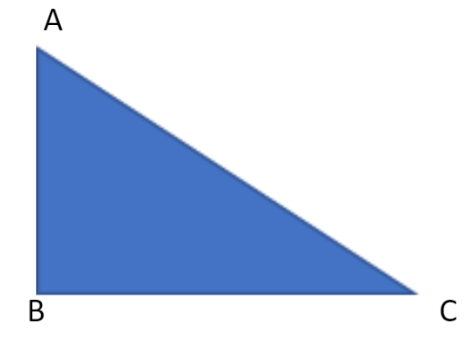
If $\angle ACB = \theta $ , then $\cos \theta = \dfrac{{BC}}{{CA}}$ .
And ${\cos ^{ - 1}}$ or cosine inverse is the inverse function of cosine. In trigonometry, generally ${\cos ^{ - 1}}\theta $ i.e. The cosine inverse assigns a definite angle that has the same value of cosine to a given number. In other words, the cosine inverse function defines an angle, not a normal value.
Complete step-by-step solution:
In this question, we need to find the principal value of ${\cos ^{ - 1}}\left( { - 1} \right)$.
First, let us assign $y = {\cos ^{ - 1}}\left( { - 1} \right)$.
Taking $\cos $ both sides of the above equation, we have $\cos y = \cos \left\{ {{{\cos }^{ - 1}}\left( { - 1} \right)} \right\}$
i.e., $\cos y = ( - 1)$ … … …(i)
But we know, $\cos \pi = ( - 1)$ … … …(ii)
Then, comparing (i) and (ii), we obtain, $\cos y = \cos \pi $.
Now taking the function ${\cos ^{ - 1}}$ both sides of the above equation, we get
${\cos ^{ - 1}}\left\{ {\cos y} \right\} = {\cos ^{ - 1}}\left\{ {\cos \pi } \right\}$
i.e., $y = \pi $ .
Hence the principal value of $y = {\cos ^{ - 1}}\left( { - 1} \right)$ is given by $\pi $.
Note: For trigonometry, the principal value of ${\cos ^{ - 1}}\theta $ for $\theta > 0$ , is the length of the arc of a unit circle centred at the origin which subtends an angle at the centre whose cosine is $\theta $. Also, ${\cos ^{ - 1}}\theta $ can also be denoted by $\operatorname{arc} $ $\cos \theta $. Again, the solution by which the least value of the absolute angle is obtained, is named as the Principal Solution. Students should note that, if $\varphi $ be the Principal Value of $\cos $, then must be $0 \leqslant \varphi \leqslant \pi $. For example, the principal value of ${\cos ^{ - 1}}\left( {\dfrac{{\sqrt 3 }}{2}} \right)$ is $\dfrac{\pi }{6}$ and obviously, $\dfrac{\pi }{6} \in \left[ {0,\pi } \right]$.
If $\angle ACB = \theta $ , then $\cos \theta = \dfrac{{BC}}{{CA}}$ .
And ${\cos ^{ - 1}}$ or cosine inverse is the inverse function of cosine. In trigonometry, generally ${\cos ^{ - 1}}\theta $ i.e. The cosine inverse assigns a definite angle that has the same value of cosine to a given number. In other words, the cosine inverse function defines an angle, not a normal value.
Complete step-by-step solution:
In this question, we need to find the principal value of ${\cos ^{ - 1}}\left( { - 1} \right)$.
First, let us assign $y = {\cos ^{ - 1}}\left( { - 1} \right)$.
Taking $\cos $ both sides of the above equation, we have $\cos y = \cos \left\{ {{{\cos }^{ - 1}}\left( { - 1} \right)} \right\}$
i.e., $\cos y = ( - 1)$ … … …(i)
But we know, $\cos \pi = ( - 1)$ … … …(ii)
Then, comparing (i) and (ii), we obtain, $\cos y = \cos \pi $.
Now taking the function ${\cos ^{ - 1}}$ both sides of the above equation, we get
${\cos ^{ - 1}}\left\{ {\cos y} \right\} = {\cos ^{ - 1}}\left\{ {\cos \pi } \right\}$
i.e., $y = \pi $ .
Hence the principal value of $y = {\cos ^{ - 1}}\left( { - 1} \right)$ is given by $\pi $.
Note: For trigonometry, the principal value of ${\cos ^{ - 1}}\theta $ for $\theta > 0$ , is the length of the arc of a unit circle centred at the origin which subtends an angle at the centre whose cosine is $\theta $. Also, ${\cos ^{ - 1}}\theta $ can also be denoted by $\operatorname{arc} $ $\cos \theta $. Again, the solution by which the least value of the absolute angle is obtained, is named as the Principal Solution. Students should note that, if $\varphi $ be the Principal Value of $\cos $, then must be $0 \leqslant \varphi \leqslant \pi $. For example, the principal value of ${\cos ^{ - 1}}\left( {\dfrac{{\sqrt 3 }}{2}} \right)$ is $\dfrac{\pi }{6}$ and obviously, $\dfrac{\pi }{6} \in \left[ {0,\pi } \right]$.
Recently Updated Pages
If x a + bt + ct2 where x is in meters and t is in class 11 physics CBSE

A car covers the first half distance between two places class 11 physics CBSE
The resultant of two vectors overrightarrow P and overrightarrow class 11 physics CBSE
Find the value of cos 135 class 11 maths CBSE
A mass M is held in place by an applied force F and class 11 physics CBSE
A solution of glucose in water is labelled as 10 dfracwv class 11 chemistry CBSE
Trending doubts
One Metric ton is equal to kg A 10000 B 1000 C 100 class 11 physics CBSE
Find the value of the expression given below sin 30circ class 11 maths CBSE
Draw a diagram of nephron and explain its structur class 11 biology CBSE
10 examples of friction in our daily life
Proton was discovered by A Thomson B Rutherford C Chadwick class 11 chemistry CBSE
Bond order ofO2 O2+ O2 and O22 is in order A O2 langle class 11 chemistry CBSE