




How do you find the slope of a line?
Answer
 Verified
556.8k+ views
Hint: Find the ratio of change in x and change in y.
We can find the slope in two ways by plotting in the graph and observing $ \dfrac{{\vartriangle x}}{{\vartriangle y}} $ which is the ratio of change of x and change of y or else we can use a direct formula where we can directly substitute in the formula of slope of line with two distinct points and find the slope.
Complete step-by-step answer:
Method 1:
First, we are going to get the slope of a graph
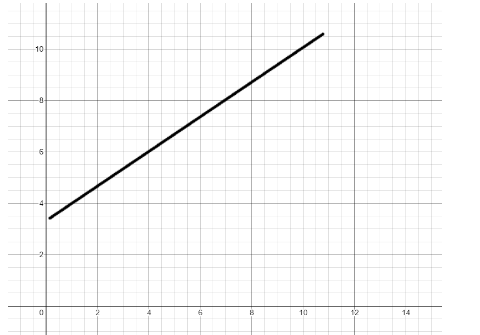
Consider the graph, we are going to find the slope of this line, by considering any two points on the line. And then we find the change in x which is \[\vartriangle x\] and change in y which is $ \vartriangle y $ .
We will draw a line parallel to the x-axis until we reach a point such, we get the change in x and similarly we will get the change in y as well, as shown in the figure below.
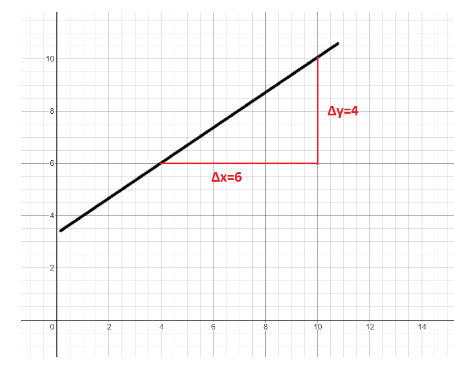
Then we find the ratio of these which will give us the slope.
$ Slope = \dfrac{{\vartriangle x}}{{\vartriangle y}} $
$ slope = \dfrac{6}{4} = \dfrac{3}{2} $
Method 2:
We are directly going to use the formula for slope of a line when two distinct points are given which is
$ slope = \dfrac{{{y_2} - {y_1}}}{{{x_2} - {x_1}}} $
Where $ \left( {{x_1},{y_1}} \right) $ and $ \left( {{x_2},{y_2}} \right) $ are the two distinct points which lie on the line whose slope we have to calculate.
For the points $ (3,1) $ and $ (4,1) $ . The slope is
$ Slope = \dfrac{{1 - 1}}{{4 - 3}} = 0 $
Note: In the formula of slope, there is no specific order for consider any point for $ \left( {{x_1},{y_1}} \right) $ or $ \left( {{x_2},{y_2}} \right) $ , as the resultant slope that we get on considering either of those scenarios, we are going to get the same resultant slope for the given two points.
We can find the slope in two ways by plotting in the graph and observing $ \dfrac{{\vartriangle x}}{{\vartriangle y}} $ which is the ratio of change of x and change of y or else we can use a direct formula where we can directly substitute in the formula of slope of line with two distinct points and find the slope.
Complete step-by-step answer:
Method 1:
First, we are going to get the slope of a graph
Consider the graph, we are going to find the slope of this line, by considering any two points on the line. And then we find the change in x which is \[\vartriangle x\] and change in y which is $ \vartriangle y $ .
We will draw a line parallel to the x-axis until we reach a point such, we get the change in x and similarly we will get the change in y as well, as shown in the figure below.
Then we find the ratio of these which will give us the slope.
$ Slope = \dfrac{{\vartriangle x}}{{\vartriangle y}} $
$ slope = \dfrac{6}{4} = \dfrac{3}{2} $
Method 2:
We are directly going to use the formula for slope of a line when two distinct points are given which is
$ slope = \dfrac{{{y_2} - {y_1}}}{{{x_2} - {x_1}}} $
Where $ \left( {{x_1},{y_1}} \right) $ and $ \left( {{x_2},{y_2}} \right) $ are the two distinct points which lie on the line whose slope we have to calculate.
For the points $ (3,1) $ and $ (4,1) $ . The slope is
$ Slope = \dfrac{{1 - 1}}{{4 - 3}} = 0 $
Note: In the formula of slope, there is no specific order for consider any point for $ \left( {{x_1},{y_1}} \right) $ or $ \left( {{x_2},{y_2}} \right) $ , as the resultant slope that we get on considering either of those scenarios, we are going to get the same resultant slope for the given two points.
Recently Updated Pages
Master Class 11 Social Science: Engaging Questions & Answers for Success

Master Class 11 Physics: Engaging Questions & Answers for Success
Master Class 11 Maths: Engaging Questions & Answers for Success
Master Class 11 Economics: Engaging Questions & Answers for Success
Master Class 11 Computer Science: Engaging Questions & Answers for Success
Master Class 11 Chemistry: Engaging Questions & Answers for Success
Trending doubts
One Metric ton is equal to kg A 10000 B 1000 C 100 class 11 physics CBSE
There are 720 permutations of the digits 1 2 3 4 5 class 11 maths CBSE
1 Quintal is equal to a 110 kg b 10 kg c 100kg d 1000 class 11 physics CBSE
State and prove Bernoullis theorem class 11 physics CBSE
Difference Between Prokaryotic Cells and Eukaryotic Cells
Which among the following are examples of coming together class 11 social science CBSE