




How do you find $\left| 4+7i \right|$ ?
Answer
 Verified
548.1k+ views
Hint: The complex number is included in a modulus sign. The modulus sign represents or is given by the distance of a point from the origin or the vertex $\left( 0,0 \right)$. So, to find the distance of our given complex number in our expression, $\left| 4+7i \right|$ we use the formula for a complex number in a modulo sign. Which is, if we have a complex number in the form, $\left| x+iy \right|$ then it is equal to the length, $\sqrt{{{x}^{2}}+{{y}^{2}}}$
Complete step by step solution:
The given expression is $\left| 4+7i \right|$
The complex number is included in a modulus sign. It means that we need to find the distance of that complex number on a complex plane from the origin.
By using the Pythagoras theorem, we derive to the formula where if the complex number $x+iy$ is represented in a modulus sign then its value is equal to $\sqrt{{{x}^{2}}+{{y}^{2}}}$
To derive this formula, we consider $x,y\;$ as the sides of the right-angled triangle whereas the distance that we need to find will be the length of the hypotenuse.
Here $x=4;y=7\;$
Let us understand this using the graphical representation.
Firstly, plot the complex number, $4+7i$ on the cartesian plane.
We shall represent it in a rectangular way so that we can find the length of the diagonal of the rectangle which is also the distance of that point from the origin.
The complex number $z=4+7i$ can be represented on the plane as the coordinates, $\left( 4,7 \right)$
Here since we take the x-axis as the set of real numbers and the y-axis as the set of imaginary numbers to represent any complex number graphically,
$4$ will be the real part and $7$ will be the imaginary part.
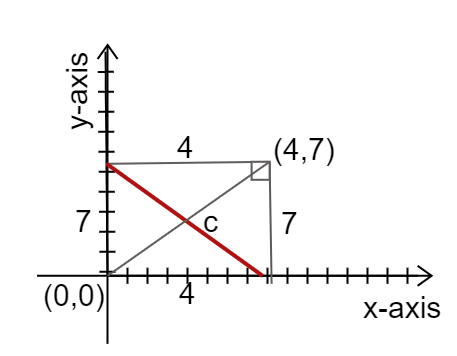
According to the Pythagoras theorem,
In a right-angled triangle, the length of hypotenuse if given by,
$\Rightarrow c=\sqrt{{{x}^{2}}+{{y}^{2}}}$
By substituting the values, we get,
$\Rightarrow c=\sqrt{{{4}^{2}}+{{7}^{2}}}$
$\Rightarrow c=\sqrt{16+49}$
$\Rightarrow c=\sqrt{65}$
Hence $\left| 4+7i \right|$ is equal to the length, $\sqrt{65}$
Note: The modulus sign converts any negative value inside its brackets to positive and a positive value to positive itself. This is the reason why modulus is also the distance of the point from the origin and distance is always measured to be a positive value.
Complete step by step solution:
The given expression is $\left| 4+7i \right|$
The complex number is included in a modulus sign. It means that we need to find the distance of that complex number on a complex plane from the origin.
By using the Pythagoras theorem, we derive to the formula where if the complex number $x+iy$ is represented in a modulus sign then its value is equal to $\sqrt{{{x}^{2}}+{{y}^{2}}}$
To derive this formula, we consider $x,y\;$ as the sides of the right-angled triangle whereas the distance that we need to find will be the length of the hypotenuse.
Here $x=4;y=7\;$
Let us understand this using the graphical representation.
Firstly, plot the complex number, $4+7i$ on the cartesian plane.
We shall represent it in a rectangular way so that we can find the length of the diagonal of the rectangle which is also the distance of that point from the origin.
The complex number $z=4+7i$ can be represented on the plane as the coordinates, $\left( 4,7 \right)$
Here since we take the x-axis as the set of real numbers and the y-axis as the set of imaginary numbers to represent any complex number graphically,
$4$ will be the real part and $7$ will be the imaginary part.
According to the Pythagoras theorem,
In a right-angled triangle, the length of hypotenuse if given by,
$\Rightarrow c=\sqrt{{{x}^{2}}+{{y}^{2}}}$
By substituting the values, we get,
$\Rightarrow c=\sqrt{{{4}^{2}}+{{7}^{2}}}$
$\Rightarrow c=\sqrt{16+49}$
$\Rightarrow c=\sqrt{65}$
Hence $\left| 4+7i \right|$ is equal to the length, $\sqrt{65}$
Note: The modulus sign converts any negative value inside its brackets to positive and a positive value to positive itself. This is the reason why modulus is also the distance of the point from the origin and distance is always measured to be a positive value.
Recently Updated Pages
Master Class 11 Computer Science: Engaging Questions & Answers for Success

Master Class 11 Business Studies: Engaging Questions & Answers for Success
Master Class 11 Economics: Engaging Questions & Answers for Success
Master Class 11 English: Engaging Questions & Answers for Success
Master Class 11 Maths: Engaging Questions & Answers for Success
Master Class 11 Biology: Engaging Questions & Answers for Success
Trending doubts
One Metric ton is equal to kg A 10000 B 1000 C 100 class 11 physics CBSE
There are 720 permutations of the digits 1 2 3 4 5 class 11 maths CBSE
Discuss the various forms of bacteria class 11 biology CBSE
Draw a diagram of a plant cell and label at least eight class 11 biology CBSE
State the laws of reflection of light
Explain zero factorial class 11 maths CBSE