




How do you evaluate $\cos 870^\circ $?
Answer
 Verified
495k+ views
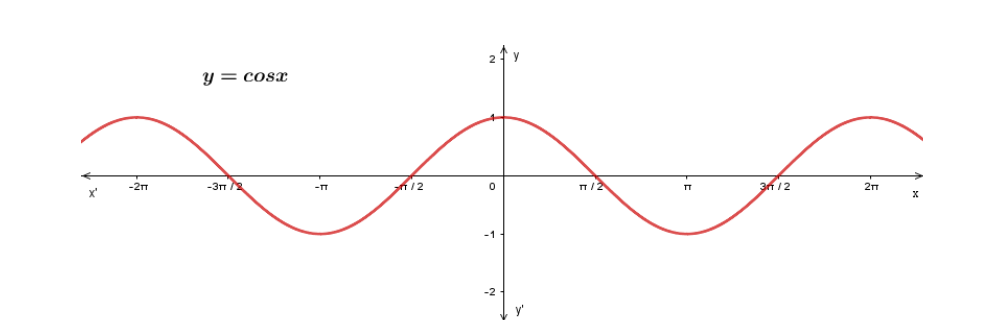
Hint: Here, in the given question, we are given a trigonometric ratio $\cos 870^\circ $ and we need to find the value of it. As we know the function $y = \cos x$ has a period of $2\pi $ or $360^\circ $, i.e. the value of $\cos x$ repeats after an interval of $2\pi $ or $360^\circ $. For any positive integer $n$, angle $\left( {360^\circ \times n + \theta } \right)$ is coterminal to angle $\theta $. Coterminal angles are angles in standard position (angles with the initial side on the positive x-axis) that have a common terminal side. Therefore, for any positive integer $n$, we have $\cos \left( {360^\circ \times n + \theta } \right) = \cos \theta $. Therefore, we will write $\cos 870^\circ $ as $\cos \left( {360^\circ \times 2 + 150^\circ } \right)$ and proceed.
Complete step-by-step answer:
We know that the function $y = \cos 870^\circ $ has a period of $2\pi $ or $360^\circ $.
Given, $\cos 870^\circ $
As we know $\cos \left( {360^\circ \times n + \theta } \right) = \cos \theta $. Therefore, we can write the above written statement as,
$ = \cos \left( {360^\circ \times 2 + 150^\circ } \right)$
$ = \cos 150^\circ $
As we know $\cos \left( {180^\circ - \theta } \right) = - \cos \theta $, because in second quadrant $\cos ine$ function is negative. Therefore, we get
$ \Rightarrow \cos \left( {180^\circ - 30^\circ } \right) = - \cos 30^\circ $
As we know value of $\cos 30^\circ $ is $\dfrac{{\sqrt 3 }}{2}$
Hence, the value of $\cos 870^\circ $ is $ - \dfrac{{\sqrt 3 }}{2}$.
So, the correct answer is “$ - \dfrac{{\sqrt 3 }}{2}$”.
Note: To solve these type of questions we should know all the required values of standard angles say, $0^\circ ,30^\circ ,60^\circ ,90^\circ ,180^\circ ,270^\circ ,360^\circ $ respectively for each trigonometric term such as $\sin ,\cos ,\tan ,\cos ec,\sec ,\cot $. Remember that $\sin e$ and $\cos ine$ functions and their reciprocals $\cos ecant$ and $\sec ant$ functions are periodic functions with period $2\pi $ or $360^\circ $. $\operatorname{Tan} gent$ and $cotangent$ functions are periodic with period $\pi $ or $180^\circ $.
Complete step-by-step answer:
We know that the function $y = \cos 870^\circ $ has a period of $2\pi $ or $360^\circ $.
Given, $\cos 870^\circ $
As we know $\cos \left( {360^\circ \times n + \theta } \right) = \cos \theta $. Therefore, we can write the above written statement as,
$ = \cos \left( {360^\circ \times 2 + 150^\circ } \right)$
$ = \cos 150^\circ $
As we know $\cos \left( {180^\circ - \theta } \right) = - \cos \theta $, because in second quadrant $\cos ine$ function is negative. Therefore, we get
$ \Rightarrow \cos \left( {180^\circ - 30^\circ } \right) = - \cos 30^\circ $
As we know value of $\cos 30^\circ $ is $\dfrac{{\sqrt 3 }}{2}$
Hence, the value of $\cos 870^\circ $ is $ - \dfrac{{\sqrt 3 }}{2}$.
So, the correct answer is “$ - \dfrac{{\sqrt 3 }}{2}$”.
Note: To solve these type of questions we should know all the required values of standard angles say, $0^\circ ,30^\circ ,60^\circ ,90^\circ ,180^\circ ,270^\circ ,360^\circ $ respectively for each trigonometric term such as $\sin ,\cos ,\tan ,\cos ec,\sec ,\cot $. Remember that $\sin e$ and $\cos ine$ functions and their reciprocals $\cos ecant$ and $\sec ant$ functions are periodic functions with period $2\pi $ or $360^\circ $. $\operatorname{Tan} gent$ and $cotangent$ functions are periodic with period $\pi $ or $180^\circ $.
Recently Updated Pages
Master Class 11 English: Engaging Questions & Answers for Success

Master Class 11 Maths: Engaging Questions & Answers for Success
Master Class 11 Biology: Engaging Questions & Answers for Success
Master Class 11 Social Science: Engaging Questions & Answers for Success
Master Class 11 Physics: Engaging Questions & Answers for Success
Master Class 11 Accountancy: Engaging Questions & Answers for Success
Trending doubts
One Metric ton is equal to kg A 10000 B 1000 C 100 class 11 physics CBSE
Discuss the various forms of bacteria class 11 biology CBSE
Draw a diagram of a plant cell and label at least eight class 11 biology CBSE
State the laws of reflection of light
Explain zero factorial class 11 maths CBSE
10 examples of friction in our daily life