




How do you evaluate $\cos {{145}^{\circ }}$? \[\]
Answer
 Verified
585.6k+ views
Hint: We recall trigonometric ratios of sine and cosine. We use the shift by half turn or right angle angle formula $\cos \left( \theta +{{90}^{\circ }} \right)=-\sin \theta $ to express the value in sine. We convert theta $\theta $ in degree to radian and use the sine series $\sin x=x-\dfrac{{{x}^{3}}}{3!}+\dfrac{{{x}^{5}}}{5!}+...$ to evaluate the required value. \[\]
Complete answer:
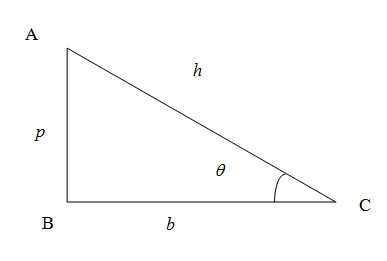
We know that in right angled triangle the side opposite to right angled triangle is called hypotenuse denoted as $h$, the vertical side is called perpendicular denoted as $p$ and the horizontal side is called the base denoted as $b$.\[\]
We know from the trigonometric ratios in a right angled triangle the sine of any angle is given by the ratio of side opposite to the angle to the hypotenuse. In the figure the sine of the angle $\theta $ is given by
\[\sin \theta =\dfrac{p}{h}...(1)\]
Similarly the cosine of an angle is the ratio of side adjacent to the angle (excluding hypotenuse) to the hypotenuse. So we have cosine of angle $\theta $
\[\cos \theta =\dfrac{b}{h}...(2)\]
We know that when angle is shifted by a full turn $\left( {{360}^{\circ }} \right)$, half turn $\left( {{180}^{\circ }} \right)$or quarter turn $\left( {{90}^{\circ }} \right)$ the trigonometric ratios return the value of their complementary trigonometric value with positive or negative sign . We write a shift formula for cosine.
\[\begin{align}
& \cos \left( \theta +{{90}^{\circ }} \right)=-\sin \theta \\
& \cos \left( \theta +{{180}^{\circ }} \right)=-\cos \theta \\
& \cos \left( \theta +{{360}^{\circ }} \right)=\cos \theta \\
\end{align}\]
We are asked to evaluate$\cos {{145}^{\circ }}$. We can write it as shift by quarter turn and use the formula $\cos \left( \theta +{{90}^{\circ }} \right)=-\sin \theta $as
\[\cos \left( {{145}^{\circ }} \right)=\cos \left( {{90}^{\circ }}+{{55}^{\circ }} \right)=-\sin {{55}^{\circ }}\]
We convert the ${{55}^{\circ }}$into radian to have
\[\begin{align}
& {{x}^{c}}=\dfrac{\pi }{{{180}^{\circ }}}\times {{\theta }^{\circ }} \\
& \Rightarrow x=\dfrac{\pi }{{{180}^{\circ }}}\times {{55}^{\circ }}\simeq 0.96 \\
\end{align}\]
We use the sine power series to evaluate the value as
\[\begin{align}
& \sin x=x-\dfrac{{{x}^{3}}}{3!}+\dfrac{{{x}^{5}}}{5!}+... \\
& \Rightarrow \sin \left( {{55}^{\circ }} \right)\simeq \sin \left( 0.96 \right)=0.96-\dfrac{{{\left( 0.96 \right)}^{3}}}{6}+\dfrac{{{\left( 0.96 \right)}^{5}}}{120} \\
& \Rightarrow \sin \left( {{55}^{\circ }} \right)\simeq 0.8191 \\
\end{align}\]
So the required value is
\[\cos {{145}^{\circ }}=-\sin {{55}^{\circ }}=-0.8124\]
Note: We can also find the approximate value of $\cos {{145}^{\circ }}$with cosine power series$\cos x=1-\dfrac{{{x}^{2}}}{2!}+\dfrac{{{x}^{4}}}{4!}+...$. . We can only calculate accurately with a calculator and the accurate value up to fourth decimal is $\cos {{145}^{\circ }}\simeq 0.8838$. The shift formulas for sine is given by $\sin \left( \theta +{{90}^{\circ }} \right)=\cos \theta ,\sin \left( \theta +{{180}^{\circ }} \right)=-\sin \theta ,\sin \left( \theta +{{360}^{\circ }} \right)=\sin \theta $.
Complete answer:
We know that in right angled triangle the side opposite to right angled triangle is called hypotenuse denoted as $h$, the vertical side is called perpendicular denoted as $p$ and the horizontal side is called the base denoted as $b$.\[\]
We know from the trigonometric ratios in a right angled triangle the sine of any angle is given by the ratio of side opposite to the angle to the hypotenuse. In the figure the sine of the angle $\theta $ is given by
\[\sin \theta =\dfrac{p}{h}...(1)\]
Similarly the cosine of an angle is the ratio of side adjacent to the angle (excluding hypotenuse) to the hypotenuse. So we have cosine of angle $\theta $
\[\cos \theta =\dfrac{b}{h}...(2)\]
We know that when angle is shifted by a full turn $\left( {{360}^{\circ }} \right)$, half turn $\left( {{180}^{\circ }} \right)$or quarter turn $\left( {{90}^{\circ }} \right)$ the trigonometric ratios return the value of their complementary trigonometric value with positive or negative sign . We write a shift formula for cosine.
\[\begin{align}
& \cos \left( \theta +{{90}^{\circ }} \right)=-\sin \theta \\
& \cos \left( \theta +{{180}^{\circ }} \right)=-\cos \theta \\
& \cos \left( \theta +{{360}^{\circ }} \right)=\cos \theta \\
\end{align}\]
We are asked to evaluate$\cos {{145}^{\circ }}$. We can write it as shift by quarter turn and use the formula $\cos \left( \theta +{{90}^{\circ }} \right)=-\sin \theta $as
\[\cos \left( {{145}^{\circ }} \right)=\cos \left( {{90}^{\circ }}+{{55}^{\circ }} \right)=-\sin {{55}^{\circ }}\]
We convert the ${{55}^{\circ }}$into radian to have
\[\begin{align}
& {{x}^{c}}=\dfrac{\pi }{{{180}^{\circ }}}\times {{\theta }^{\circ }} \\
& \Rightarrow x=\dfrac{\pi }{{{180}^{\circ }}}\times {{55}^{\circ }}\simeq 0.96 \\
\end{align}\]
We use the sine power series to evaluate the value as
\[\begin{align}
& \sin x=x-\dfrac{{{x}^{3}}}{3!}+\dfrac{{{x}^{5}}}{5!}+... \\
& \Rightarrow \sin \left( {{55}^{\circ }} \right)\simeq \sin \left( 0.96 \right)=0.96-\dfrac{{{\left( 0.96 \right)}^{3}}}{6}+\dfrac{{{\left( 0.96 \right)}^{5}}}{120} \\
& \Rightarrow \sin \left( {{55}^{\circ }} \right)\simeq 0.8191 \\
\end{align}\]
So the required value is
\[\cos {{145}^{\circ }}=-\sin {{55}^{\circ }}=-0.8124\]
Note: We can also find the approximate value of $\cos {{145}^{\circ }}$with cosine power series$\cos x=1-\dfrac{{{x}^{2}}}{2!}+\dfrac{{{x}^{4}}}{4!}+...$. . We can only calculate accurately with a calculator and the accurate value up to fourth decimal is $\cos {{145}^{\circ }}\simeq 0.8838$. The shift formulas for sine is given by $\sin \left( \theta +{{90}^{\circ }} \right)=\cos \theta ,\sin \left( \theta +{{180}^{\circ }} \right)=-\sin \theta ,\sin \left( \theta +{{360}^{\circ }} \right)=\sin \theta $.
Recently Updated Pages
Master Class 11 Social Science: Engaging Questions & Answers for Success

Master Class 11 English: Engaging Questions & Answers for Success
Master Class 11 Maths: Engaging Questions & Answers for Success
Master Class 11 Chemistry: Engaging Questions & Answers for Success
Master Class 11 Biology: Engaging Questions & Answers for Success
Master Class 11 Physics: Engaging Questions & Answers for Success
Trending doubts
One Metric ton is equal to kg A 10000 B 1000 C 100 class 11 physics CBSE
Difference Between Prokaryotic Cells and Eukaryotic Cells
There are 720 permutations of the digits 1 2 3 4 5 class 11 maths CBSE
Draw a diagram of a plant cell and label at least eight class 11 biology CBSE
Two of the body parts which do not appear in MRI are class 11 biology CBSE
Which gas is abundant in air class 11 chemistry CBSE