




How do you derive the law of cosines?
Answer
 Verified
607.8k+ views
Hint: This problem deals with the derivation of the law of cosines. The law of cosines is for calculating one side of a triangle when the angle is opposite and the other two sides which are known. Here let the unknown side be \[c\], and the angle opposite angle to this side is $\alpha $, and the other two sides are $a$ and $b$, from here we can derive the law of cosines.
Complete Step by Step Solution:
In trigonometry, the law of cosines relates the lengths of the sides of a triangle to the cosine of one of its angles. Using the notations as given in the above hint, the law of cosines states where $\alpha $ denotes the angle contained between sides of lengths $a$ and $b$ and the opposite side of length $c$.
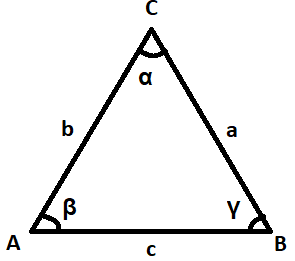
Then the law of cosines is given by:
\[ \Rightarrow {c^2} = {a^2} + {b^2} - 2ab\cos \alpha \]
Here $a,b$ and $c$ are the sides of the triangle and $\alpha $is the angle between the sides $b$and $c$.
This can be applied to any triangle.
If the unknown side is $a$ and the angle opposite to this side is the angle is $\beta $, where the other two sides are known $b$ and $c$. Then using the law of cosines, the side $a$ is given by:
\[ \Rightarrow {a^2} = {b^2} + {c^2} - 2bc\cos \beta \]
If the unknown side is $b$ and the angle opposite to this side is the angle is $\gamma $, where the other two sides are known $a$ and $c$. Then using the law of cosines, the side $b$ is given by:
\[ \Rightarrow {b^2} = {a^2} + {c^2} - 2ac\cos \gamma \]
Note: Please note that the law of cosines is used here to find the unknown side of a triangle, this can be used to find the unknown angle which is given by:
$ \Rightarrow \cos \alpha = \dfrac{{{a^2} + {b^2} - {c^2}}}{{2ab}}$
Law of sines is used to find all the sides of the triangle and all the angles of the triangle, given by:
$ \Rightarrow \dfrac{a}{{\sin \beta }} = \dfrac{b}{{\sin \gamma }} = \dfrac{c}{{\sin \alpha }}$
Complete Step by Step Solution:
In trigonometry, the law of cosines relates the lengths of the sides of a triangle to the cosine of one of its angles. Using the notations as given in the above hint, the law of cosines states where $\alpha $ denotes the angle contained between sides of lengths $a$ and $b$ and the opposite side of length $c$.
Then the law of cosines is given by:
\[ \Rightarrow {c^2} = {a^2} + {b^2} - 2ab\cos \alpha \]
Here $a,b$ and $c$ are the sides of the triangle and $\alpha $is the angle between the sides $b$and $c$.
This can be applied to any triangle.
If the unknown side is $a$ and the angle opposite to this side is the angle is $\beta $, where the other two sides are known $b$ and $c$. Then using the law of cosines, the side $a$ is given by:
\[ \Rightarrow {a^2} = {b^2} + {c^2} - 2bc\cos \beta \]
If the unknown side is $b$ and the angle opposite to this side is the angle is $\gamma $, where the other two sides are known $a$ and $c$. Then using the law of cosines, the side $b$ is given by:
\[ \Rightarrow {b^2} = {a^2} + {c^2} - 2ac\cos \gamma \]
Note: Please note that the law of cosines is used here to find the unknown side of a triangle, this can be used to find the unknown angle which is given by:
$ \Rightarrow \cos \alpha = \dfrac{{{a^2} + {b^2} - {c^2}}}{{2ab}}$
Law of sines is used to find all the sides of the triangle and all the angles of the triangle, given by:
$ \Rightarrow \dfrac{a}{{\sin \beta }} = \dfrac{b}{{\sin \gamma }} = \dfrac{c}{{\sin \alpha }}$
Recently Updated Pages
Basicity of sulphurous acid and sulphuric acid are

Master Class 11 English: Engaging Questions & Answers for Success
Master Class 11 Physics: Engaging Questions & Answers for Success
Master Class 11 Computer Science: Engaging Questions & Answers for Success
Master Class 11 Chemistry: Engaging Questions & Answers for Success
Master Class 11 Social Science: Engaging Questions & Answers for Success
Trending doubts
Difference Between Prokaryotic Cells and Eukaryotic Cells
Two of the body parts which do not appear in MRI are class 11 biology CBSE
One Metric ton is equal to kg A 10000 B 1000 C 100 class 11 physics CBSE
10 examples of friction in our daily life
Draw a diagram of nephron and explain its structur class 11 biology CBSE
What will happen if the mucus is not secreted by the class 11 biology CBSE