




How do we graph for \[x = {e^y}?\]
Answer
 Verified
602.7k+ views
Hint: In this question, we have an equation. To plot the graph for a lot of expression, you build a table and choose values for \[x\] from which you calculate \[y\]. But, in this case it is the other way round. You choose values for \[y\] and then calculate \[x\]. So, you are plotting \[x\] against \[y\]. To calculate the result for \[x = {e^y}\] rotate the result of \[y = {e^x}\] clockwise \[90^\circ \].
Complete step by step answer:
In this question, an equation \[x = {e^y}\] is given, that wants to plot the graph for \[x\]. First, we know about the graph, the graph can be defined as a pictorial representation or a diagram that represents data or values in an organised manner. The points on the graph often represent the relationship between two or more things.
There are four types of graphs.
Bar graphs: Bar graph is a diagram that uses narrow bands of different height to show different amounts so that they can be compared.
Histogram: Histogram is a graphical display of data using bars of different heights. The height of each bar shows how many fall into each range.
Pie chart: Pie chart is a circular statical graphic, which is divided into slices to illustrate numerical proportion.
Cartesian graph:
The graph for the equation \[y = {e^x}\] is a bit more difficult to graph, because just about all of \[y\] values will be decimal approximations. But if I round off to a reasonable number of decimal places (one or two is generally fine for the purpose of graphing), then this graph will be fairly easy.
Calculate the value of \[y\] for the different values of \[x\].
For \[x = - 2\], the value of \[y\] is.
\[ \Rightarrow {e^{ - 2}} \approx 0 \cdot 135\]
For \[x = - 1\], the value of \[y\] is.
\[ \Rightarrow {e^{ - 1}} \approx 0 \cdot 368\]
For \[x = 0\], the value of \[y\] is.
\[ \Rightarrow {e^0} \approx 1\]
For \[x = 1\], the value of \[y\] is.
\[ \Rightarrow {e^1} \approx 2 \cdot 718\]
For \[x = 2\], the value of \[y\] is.
\[ \Rightarrow {e^2} \approx 7 \cdot 389\]
For \[x = 3\], the value of \[y\] is.
\[ \Rightarrow {e^3} \approx 20.086\]
The graph for the equation \[y = {e^x}\] is shown in Figure (1).
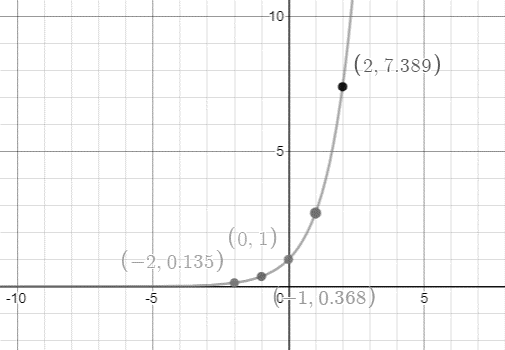
Figure 1
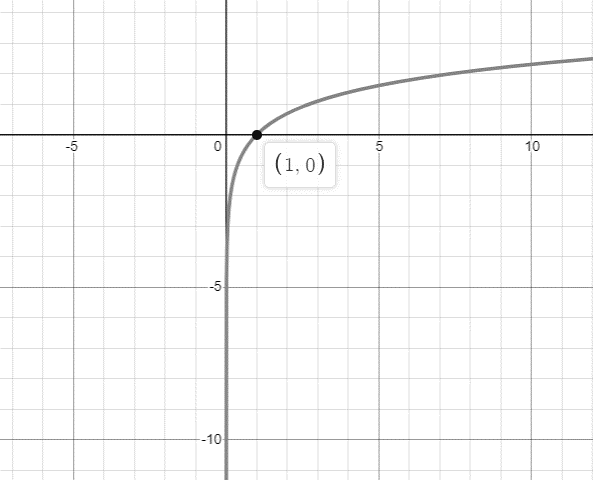
To calculate the graph for \[x = {e^y}\], rotate the graph of the equation clockwise \[90^\circ \].
Note:
If you have to plot the graph for the equation you build a table and choose values for \[x\] from which you calculate \[y\]. And plot the coordinate in the cartesian graph for values of \[y\] for different values of \[x\]. The shown curve or lines is the graph for that equation.
Complete step by step answer:
In this question, an equation \[x = {e^y}\] is given, that wants to plot the graph for \[x\]. First, we know about the graph, the graph can be defined as a pictorial representation or a diagram that represents data or values in an organised manner. The points on the graph often represent the relationship between two or more things.
There are four types of graphs.
Bar graphs: Bar graph is a diagram that uses narrow bands of different height to show different amounts so that they can be compared.
Histogram: Histogram is a graphical display of data using bars of different heights. The height of each bar shows how many fall into each range.
Pie chart: Pie chart is a circular statical graphic, which is divided into slices to illustrate numerical proportion.
Cartesian graph:
The graph for the equation \[y = {e^x}\] is a bit more difficult to graph, because just about all of \[y\] values will be decimal approximations. But if I round off to a reasonable number of decimal places (one or two is generally fine for the purpose of graphing), then this graph will be fairly easy.
Calculate the value of \[y\] for the different values of \[x\].
For \[x = - 2\], the value of \[y\] is.
\[ \Rightarrow {e^{ - 2}} \approx 0 \cdot 135\]
For \[x = - 1\], the value of \[y\] is.
\[ \Rightarrow {e^{ - 1}} \approx 0 \cdot 368\]
For \[x = 0\], the value of \[y\] is.
\[ \Rightarrow {e^0} \approx 1\]
For \[x = 1\], the value of \[y\] is.
\[ \Rightarrow {e^1} \approx 2 \cdot 718\]
For \[x = 2\], the value of \[y\] is.
\[ \Rightarrow {e^2} \approx 7 \cdot 389\]
For \[x = 3\], the value of \[y\] is.
\[ \Rightarrow {e^3} \approx 20.086\]
The graph for the equation \[y = {e^x}\] is shown in Figure (1).
Figure 1
To calculate the graph for \[x = {e^y}\], rotate the graph of the equation clockwise \[90^\circ \].
Note:
If you have to plot the graph for the equation you build a table and choose values for \[x\] from which you calculate \[y\]. And plot the coordinate in the cartesian graph for values of \[y\] for different values of \[x\]. The shown curve or lines is the graph for that equation.
Recently Updated Pages
The given figure shows two endocrine glands marked class 11 biology NEET_UG

Match columnI with columnII and select the correct class 11 biology NEET
Match column I with column II and select the correct class 11 biology NEET_UG
Which floral family has left 9 right + 1 arrangement class 11 biology NEET_UG
Which is not a variety of sheep A Lohi B Beetal C Nellore class 11 biology NEET_UG
Match column I with column II and select the correct class 11 biology NEET_UG
Trending doubts
Difference Between Prokaryotic Cells and Eukaryotic Cells
One Metric ton is equal to kg A 10000 B 1000 C 100 class 11 physics CBSE
Two of the body parts which do not appear in MRI are class 11 biology CBSE
10 examples of friction in our daily life
Draw a diagram of nephron and explain its structur class 11 biology CBSE
Draw a diagram of a plant cell and label at least eight class 11 biology CBSE