




How can we see an object?
Answer
 Verified
595.8k+ views
Hint: When light rays are reflected from an object and received by the human eye, the image will be formed on the retina and the brain will process these signals and interpret the image of the object, the detailed explanation will be discussed in the below sections.
Complete answer:
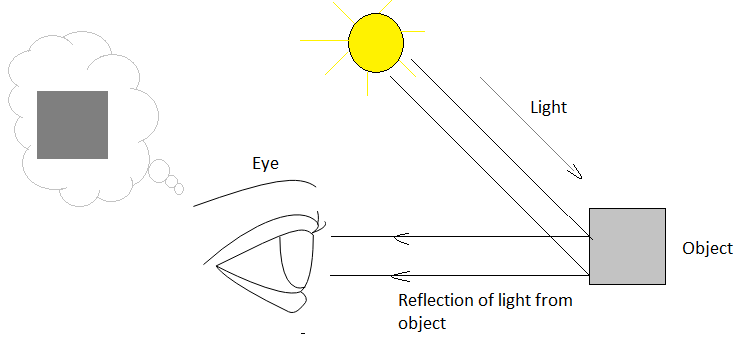
Light rays are reflected from the surface of an object and reach to our eyes and the image is formed on the retina, due to lens present in human eye it refracts the reflected light coming from an object and forms a real and inverted image on retina (if eye is free from any type of defect).
The signals from the light sensitive retina have been transferred through the optic nerve and the brain cells deciphers this information by which we can detect the location or the position, appearance(how it looks ) or movements of an object.
An example of reflected light from an object and received by eye is shown in the below diagram,
There are two types of photo-receptor rods and cones and present on the retina. Cones are responsible for eye’s color sensitivity and rods for controlling and seeing vision at low levels and electrical impulses play a significant role in transferring these visual information to the brain.
$\therefore $ We can say that due to reflection of light from an object, image formation on the retina and receiving information through the optic nerve to the brain we can see an object.
Note:
In the daylight we can see objects majorly due to light rays from the sun reflected through objects, but at midnight if there is no external or artificial light source present in surrounding we can’t see at all because there are no light rays to be reflected from objects to be seen or interpreted by our eyes.
Complete answer:
Light rays are reflected from the surface of an object and reach to our eyes and the image is formed on the retina, due to lens present in human eye it refracts the reflected light coming from an object and forms a real and inverted image on retina (if eye is free from any type of defect).
The signals from the light sensitive retina have been transferred through the optic nerve and the brain cells deciphers this information by which we can detect the location or the position, appearance(how it looks ) or movements of an object.
An example of reflected light from an object and received by eye is shown in the below diagram,
There are two types of photo-receptor rods and cones and present on the retina. Cones are responsible for eye’s color sensitivity and rods for controlling and seeing vision at low levels and electrical impulses play a significant role in transferring these visual information to the brain.
$\therefore $ We can say that due to reflection of light from an object, image formation on the retina and receiving information through the optic nerve to the brain we can see an object.
Note:
In the daylight we can see objects majorly due to light rays from the sun reflected through objects, but at midnight if there is no external or artificial light source present in surrounding we can’t see at all because there are no light rays to be reflected from objects to be seen or interpreted by our eyes.
Recently Updated Pages
Master Class 12 Business Studies: Engaging Questions & Answers for Success

Master Class 12 Chemistry: Engaging Questions & Answers for Success
Master Class 12 Biology: Engaging Questions & Answers for Success
Class 12 Question and Answer - Your Ultimate Solutions Guide
Master Class 11 English: Engaging Questions & Answers for Success
Master Class 11 Social Science: Engaging Questions & Answers for Success
Trending doubts
Which are the Top 10 Largest Countries of the World?
Draw a labelled sketch of the human eye class 12 physics CBSE
Differentiate between homogeneous and heterogeneous class 12 chemistry CBSE
Differentiate between Pyramid of energy and pyramid class 12 biology CBSE
Why is the cell called the structural and functional class 12 biology CBSE
Draw the diagram of the pyramid of energy Explain In class 12 biology CBSE