




How can vectors be combined?
Answer
 Verified
557.7k+ views
Hint: Vectors have magnitude as well as direction so they can`t be added or multiplied like any other quantities like in scalar addition you directly add them like 3+4=7 but that is not the case in vector combination.
Complete step by step answer:
Vector representation is a diagram
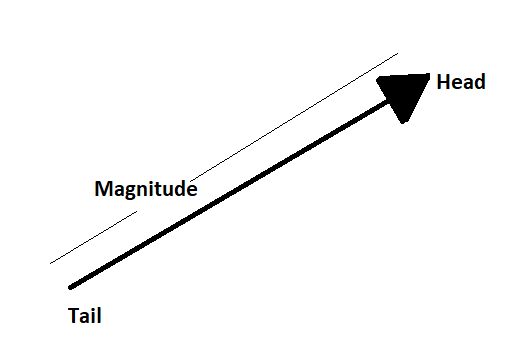
Consider the above diagram the length of the line represents the magnitude of the vector and the arrowhead represents the direction of the vector
We can geometrically add or combine two or more vectors
Consider the following two vectors A and B both have their Individual magnitude and direction now we need to get the resultant vector by combining them.
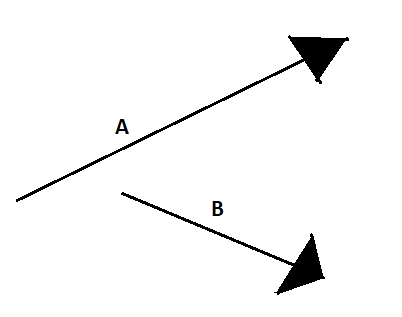
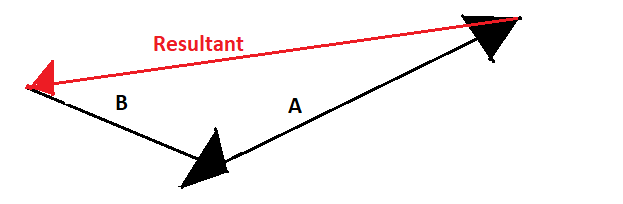
For combining these two vectors we use a special approach: we put the tail of one vector over the head of the other vector without altering the direction of any of these two vectors. Now measure the length on one vector and draw it without altering its direction, now measure the length of the second vector and draw it on the first vector keeping the tail of the second vector on the head of the first vector the direction of the second vector should also not be altered. Now, this forms two sides of the triangle now draw the third side to complete the triangle and the direction of this side should be in the opposite manner of that of the other two sides. Now this third side of the triangle represents the resultant of the two vectors and its length gives the magnitude of resultant
Note:
-The direction of the resultant vector should be in the opposite manner than that of the other two vectors.
-This is a geometrical combination of the vectors so their measurement should be taken care of.
-The tail of one vector should be carefully plotted over the head of another vector any overlapping my cause deviation of the resultant.
Complete step by step answer:
Vector representation is a diagram
Consider the above diagram the length of the line represents the magnitude of the vector and the arrowhead represents the direction of the vector
We can geometrically add or combine two or more vectors
Consider the following two vectors A and B both have their Individual magnitude and direction now we need to get the resultant vector by combining them.
For combining these two vectors we use a special approach: we put the tail of one vector over the head of the other vector without altering the direction of any of these two vectors. Now measure the length on one vector and draw it without altering its direction, now measure the length of the second vector and draw it on the first vector keeping the tail of the second vector on the head of the first vector the direction of the second vector should also not be altered. Now, this forms two sides of the triangle now draw the third side to complete the triangle and the direction of this side should be in the opposite manner of that of the other two sides. Now this third side of the triangle represents the resultant of the two vectors and its length gives the magnitude of resultant
Note:
-The direction of the resultant vector should be in the opposite manner than that of the other two vectors.
-This is a geometrical combination of the vectors so their measurement should be taken care of.
-The tail of one vector should be carefully plotted over the head of another vector any overlapping my cause deviation of the resultant.
Recently Updated Pages
Master Class 11 English: Engaging Questions & Answers for Success

Master Class 11 Maths: Engaging Questions & Answers for Success
Master Class 11 Biology: Engaging Questions & Answers for Success
Master Class 11 Social Science: Engaging Questions & Answers for Success
Master Class 11 Physics: Engaging Questions & Answers for Success
Master Class 11 Accountancy: Engaging Questions & Answers for Success
Trending doubts
One Metric ton is equal to kg A 10000 B 1000 C 100 class 11 physics CBSE
There are 720 permutations of the digits 1 2 3 4 5 class 11 maths CBSE
Discuss the various forms of bacteria class 11 biology CBSE
Draw a diagram of a plant cell and label at least eight class 11 biology CBSE
State the laws of reflection of light
Explain zero factorial class 11 maths CBSE