




Hibiscus has all floral parts, but the plant lacks fruit. Why?
Answer
 Verified
544.8k+ views
Hint: The flower is the reproductive part of the plant. After fertilisation, the flowers develop into fruits. Fruit is the ripened ovary. The seed is formed as a result of the fertilisation which contains the growing embryo.
Complete answer:
The flower is the reproductive part of the plant. It contains male or female parts along with petals, sepals which help in bringing about the reproductive process. After fertilisation, the endosperm forms the seeds and the petals and sepals wither off. The male and female parts can be present in the same flower, in the flowers of the same plant or in different plants. The figure below shows the various parts of the flower.
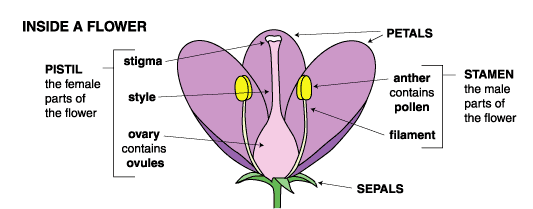
In the case of hibiscus, it belongs to the family Malvaceae. It contains all the floral whorls in a single flower as it is a hermaphrodite.
- It contains five petals.
- It contains five sepals.
- Androecium of the male part contains stamens.
- The gynoecium is the female part which is called the pistil.
The hibiscus plants propagate through vegetative reproduction rather than by the means of seeds or by sexual reproduction. It can grow from stem, roots. The flower is a complete flower that contains all the floral parts but the skill they do not form fruit after fertilisation because when the pods of the plant matures, it forms a crack due to which the seeds are thrown. Due to this, the plants do not bear any fruit.
Note: The role of petals is to make the flower attractive so that the pollinators like insects, butterflies are attracted and can bring about pollination. The sepals are green and leaf-like which helps in protecting the flower buds and also helps in holding all the floral parts together.
Complete answer:
The flower is the reproductive part of the plant. It contains male or female parts along with petals, sepals which help in bringing about the reproductive process. After fertilisation, the endosperm forms the seeds and the petals and sepals wither off. The male and female parts can be present in the same flower, in the flowers of the same plant or in different plants. The figure below shows the various parts of the flower.
In the case of hibiscus, it belongs to the family Malvaceae. It contains all the floral whorls in a single flower as it is a hermaphrodite.
- It contains five petals.
- It contains five sepals.
- Androecium of the male part contains stamens.
- The gynoecium is the female part which is called the pistil.
The hibiscus plants propagate through vegetative reproduction rather than by the means of seeds or by sexual reproduction. It can grow from stem, roots. The flower is a complete flower that contains all the floral parts but the skill they do not form fruit after fertilisation because when the pods of the plant matures, it forms a crack due to which the seeds are thrown. Due to this, the plants do not bear any fruit.
Note: The role of petals is to make the flower attractive so that the pollinators like insects, butterflies are attracted and can bring about pollination. The sepals are green and leaf-like which helps in protecting the flower buds and also helps in holding all the floral parts together.
Recently Updated Pages
Master Class 11 English: Engaging Questions & Answers for Success

Master Class 11 Social Science: Engaging Questions & Answers for Success
Master Class 11 Maths: Engaging Questions & Answers for Success
Master Class 11 Biology: Engaging Questions & Answers for Success
Master Class 11 Physics: Engaging Questions & Answers for Success
Master Class 11 Chemistry: Engaging Questions & Answers for Success
Trending doubts
One Metric ton is equal to kg A 10000 B 1000 C 100 class 11 physics CBSE
Difference Between Prokaryotic Cells and Eukaryotic Cells
Find the value of the expression given below sin 30circ class 11 maths CBSE
Difference between physical and chemical change class 11 chemistry CBSE
Two of the body parts which do not appear in MRI are class 11 biology CBSE
Draw a diagram of a plant cell and label at least eight class 11 biology CBSE