




Heterophylly of limnophila is
a. Environmental
b. Developmental
c. Habitual
d. Both B and C.
Answer
 Verified
515.4k+ views
Hint: Heterophylly is a phenomenon in which two types of leaves are present in a plant. It is a condition of the plant in which the foliage leaves are of more than one type. The presence of different leaves in the same or different stem of the same plant can therefore be defined in heterophylly. As like, the aerial leaves are different from floating leaves and submerged leaves.
Complete answer:
As we discussed what is heterophylly let us know more about it. As we knew, the occurrence of more than one type of leaves on the same plant is called heterophylly. Normally, when mature, all the leaves on a plant are almost identical. Some plants may have different kinds of leaves. Heterophylly is also noticed in other plants like coriander, Ficus etc.
It is of three types- Developmental, Habitual, Environmental.
Developmental heterospory is leaves of different forms and shapes arise at different times during the growth of the same plant. Example- Brassica campestris (Mustard), Sonchus, Eucalyptus.
Second is Habitual heterophylly in which leaves with different shapes and incisions arise on the plant as if the Hemi phragma heterophylly, the main stem bears ovate and entire leaves, while the branches have acicular leaves.
Third is environmental heterophylly. It is found in some aquatic plants, where aerial and floating leaves differ from the submerged leaves. The aerial and floating leaves are generally broad and usually unlobed while submerged leaves are ribbon shaped, linear and are very much dissected. Example- Ranunculus, Aquafil, limnophila.
Hence, limnophila is an environmental heterophylly.
In some plants with opposite phyllotaxy, a different phenomenon is observed. In some rare cases, opposite leaves on a plant have the same size. Such examples - Goldfussia and Pell onia. They are of unequal size. This is known as anisophylly.
Note:
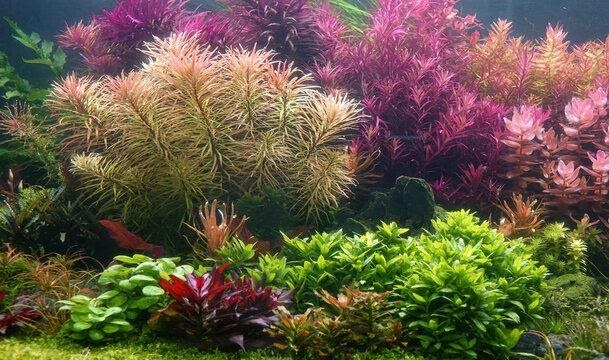
As we discussed about the Limnophila heterophylly, it has leaves in proper whorls and leaves are pinnate and bright green in color. The leaves have a reddish color under strong light. Its fruits are capsules, ellipsoid, green-brown when submersed, dark brown when immersed. These plants are quite common in aquariums. It is a nutrient rich water column. Some aquatic animals feed on these plants from nutrient purposes.
Complete answer:
As we discussed what is heterophylly let us know more about it. As we knew, the occurrence of more than one type of leaves on the same plant is called heterophylly. Normally, when mature, all the leaves on a plant are almost identical. Some plants may have different kinds of leaves. Heterophylly is also noticed in other plants like coriander, Ficus etc.
It is of three types- Developmental, Habitual, Environmental.
Developmental heterospory is leaves of different forms and shapes arise at different times during the growth of the same plant. Example- Brassica campestris (Mustard), Sonchus, Eucalyptus.
Second is Habitual heterophylly in which leaves with different shapes and incisions arise on the plant as if the Hemi phragma heterophylly, the main stem bears ovate and entire leaves, while the branches have acicular leaves.
Third is environmental heterophylly. It is found in some aquatic plants, where aerial and floating leaves differ from the submerged leaves. The aerial and floating leaves are generally broad and usually unlobed while submerged leaves are ribbon shaped, linear and are very much dissected. Example- Ranunculus, Aquafil, limnophila.
Hence, limnophila is an environmental heterophylly.
In some plants with opposite phyllotaxy, a different phenomenon is observed. In some rare cases, opposite leaves on a plant have the same size. Such examples - Goldfussia and Pell onia. They are of unequal size. This is known as anisophylly.
Note:
As we discussed about the Limnophila heterophylly, it has leaves in proper whorls and leaves are pinnate and bright green in color. The leaves have a reddish color under strong light. Its fruits are capsules, ellipsoid, green-brown when submersed, dark brown when immersed. These plants are quite common in aquariums. It is a nutrient rich water column. Some aquatic animals feed on these plants from nutrient purposes.
Recently Updated Pages
Master Class 11 Computer Science: Engaging Questions & Answers for Success

Master Class 11 Business Studies: Engaging Questions & Answers for Success
Master Class 11 Economics: Engaging Questions & Answers for Success
Master Class 11 English: Engaging Questions & Answers for Success
Master Class 11 Maths: Engaging Questions & Answers for Success
Master Class 11 Biology: Engaging Questions & Answers for Success
Trending doubts
One Metric ton is equal to kg A 10000 B 1000 C 100 class 11 physics CBSE
There are 720 permutations of the digits 1 2 3 4 5 class 11 maths CBSE
Discuss the various forms of bacteria class 11 biology CBSE
Draw a diagram of a plant cell and label at least eight class 11 biology CBSE
State the laws of reflection of light
Explain zero factorial class 11 maths CBSE