




Here,N – O – N bond angle is maximum in:
A. $N{{O}_{2}}^{+}$
B. $N{{O}_{2}}$
C. $N{{O}_{3}}$
D. ${{N}_{2}}{{O}_{3}}$
Answer
 Verified
531.6k+ views
Hint: Bond angle is the angle between two adjacent atoms. The valence electrons of an atom are distributed as bond and lone pairs on a covalent molecule. These bond and lone pairs affect the bond angle of any molecule. This is according to the VSEPR theory, that the bond and lone pair of electrons decide the geometry of atoms and hence the bond angles.
Complete answer:
The shapes of molecules tell us the bond angles between them. These shapes are identified using VSEPR theory that stands for valence shell electron pair repulsion theory. This theory suggests that a shape of a molecule is dependent on the valence pair of electrons in the atoms of that molecule. These valence electrons are distributed in the form of bond pairs and lone pairs. The interactions of these pairs are in the order, lone pair – lone pair > lone pair – bond pair > bond pair – bond pair. This states that lone pair lone pair interaction is more due to which the shape of the molecule distorts and the bond angle changes.
The shape of $N{{O}_{2}}^{+}$ is linear as the valence electrons are distributed as two double bond pairs, as
 This linear arrangement of the molecule is due to the repulsions between the electron rich regions, so it has a bond angle of $180{}^\circ $.
While,$N{{O}_{2}}$ structure
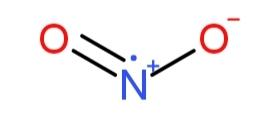 consists of an extra electron pair so, electron density due to the absence of 2 double bonds creates less repulsion, so it does not have maximum bond angle as the angle is $134{}^\circ $.
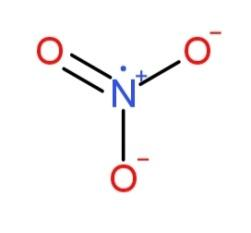
$N{{O}_{3}}$
 And ${{N}_{2}}{{O}_{3}}$
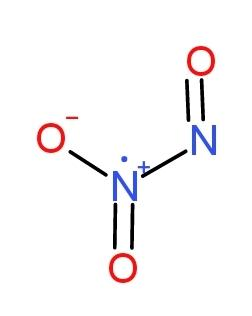 has bond angles of $120{}^\circ $ and $130{}^\circ $ respectively.
So, the N – O – N bond angle is maximum in $N{{O}_{2}}^{+}$.
Therefore option A is correct.
Note:
$N{{O}_{3}}$ has trigonal planar geometry that makes the angles 120 degree. The VSEPR theory suggests that the presence of lone pairs and bond pairs create repulsions to the extent that they change the shape of any molecule. The $N{{O}_{2}}^{+}$ molecule consist of one electron less on nitrogen due to which the double bonds are formed that makes the shape linear.
Complete answer:
The shapes of molecules tell us the bond angles between them. These shapes are identified using VSEPR theory that stands for valence shell electron pair repulsion theory. This theory suggests that a shape of a molecule is dependent on the valence pair of electrons in the atoms of that molecule. These valence electrons are distributed in the form of bond pairs and lone pairs. The interactions of these pairs are in the order, lone pair – lone pair > lone pair – bond pair > bond pair – bond pair. This states that lone pair lone pair interaction is more due to which the shape of the molecule distorts and the bond angle changes.
The shape of $N{{O}_{2}}^{+}$ is linear as the valence electrons are distributed as two double bond pairs, as
While,$N{{O}_{2}}$ structure
$N{{O}_{3}}$
So, the N – O – N bond angle is maximum in $N{{O}_{2}}^{+}$.
Therefore option A is correct.
Note:
$N{{O}_{3}}$ has trigonal planar geometry that makes the angles 120 degree. The VSEPR theory suggests that the presence of lone pairs and bond pairs create repulsions to the extent that they change the shape of any molecule. The $N{{O}_{2}}^{+}$ molecule consist of one electron less on nitrogen due to which the double bonds are formed that makes the shape linear.
Recently Updated Pages
Master Class 11 English: Engaging Questions & Answers for Success

Master Class 11 Social Science: Engaging Questions & Answers for Success
Master Class 11 Maths: Engaging Questions & Answers for Success
Master Class 11 Biology: Engaging Questions & Answers for Success
Master Class 11 Physics: Engaging Questions & Answers for Success
Master Class 11 Chemistry: Engaging Questions & Answers for Success
Trending doubts
Find the value of the expression given below sin 30circ class 11 maths CBSE
Difference between physical and chemical change class 11 chemistry CBSE
How do I convert ms to kmh Give an example class 11 physics CBSE
What is the atomic mass of Sodium a 22 gmol b 23 gmol class 11 chemistry CBSE
In which country Lascaux cave is located A India B class 11 social science CBSE
1 ton equals to A 100 kg B 1000 kg C 10 kg D 10000 class 11 physics CBSE