




Here (A), (B), (C), (D), (E), (F), (G) and (H) are as follows.
(A) : ${{(N{{H}_{4}})}_{2}}C{{r}_{2}}{{O}_{7}}$ (B): $N{{H}_{3}}$ (C) : $C{{r}_{2}}{{O}_{3}}$ (D) : ${{N}_{2}}$ (E) : AlN (F) : $CrC{{l}_{3}}$ (G) : $N{{a}_{2}}Cr{{O}_{4}}$
(H) : $PbCr{{O}_{4}}$
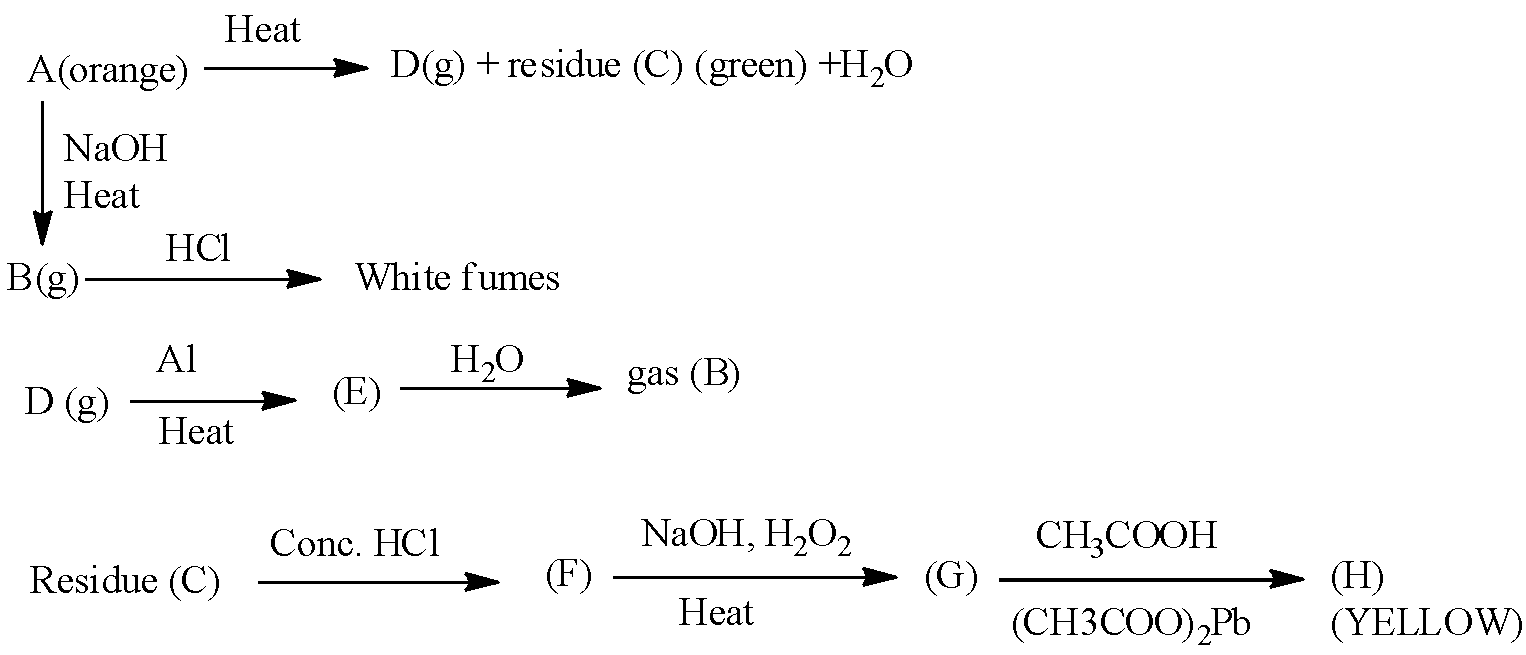
Write the above chemical reaction.
Answer
 Verified
532.2k+ views
Hint: Ammonium chromate is an orange color compound and it is easily going to form nitrogen gas while on heating. Means ammonium chromate compound is heat sensitive in nature. While treated with a base like sodium hydroxide ammonium chromate is going to release ammonia gas as a product.
Complete answer:
- In the question it is asked to write the chemical reaction by following the given chemical route.
- First we have to start writing the chemical reaction with ammonium chromate (A).
- The chemical ammonium chromate (A) is going to react with sodium hydroxide.
\[\underset{A}{\mathop{{{(N{{H}_{4}})}_{2}}C{{r}_{2}}{{O}_{7}}}}\,+2NaOH\xrightarrow{\Delta }\underset{B}{\mathop{2N{{H}_{3}}}}\,+2{{H}_{2}}O+N{{a}_{2}}O+2Cr{{O}_{3}}\]
- On heating the compound ‘A’ with sodium hydroxide ammonia gas (B) is going to form. In the above chemical reaction we can see that one mole of A reacts with 2 moles of sodium hydroxide and forms 2 moles of ammonia gas (B) as the product.
- The compound B is going to react with hydrochloric acid and forms white fumes due to the liberation of the ammonium chloride gas. The chemical reaction is as follows.
\[N{{H}_{3}}+HCl\to N{{H}_{4}}Cl\]
- Now coming to the formation of the compound D from A.
- The compound ‘A’ on heating produces nitrogen gas. With nitrogen there is a formation of the green color residue called chromium oxide. The chemical reaction is as follows.
\[{{(N{{H}_{4}})}_{2}}C{{r}_{2}}{{O}_{7}}\xrightarrow{\Delta }\underset{D}{\mathop{{{N}_{2}}}}\,+\underset{C}{\mathop{C{{r}_{2}}{{O}_{3}}}}\,+4{{H}_{2}}O\]
- The nitrogen gas (D) which is formed in the above chemical reaction is going to react with aluminum and forms aluminum nitride chemical as ‘E’. The chemical reaction is as follows.
\[2Al+\underset{D}{\mathop{{{N}_{2}}}}\,\xrightarrow{heat}2\underset{E}{\mathop{AlN}}\,\]
- The compound ‘E’ on reaction with water (hydrolysis) forms aluminum hydroxide and ammonia gas (B) as the products. The chemical reaction is as follows.
\[AlN+3{{H}_{2}}O\to Al{{(OH)}_{3}}+\underset{B}{\mathop{N{{H}_{3}}}}\,\]
- The chemical chromium trioxide (C) which is formed from ‘A’ is going to react with hydrochloric acid and forms chromium chloride (F) as the product. The chemical reaction is as follows.
\[C{{r}_{2}}{{O}_{3}}+6HCl\to \underset{F}{\mathop{2CrC{{l}_{3}}}}\,+3{{H}_{2}}O\]
- The chemical ‘F’ on heating with sodium hydroxide and hydrogen peroxide forms a compound called sodium chromate (G). The chemical reaction is as follows.
\[2CrC{{l}_{3}}+4NaOH+2{{H}_{2}}{{O}_{2}}\xrightarrow{heat}\underset{G}{\mathop{2N{{a}_{2}}Cr{{O}_{4}}}}\,+6HCl+{{H}_{2}}\]
- The compound (G) which is formed in the above chemical reaction is going to react with acetic acid and forms a yellow precipitate called lead chromate (H). The chemical reaction is as follows.
\[N{{a}_{2}}Cr{{O}_{4}}+{{(C{{H}_{3}}COOH)}_{2}}Pb\xrightarrow{C{{H}_{3}}COOH}\underset{H,yellow\text{ }ppt}{\mathop{PbCr{{O}_{4}}}}\,+2C{{H}_{3}}COONa\]
Note:
We have to write the above chemical reactions very carefully because if we are going to write one chemical reaction wrong automatically the total chain reactions will get disturbed and they are not going to be balanced also.
Complete answer:
- In the question it is asked to write the chemical reaction by following the given chemical route.
- First we have to start writing the chemical reaction with ammonium chromate (A).
- The chemical ammonium chromate (A) is going to react with sodium hydroxide.
\[\underset{A}{\mathop{{{(N{{H}_{4}})}_{2}}C{{r}_{2}}{{O}_{7}}}}\,+2NaOH\xrightarrow{\Delta }\underset{B}{\mathop{2N{{H}_{3}}}}\,+2{{H}_{2}}O+N{{a}_{2}}O+2Cr{{O}_{3}}\]
- On heating the compound ‘A’ with sodium hydroxide ammonia gas (B) is going to form. In the above chemical reaction we can see that one mole of A reacts with 2 moles of sodium hydroxide and forms 2 moles of ammonia gas (B) as the product.
- The compound B is going to react with hydrochloric acid and forms white fumes due to the liberation of the ammonium chloride gas. The chemical reaction is as follows.
\[N{{H}_{3}}+HCl\to N{{H}_{4}}Cl\]
- Now coming to the formation of the compound D from A.
- The compound ‘A’ on heating produces nitrogen gas. With nitrogen there is a formation of the green color residue called chromium oxide. The chemical reaction is as follows.
\[{{(N{{H}_{4}})}_{2}}C{{r}_{2}}{{O}_{7}}\xrightarrow{\Delta }\underset{D}{\mathop{{{N}_{2}}}}\,+\underset{C}{\mathop{C{{r}_{2}}{{O}_{3}}}}\,+4{{H}_{2}}O\]
- The nitrogen gas (D) which is formed in the above chemical reaction is going to react with aluminum and forms aluminum nitride chemical as ‘E’. The chemical reaction is as follows.
\[2Al+\underset{D}{\mathop{{{N}_{2}}}}\,\xrightarrow{heat}2\underset{E}{\mathop{AlN}}\,\]
- The compound ‘E’ on reaction with water (hydrolysis) forms aluminum hydroxide and ammonia gas (B) as the products. The chemical reaction is as follows.
\[AlN+3{{H}_{2}}O\to Al{{(OH)}_{3}}+\underset{B}{\mathop{N{{H}_{3}}}}\,\]
- The chemical chromium trioxide (C) which is formed from ‘A’ is going to react with hydrochloric acid and forms chromium chloride (F) as the product. The chemical reaction is as follows.
\[C{{r}_{2}}{{O}_{3}}+6HCl\to \underset{F}{\mathop{2CrC{{l}_{3}}}}\,+3{{H}_{2}}O\]
- The chemical ‘F’ on heating with sodium hydroxide and hydrogen peroxide forms a compound called sodium chromate (G). The chemical reaction is as follows.
\[2CrC{{l}_{3}}+4NaOH+2{{H}_{2}}{{O}_{2}}\xrightarrow{heat}\underset{G}{\mathop{2N{{a}_{2}}Cr{{O}_{4}}}}\,+6HCl+{{H}_{2}}\]
- The compound (G) which is formed in the above chemical reaction is going to react with acetic acid and forms a yellow precipitate called lead chromate (H). The chemical reaction is as follows.
\[N{{a}_{2}}Cr{{O}_{4}}+{{(C{{H}_{3}}COOH)}_{2}}Pb\xrightarrow{C{{H}_{3}}COOH}\underset{H,yellow\text{ }ppt}{\mathop{PbCr{{O}_{4}}}}\,+2C{{H}_{3}}COONa\]
Note:
We have to write the above chemical reactions very carefully because if we are going to write one chemical reaction wrong automatically the total chain reactions will get disturbed and they are not going to be balanced also.
Recently Updated Pages
Master Class 11 Computer Science: Engaging Questions & Answers for Success

Master Class 11 Business Studies: Engaging Questions & Answers for Success
Master Class 11 Economics: Engaging Questions & Answers for Success
Master Class 11 English: Engaging Questions & Answers for Success
Master Class 11 Maths: Engaging Questions & Answers for Success
Master Class 11 Biology: Engaging Questions & Answers for Success
Trending doubts
One Metric ton is equal to kg A 10000 B 1000 C 100 class 11 physics CBSE
There are 720 permutations of the digits 1 2 3 4 5 class 11 maths CBSE
Discuss the various forms of bacteria class 11 biology CBSE
Draw a diagram of a plant cell and label at least eight class 11 biology CBSE
State the laws of reflection of light
Explain zero factorial class 11 maths CBSE