




Herbivorous animals can digest cellulose because
(a) Their molar and premolar teeth can crush and grind the food.
(b) Bacteria present in their caecum help in the digestion of cellulose.
(c) Gastric juice has a digestive enzyme for cellulose digestion.
(d) The alimentary canal is short.
Answer
 Verified
644.4k+ views
Hint: Digestion of cellulose occurs in the process of fermentation, which happens in anaerobic conditions.
Complete answer:
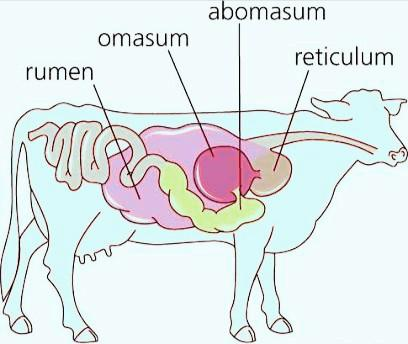
The stomach of herbivores more specifically the ruminants has four parts or four different chambers. In one part named rumen, some symbiotic microorganisms are present, which include bacteria like Rumenococcus and ciliates like Entodinium caudatum. These symbiotic microorganisms help in fermentation and breakdown of cellulose and thus help in their digestion.
Additional Information:
The parts of the digestive system of ruminants and their features are as follows:
- Rumen- The largest portion of the stomach is the rumen. This region contains villi with a cornified surface that helps in breaking and churning of food.
- Reticulum- The surface of the reticulum is lined by a stratified keratinized epithelium.
- A systematic and ordered contraction relaxation occurs between the rumen and reticulum which helps in mixing and churning the food substance. It also helps in regurgitation and passing of food onto the omasum.
- Omasum: This region is specialized for mixing and breaking down ingested food substances.
- Abomasum: Gastric juices are secreted from abomasum and it helps in biochemical digestion of food.
So, the correct answer is, "Herbivorous animals can digest cellulose because of bacteria present in their caecum help in the digestion of cellulose."
Note: Rumen and reticulum are specialized for food storage and while the food is stored inside them, the symbiotic microorganisms help in the breakdown of glucose, but the abomasum is known as the true stomach as the majority of biochemical digestion occurs here.
The structures where food is stored in the rumen and reticulum are known as water pockets or diverticula.
Complete answer:
The stomach of herbivores more specifically the ruminants has four parts or four different chambers. In one part named rumen, some symbiotic microorganisms are present, which include bacteria like Rumenococcus and ciliates like Entodinium caudatum. These symbiotic microorganisms help in fermentation and breakdown of cellulose and thus help in their digestion.
Additional Information:
The parts of the digestive system of ruminants and their features are as follows:
- Rumen- The largest portion of the stomach is the rumen. This region contains villi with a cornified surface that helps in breaking and churning of food.
- Reticulum- The surface of the reticulum is lined by a stratified keratinized epithelium.
- A systematic and ordered contraction relaxation occurs between the rumen and reticulum which helps in mixing and churning the food substance. It also helps in regurgitation and passing of food onto the omasum.
- Omasum: This region is specialized for mixing and breaking down ingested food substances.
- Abomasum: Gastric juices are secreted from abomasum and it helps in biochemical digestion of food.
So, the correct answer is, "Herbivorous animals can digest cellulose because of bacteria present in their caecum help in the digestion of cellulose."
Note: Rumen and reticulum are specialized for food storage and while the food is stored inside them, the symbiotic microorganisms help in the breakdown of glucose, but the abomasum is known as the true stomach as the majority of biochemical digestion occurs here.
The structures where food is stored in the rumen and reticulum are known as water pockets or diverticula.
Recently Updated Pages
Master Class 11 English: Engaging Questions & Answers for Success

Master Class 11 Social Science: Engaging Questions & Answers for Success
Master Class 11 Maths: Engaging Questions & Answers for Success
Master Class 11 Biology: Engaging Questions & Answers for Success
Master Class 11 Physics: Engaging Questions & Answers for Success
Master Class 11 Chemistry: Engaging Questions & Answers for Success
Trending doubts
One Metric ton is equal to kg A 10000 B 1000 C 100 class 11 physics CBSE
Difference Between Prokaryotic Cells and Eukaryotic Cells
Two of the body parts which do not appear in MRI are class 11 biology CBSE
Find the value of the expression given below sin 30circ class 11 maths CBSE
Draw a diagram of a plant cell and label at least eight class 11 biology CBSE
10 examples of friction in our daily life