




What is hemoglobin?
(a) Main component of RBCs
(b) Iron- containing protein
(c) Transports oxygen
(d) All of the above
Answer
 Verified
620.4k+ views
Hint: Hemoglobin is associated with the movement of many gases inside the body. Haemoglobin is responsible for the oxygen capacity of the blood and contains an important metal that also helps in providing red color to the blood.
Complete answer:
RBCs present in the blood contain hemoglobin abbreviated as Hb. In blood, hemoglobin is responsible for carrying oxygen from the respiratory organs of the body. After that, it then releases the oxygen to allow aerobic respiration so that the body may gain the energy required for the proper functioning of the organs and the organism and hence support the process of metabolism. The amount of hemoglobin in the blood of a healthy individual is about 12 to 20 grams in every blood of 100ml. Globulin is surrounded by four heme or iron- containing groups of makeup hemoglobin molecules and ultimately gives it a tetrahedral structure.
Additional Information:
- It is the iron atom in the hemoglobin molecule which is responsible for binding the oxygen while transportation from the respiratory organs to the tissues of the body.
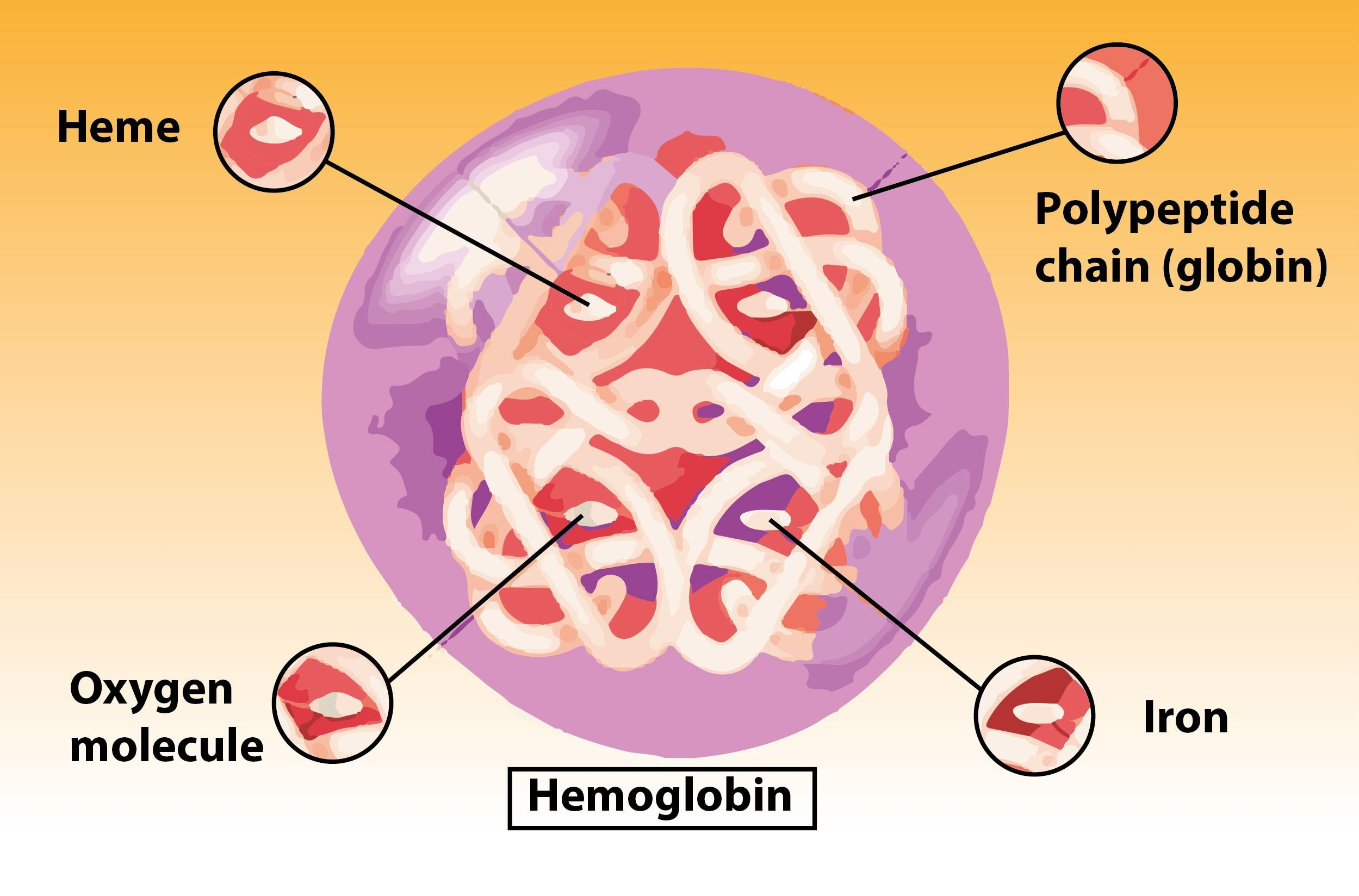
- The heme group which is responsible for occupying $4\%$ of the weight of the hemoglobin molecule, is made up of an organic compound that is ring- like in structure also known as porphyrin, which is responsible for the attachment of iron to the hemoglobin.
- Hemoglobin is also responsible for the transportation of carbon dioxide from the tissues to the respiratory organs and while transporting the hemoglobin combined with the carbon dioxide molecules is termed as carbaminohemoglobin.
- Molecules of mammalian hemoglobin can carry up to four molecules of oxygen at a time.
So, the correct option is, ”All of the above”.
Note:
- The oxygen-binding capacity of a hemoglobin molecule is 1.34 ml of oxygen per gram.
- Proteins in the mammalian body are responsible for about 96% of the dry contained in RBC and 35% of total content or the wet weight.
Complete answer:
RBCs present in the blood contain hemoglobin abbreviated as Hb. In blood, hemoglobin is responsible for carrying oxygen from the respiratory organs of the body. After that, it then releases the oxygen to allow aerobic respiration so that the body may gain the energy required for the proper functioning of the organs and the organism and hence support the process of metabolism. The amount of hemoglobin in the blood of a healthy individual is about 12 to 20 grams in every blood of 100ml. Globulin is surrounded by four heme or iron- containing groups of makeup hemoglobin molecules and ultimately gives it a tetrahedral structure.
Additional Information:
- It is the iron atom in the hemoglobin molecule which is responsible for binding the oxygen while transportation from the respiratory organs to the tissues of the body.
- The heme group which is responsible for occupying $4\%$ of the weight of the hemoglobin molecule, is made up of an organic compound that is ring- like in structure also known as porphyrin, which is responsible for the attachment of iron to the hemoglobin.
- Hemoglobin is also responsible for the transportation of carbon dioxide from the tissues to the respiratory organs and while transporting the hemoglobin combined with the carbon dioxide molecules is termed as carbaminohemoglobin.
- Molecules of mammalian hemoglobin can carry up to four molecules of oxygen at a time.
So, the correct option is, ”All of the above”.
Note:
- The oxygen-binding capacity of a hemoglobin molecule is 1.34 ml of oxygen per gram.
- Proteins in the mammalian body are responsible for about 96% of the dry contained in RBC and 35% of total content or the wet weight.
Recently Updated Pages
The given figure shows two endocrine glands marked class 11 biology NEET_UG

Match columnI with columnII and select the correct class 11 biology NEET
Match column I with column II and select the correct class 11 biology NEET_UG
Which floral family has left 9 right + 1 arrangement class 11 biology NEET_UG
Which is not a variety of sheep A Lohi B Beetal C Nellore class 11 biology NEET_UG
Match column I with column II and select the correct class 11 biology NEET_UG
Trending doubts
One Metric ton is equal to kg A 10000 B 1000 C 100 class 11 physics CBSE
Draw a diagram of a plant cell and label at least eight class 11 biology CBSE
Difference Between Prokaryotic Cells and Eukaryotic Cells
Draw a well labelled diagram of reflex arc and explain class 11 biology CBSE
Two of the body parts which do not appear in MRI are class 11 biology CBSE
1 ton equals to A 100 kg B 1000 kg C 10 kg D 10000 class 11 physics CBSE