




Head of the cockroach according to its position is known as
A. Hypopharynx
B. Hepatocerebral
C. Hypognathous
D. Supragnathus
Answer
 Verified
641.1k+ views
Hint: Cockroach belongs to the phylum Arthropoda (jointed appendages). After head removal cockroach still remains alive for a week. The head is vertically oriented in the cockroach.
Complete answer: Insects are classified broadly into three categories on the basis of the orientation of the head during the resting position with respect to the long or the vertical axis of the body of the insect. They are as follows. -
a. Prognathous: In these types of insects, the head is horizontally oriented. The parts of their mouth interiorly. Examples of such insects are carabid beetles and earwigs
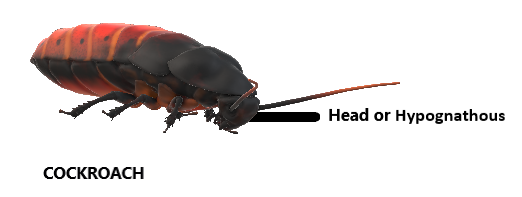
b. Hypognathous: In these types of insects, the head is vertically oriented. The parts of their mouth are pointed ventrally downwards. Examples of such insects are cockroaches, grasshoppers, houseflies, and honey bees.
c. Opisthognathous: In these types of insects, the head is obliquely oriented. The parts of their mouth are pointed ventro-posteriorly rearwards. Examples of such insects are leafhoppers, aphids, and whiteflies.
So, the correct answer is option C.
Note: Cockroaches are insects of the order Blattodea. They are known as roach as well. They belong to the phylum Arthropoda and class Insecta. They are the most common pests. There are 3000 species of cockroaches. They reproduce through eggs.
Complete answer: Insects are classified broadly into three categories on the basis of the orientation of the head during the resting position with respect to the long or the vertical axis of the body of the insect. They are as follows. -
a. Prognathous: In these types of insects, the head is horizontally oriented. The parts of their mouth interiorly. Examples of such insects are carabid beetles and earwigs
b. Hypognathous: In these types of insects, the head is vertically oriented. The parts of their mouth are pointed ventrally downwards. Examples of such insects are cockroaches, grasshoppers, houseflies, and honey bees.
c. Opisthognathous: In these types of insects, the head is obliquely oriented. The parts of their mouth are pointed ventro-posteriorly rearwards. Examples of such insects are leafhoppers, aphids, and whiteflies.
So, the correct answer is option C.
Note: Cockroaches are insects of the order Blattodea. They are known as roach as well. They belong to the phylum Arthropoda and class Insecta. They are the most common pests. There are 3000 species of cockroaches. They reproduce through eggs.
Recently Updated Pages
Which will be the least stable resonating structure class 11 chemistry CBSE

How many 5 digit telephone numbers can be construc-class-11-maths-CBSE
How do you find the angle of the resultant vector class 11 physics CBSE
Draw labelled diagram of the following i Gram seed class 11 biology CBSE
1 Quintal is equal to a 110 kg b 10 kg c 100kg d 1000 class 11 physics CBSE
What is the need and importance of classification class 11 biology CBSE
Trending doubts
Find the value of the expression given below sin 30circ class 11 maths CBSE
One Metric ton is equal to kg A 10000 B 1000 C 100 class 11 physics CBSE
Draw a diagram of nephron and explain its structur class 11 biology CBSE
10 examples of friction in our daily life
Draw a diagram of a plant cell and label at least eight class 11 biology CBSE
Difference Between Prokaryotic Cells and Eukaryotic Cells