




Have you ever noticed that when you reach into a bag of M and \[{M^1}\]s, that you are most likely to pull out a brown one?
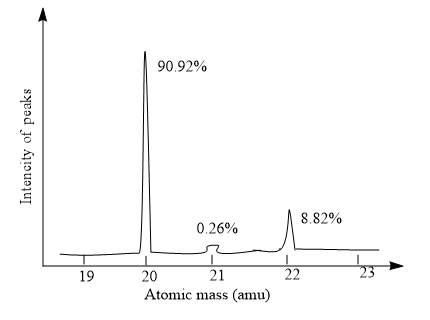
A group of students studied the mass spectrum of a new element they wanted to name cadmium is shown below.
What is the relative atomic mass of cadmium?
Answer
 Verified
575.7k+ views
Hint: Here, given a graphical representation of the mass spectrum of the element candium with, the intensity of peaks on the y-axis and atomic mass is along the x-axis. And it shows three peaks. And the tallest peak will indicate the base peak and it is a particularly stable ion. And the mass spectrum, which represents a plot of intensity vs m/z ratio. And m/z ratio indicates the mass to charge ratio.
Complete answer:
In the given plot, the base peak shows at the atomic mass $20$ and the intensity of the peaks is equal to \[90.92\% \]. And the element with atomic mass $21$ shows the intensity of the peak at\[0.26\% \]. The element with atomic mass $22$ shows the peak with intensity \[8.82\% \].
The relative atomic mass of an element is the sum of the product of the percentage of peaks and the atomic mass and the formula of relative atomic mass can be written as,
\[\Sigma \% \,of\,peaks\, \times atomic\,mass\]
\[20 \to 90.92\% \]
\[21 \to 0.26\% \]
\[22 \to 8.82\% \]
Substitute the values in above equation, will get,
Relative atomic mass\[ = \dfrac{{90.92}}{{100}} \times 20\, + \,\dfrac{{0.26}}{{100}} \times 21\, + \,\dfrac{{8.82}}{{100}} \times 22\]
\[ = 18.184 + 0.0546 + 1.9404\]
\[ = 20.179\]
Hence, the relative atomic mass of candium is equal to \[20.179\].
Note:
From the given plot of the mass spectrum, we get the relative atomic mass of cadmium is equal to \[20.179\]. And it is a pattern that represents the distribution of the ions by using the mass to charge ratio. To read a mass spectrum, first, we have to identify the molecular ion and next to identify the fragmentation. And calculate the \[\Delta m\] of each peak. If there are any heteroatoms, identify them also, after that name the molecule.
Complete answer:
In the given plot, the base peak shows at the atomic mass $20$ and the intensity of the peaks is equal to \[90.92\% \]. And the element with atomic mass $21$ shows the intensity of the peak at\[0.26\% \]. The element with atomic mass $22$ shows the peak with intensity \[8.82\% \].
The relative atomic mass of an element is the sum of the product of the percentage of peaks and the atomic mass and the formula of relative atomic mass can be written as,
\[\Sigma \% \,of\,peaks\, \times atomic\,mass\]
\[20 \to 90.92\% \]
\[21 \to 0.26\% \]
\[22 \to 8.82\% \]
Substitute the values in above equation, will get,
Relative atomic mass\[ = \dfrac{{90.92}}{{100}} \times 20\, + \,\dfrac{{0.26}}{{100}} \times 21\, + \,\dfrac{{8.82}}{{100}} \times 22\]
\[ = 18.184 + 0.0546 + 1.9404\]
\[ = 20.179\]
Hence, the relative atomic mass of candium is equal to \[20.179\].
Note:
From the given plot of the mass spectrum, we get the relative atomic mass of cadmium is equal to \[20.179\]. And it is a pattern that represents the distribution of the ions by using the mass to charge ratio. To read a mass spectrum, first, we have to identify the molecular ion and next to identify the fragmentation. And calculate the \[\Delta m\] of each peak. If there are any heteroatoms, identify them also, after that name the molecule.
Recently Updated Pages
If x a + bt + ct2 where x is in meters and t is in class 11 physics CBSE

A car covers the first half distance between two places class 11 physics CBSE
The resultant of two vectors overrightarrow P and overrightarrow class 11 physics CBSE
Find the value of cos 135 class 11 maths CBSE
A mass M is held in place by an applied force F and class 11 physics CBSE
A solution of glucose in water is labelled as 10 dfracwv class 11 chemistry CBSE
Trending doubts
Find the value of the expression given below sin 30circ class 11 maths CBSE
One Metric ton is equal to kg A 10000 B 1000 C 100 class 11 physics CBSE
Draw a diagram of nephron and explain its structur class 11 biology CBSE
10 examples of friction in our daily life
Proton was discovered by A Thomson B Rutherford C Chadwick class 11 chemistry CBSE
Bond order ofO2 O2+ O2 and O22 is in order A O2 langle class 11 chemistry CBSE