



 Watch Video


$\hat i$ and $\hat j$ are unit vectors along $x - axis$ and $y - axis$ respectively.
A) What is the magnitude and direction of the vectors $\left( {\hat i + \hat j} \right)$ and $\left( {\hat i - \hat j} \right)$ ?
B) What are the components of the vectors $\overrightarrow B = 2\hat i + 3\hat j$ along the direction of $\left( {\hat i + \hat j} \right)$ and $\left( {\hat i - \hat j} \right)$ ?
Answer
 Verified
594.9k+ views
Hint:Use the value of $\hat i$ and $\hat j$ as $1$ because they are unit vectors. Now, to find the direction, find the inverse of $\tan $.
For finding the component of vectors find the angle between the vectors $\vec B$ and $\left( {\hat i + \hat j} \right)$ and then find the product of the angle and vector $\vec B$.
Complete step by step answer:
According to the question, we know that $\hat i$ and $\hat j$ are unit vectors along $x - axis$ and $y - axis$ respectively.
(a)
For finding the magnitude we use the expression –
$\vec A = \sqrt {{a^2} + {b^2} + {c^2}} $
Therefore, for calculating the magnitude of vector $\left( {\hat i + \hat j} \right)$ -
$ \Rightarrow \sqrt {{{\left( {\hat i} \right)}^2} + {{\left( {\hat j} \right)}^2}} $
We know that, $\hat i.\hat i = 1$ and $\hat j.\hat j = 1$
Therefore, magnitude of vector $\left( {\hat i + \hat j} \right)$ -
$ \Rightarrow \sqrt {{{\left( 1 \right)}^2} + {{\left( 1 \right)}^2}} = \sqrt 2 $
Hence, the magnitude of the vector $\left( {\hat i + \hat j} \right)$ is $\sqrt 2 $.
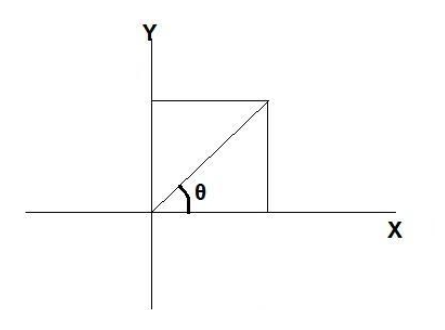
Now,
$
\tan \theta = \dfrac{1}{1} \\
\theta = {\tan ^{ - 1}}\left( 1 \right) \\
\theta = {45^ \circ } \\
$
Therefore, the direction is ${45^ \circ }$ to the $x - axis$.
Now, calculating the magnitude of vector $\left( {\hat i - \hat j} \right)$ -
$ \Rightarrow \sqrt {{{\left( 1 \right)}^2} + {{\left( { - 1} \right)}^2}} = \sqrt 2 $
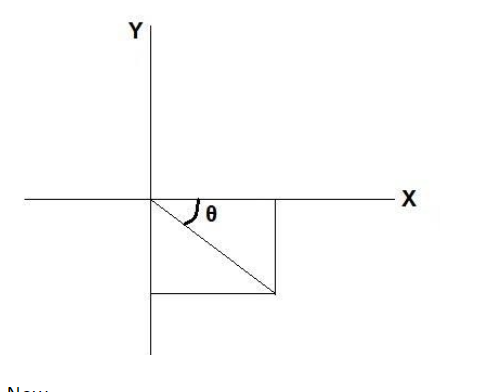
Now,
$
\tan \theta = - \dfrac{1}{1} \\
\theta = {\tan ^{ - 1}}\left( { - 1} \right) \\
\theta = - {45^ \circ } \\
$
Hence, the direction of the vector $\left( {\hat i - \hat j} \right)$ is $ - {45^ \circ }$ with the $x - axis$.
(b)
From the question, it is given that –
$\overrightarrow B = 2\hat i + 3\hat j$
Let,
$
\vec a = \hat i + \hat j \\
\vec b = \hat i - \hat j \\
$
To get the component of $\vec B$ along the direction of $\vec a$ we have to find the angle between them –
So, we need to do this by their dot product –
$
\vec B.\vec a = \left| {\vec B} \right|\left| {\vec a} \right|\cos \theta \\
\cos \theta = \dfrac{{\vec B.\vec a}}{{\left| {\vec B} \right|\left| {\vec a} \right|}} \cdots \left( 1 \right) \\
$
Magnitude of vector $\vec B$ -
$\left| {\vec B} \right| = \sqrt {{{\left( 2 \right)}^2} + {{\left( 3 \right)}^2}} = \sqrt {4 + 9} = \sqrt {13} units$
Magnitude of vector $\vec a$ -
$\left| {\vec a} \right| = \sqrt {1 + 1} = \sqrt 2 $
Putting all the values needed for finding the component in equation $\left( 1 \right)$, we get –
$
\therefore \cos \theta = \dfrac{{\left( {2\hat i + 3\hat j} \right).\left( {\hat i + \hat j} \right)}}{{\sqrt {13} \times \sqrt 2 }} = \dfrac{{2 + 3}}{{\sqrt {26} }} \\
\cos \theta = \dfrac{5}{{\sqrt {26} }} \\
$
Hence, the component of $\vec B$ along direction of $\vec a$ is $\dfrac{5}{{\sqrt {26} }}\left( {2\hat i + 3\hat j} \right)$
Similarly,
To get the component of $\vec B$ along the direction of $\vec b$ we have to find the angle between them –
So, we need to do this by their dot product –
$
\vec B.\vec b = \left| {\vec B} \right|\left| {\vec b} \right|\cos \theta \\
\cos \theta = \dfrac{{\vec B.\vec b}}{{\left| {\vec B} \right|\left| {\vec b} \right|}} \cdots \left( 2 \right) \\
$
Magnitude of vector $\vec b$ -
$\left| {\vec b} \right| = \sqrt {1 + 1} = \sqrt 2 $
Putting all the values needed for finding the component in equation $\left( 2 \right)$, we get –
$
\therefore \cos \theta = \dfrac{{\left( {2\hat i + 3\hat j} \right).\left( {\hat i - \hat j} \right)}}{{\sqrt {13} \times \sqrt 2 }} = \dfrac{{2 - 3}}{{\sqrt {26} }} \\
\cos \theta = \dfrac{{ - 1}}{{\sqrt {26} }} \\
$
Hence, the component of $\vec B$ along direction of $\vec a$ is $\dfrac{{ - 1}}{{\sqrt {26} }}\left( {2\hat i + 3\hat j} \right)$.
Note: -The magnitude of a vector is the length of the vector. The magnitude of the vector $\vec a$ is denoted as $\left| {\vec a} \right|$.
Formulas for the magnitude of vectors in two dimensions in terms of their coordinates are –
If $\vec a = {a_1}\hat i + {a_2}\hat j$ then, magnitude is –
$\left| {\vec a} \right| = \sqrt {a_1^2 + a_2^2} $
For finding the component of vectors find the angle between the vectors $\vec B$ and $\left( {\hat i + \hat j} \right)$ and then find the product of the angle and vector $\vec B$.
Complete step by step answer:
According to the question, we know that $\hat i$ and $\hat j$ are unit vectors along $x - axis$ and $y - axis$ respectively.
(a)
For finding the magnitude we use the expression –
$\vec A = \sqrt {{a^2} + {b^2} + {c^2}} $
Therefore, for calculating the magnitude of vector $\left( {\hat i + \hat j} \right)$ -
$ \Rightarrow \sqrt {{{\left( {\hat i} \right)}^2} + {{\left( {\hat j} \right)}^2}} $
We know that, $\hat i.\hat i = 1$ and $\hat j.\hat j = 1$
Therefore, magnitude of vector $\left( {\hat i + \hat j} \right)$ -
$ \Rightarrow \sqrt {{{\left( 1 \right)}^2} + {{\left( 1 \right)}^2}} = \sqrt 2 $
Hence, the magnitude of the vector $\left( {\hat i + \hat j} \right)$ is $\sqrt 2 $.
Now,
$
\tan \theta = \dfrac{1}{1} \\
\theta = {\tan ^{ - 1}}\left( 1 \right) \\
\theta = {45^ \circ } \\
$
Therefore, the direction is ${45^ \circ }$ to the $x - axis$.
Now, calculating the magnitude of vector $\left( {\hat i - \hat j} \right)$ -
$ \Rightarrow \sqrt {{{\left( 1 \right)}^2} + {{\left( { - 1} \right)}^2}} = \sqrt 2 $
Now,
$
\tan \theta = - \dfrac{1}{1} \\
\theta = {\tan ^{ - 1}}\left( { - 1} \right) \\
\theta = - {45^ \circ } \\
$
Hence, the direction of the vector $\left( {\hat i - \hat j} \right)$ is $ - {45^ \circ }$ with the $x - axis$.
(b)
From the question, it is given that –
$\overrightarrow B = 2\hat i + 3\hat j$
Let,
$
\vec a = \hat i + \hat j \\
\vec b = \hat i - \hat j \\
$
To get the component of $\vec B$ along the direction of $\vec a$ we have to find the angle between them –
So, we need to do this by their dot product –
$
\vec B.\vec a = \left| {\vec B} \right|\left| {\vec a} \right|\cos \theta \\
\cos \theta = \dfrac{{\vec B.\vec a}}{{\left| {\vec B} \right|\left| {\vec a} \right|}} \cdots \left( 1 \right) \\
$
Magnitude of vector $\vec B$ -
$\left| {\vec B} \right| = \sqrt {{{\left( 2 \right)}^2} + {{\left( 3 \right)}^2}} = \sqrt {4 + 9} = \sqrt {13} units$
Magnitude of vector $\vec a$ -
$\left| {\vec a} \right| = \sqrt {1 + 1} = \sqrt 2 $
Putting all the values needed for finding the component in equation $\left( 1 \right)$, we get –
$
\therefore \cos \theta = \dfrac{{\left( {2\hat i + 3\hat j} \right).\left( {\hat i + \hat j} \right)}}{{\sqrt {13} \times \sqrt 2 }} = \dfrac{{2 + 3}}{{\sqrt {26} }} \\
\cos \theta = \dfrac{5}{{\sqrt {26} }} \\
$
Hence, the component of $\vec B$ along direction of $\vec a$ is $\dfrac{5}{{\sqrt {26} }}\left( {2\hat i + 3\hat j} \right)$
Similarly,
To get the component of $\vec B$ along the direction of $\vec b$ we have to find the angle between them –
So, we need to do this by their dot product –
$
\vec B.\vec b = \left| {\vec B} \right|\left| {\vec b} \right|\cos \theta \\
\cos \theta = \dfrac{{\vec B.\vec b}}{{\left| {\vec B} \right|\left| {\vec b} \right|}} \cdots \left( 2 \right) \\
$
Magnitude of vector $\vec b$ -
$\left| {\vec b} \right| = \sqrt {1 + 1} = \sqrt 2 $
Putting all the values needed for finding the component in equation $\left( 2 \right)$, we get –
$
\therefore \cos \theta = \dfrac{{\left( {2\hat i + 3\hat j} \right).\left( {\hat i - \hat j} \right)}}{{\sqrt {13} \times \sqrt 2 }} = \dfrac{{2 - 3}}{{\sqrt {26} }} \\
\cos \theta = \dfrac{{ - 1}}{{\sqrt {26} }} \\
$
Hence, the component of $\vec B$ along direction of $\vec a$ is $\dfrac{{ - 1}}{{\sqrt {26} }}\left( {2\hat i + 3\hat j} \right)$.
Note: -The magnitude of a vector is the length of the vector. The magnitude of the vector $\vec a$ is denoted as $\left| {\vec a} \right|$.
Formulas for the magnitude of vectors in two dimensions in terms of their coordinates are –
If $\vec a = {a_1}\hat i + {a_2}\hat j$ then, magnitude is –
$\left| {\vec a} \right| = \sqrt {a_1^2 + a_2^2} $
Watch videos on
$\hat i$ and $\hat j$ are unit vectors along $x - axis$ and $y - axis$ respectively.
A) What is the magnitude and direction of the vectors $\left( {\hat i + \hat j} \right)$ and $\left( {\hat i - \hat j} \right)$ ?
B) What are the components of the vectors $\overrightarrow B = 2\hat i + 3\hat j$ along the direction of $\left( {\hat i + \hat j} \right)$ and $\left( {\hat i - \hat j} \right)$ ?
A) What is the magnitude and direction of the vectors $\left( {\hat i + \hat j} \right)$ and $\left( {\hat i - \hat j} \right)$ ?
B) What are the components of the vectors $\overrightarrow B = 2\hat i + 3\hat j$ along the direction of $\left( {\hat i + \hat j} \right)$ and $\left( {\hat i - \hat j} \right)$ ?

Motion in a Plane | NCERT EXERCISE 3.19 | Class 11 Phyiscs | Gaurav Tiwari Sir
Subscribe
 Share
Share likes
12.2K Views
2 years ago
Recently Updated Pages
Master Class 11 Social Science: Engaging Questions & Answers for Success

Master Class 11 Physics: Engaging Questions & Answers for Success
Master Class 11 Maths: Engaging Questions & Answers for Success
Master Class 11 Economics: Engaging Questions & Answers for Success
Master Class 11 Computer Science: Engaging Questions & Answers for Success
Master Class 11 Chemistry: Engaging Questions & Answers for Success
Trending doubts
There are 720 permutations of the digits 1 2 3 4 5 class 11 maths CBSE
1 Quintal is equal to a 110 kg b 10 kg c 100kg d 1000 class 11 physics CBSE
State and prove Bernoullis theorem class 11 physics CBSE
Which among the following are examples of coming together class 11 social science CBSE
Explain zero factorial class 11 maths CBSE
The endarch condition is characteristic of a Root b class 11 biology CBSE