




What happens to the field lines in a uniform magnetic field?
Answer
 Verified
511.2k+ views
Hint: Magnetic forces are visible in a magnetic field, which is a vector field in the vicinity of a magnet, electric current, or changing electric field. Moving electric charges and inherent magnetic moments of basic particles coupled with a fundamental quantum characteristic known as the spin generate a magnetic field. Both the magnetic and electric fields are interconnected and are components of the electromagnetic force, one of nature's four basic forces.
Complete answer:
A different approach to display the information contained inside a magnetic vector field is to utilise field lines. Magnetic field lines are made up of fictitious lines. Magnetic field lines are a type of visual representation of magnetic fields. They provide the magnetic force direction on a north monopole at any particular location. The magnitude of the field is indicated by the density of the lines. For example, at the poles of a magnet, the magnetic field is stronger and more dense. It becomes weaker as we go away from the poles, and the lines become less thick.
Magnetic field lines are the lines in a magnetic field whose tangent indicates the field direction at any given place and whose density gives the field magnitude. They indicate the magnetic field's direction. The number of magnetic field lines determines the strength of the magnetic field. Because the lines are higher near the poles, the magnetic field is greater there. The intensity of a magnetic field is proportional to the number of magnetic field lines present in a given region.
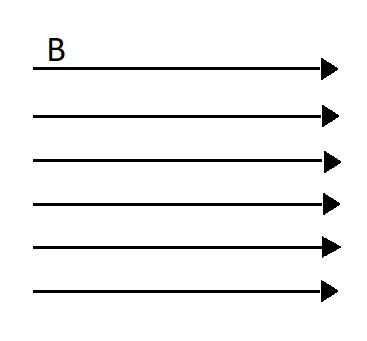
The field lines in a homogeneous magnetic field are parallel equidistant straight lines.
The magnetic field is considered to be uniform if the magnetic induction has the same magnitude and direction at all sites in the area. A uniform magnetic field is one in which magnetic field lines flow in a straight path from the North Pole to the South Pole of a magnet with uniform severance; this is difficult to achieve with a single stable magnet.
Note:
At any point in space, the magnetic field's direction is tangent to the field line. A tiny compass will point towards the field line's direction. The field's strength is related to the distance between the lines. It is proportional to the number of lines per unit area that are parallel to the lines (called the areal density). Magnetic field lines can never cross, implying that each point in space has its own magnetic field. Magnetic field lines are endless, producing closed loops that have no beginning or end. They run all the way from the north to the south pole.
Complete answer:
A different approach to display the information contained inside a magnetic vector field is to utilise field lines. Magnetic field lines are made up of fictitious lines. Magnetic field lines are a type of visual representation of magnetic fields. They provide the magnetic force direction on a north monopole at any particular location. The magnitude of the field is indicated by the density of the lines. For example, at the poles of a magnet, the magnetic field is stronger and more dense. It becomes weaker as we go away from the poles, and the lines become less thick.
Magnetic field lines are the lines in a magnetic field whose tangent indicates the field direction at any given place and whose density gives the field magnitude. They indicate the magnetic field's direction. The number of magnetic field lines determines the strength of the magnetic field. Because the lines are higher near the poles, the magnetic field is greater there. The intensity of a magnetic field is proportional to the number of magnetic field lines present in a given region.
The field lines in a homogeneous magnetic field are parallel equidistant straight lines.
The magnetic field is considered to be uniform if the magnetic induction has the same magnitude and direction at all sites in the area. A uniform magnetic field is one in which magnetic field lines flow in a straight path from the North Pole to the South Pole of a magnet with uniform severance; this is difficult to achieve with a single stable magnet.
Note:
At any point in space, the magnetic field's direction is tangent to the field line. A tiny compass will point towards the field line's direction. The field's strength is related to the distance between the lines. It is proportional to the number of lines per unit area that are parallel to the lines (called the areal density). Magnetic field lines can never cross, implying that each point in space has its own magnetic field. Magnetic field lines are endless, producing closed loops that have no beginning or end. They run all the way from the north to the south pole.
Recently Updated Pages
Master Class 11 Social Science: Engaging Questions & Answers for Success

Master Class 11 Physics: Engaging Questions & Answers for Success
Master Class 11 Maths: Engaging Questions & Answers for Success
Master Class 11 Economics: Engaging Questions & Answers for Success
Master Class 11 Computer Science: Engaging Questions & Answers for Success
Master Class 11 Chemistry: Engaging Questions & Answers for Success
Trending doubts
One Metric ton is equal to kg A 10000 B 1000 C 100 class 11 physics CBSE
There are 720 permutations of the digits 1 2 3 4 5 class 11 maths CBSE
1 Quintal is equal to a 110 kg b 10 kg c 100kg d 1000 class 11 physics CBSE
State and prove Bernoullis theorem class 11 physics CBSE
Difference Between Prokaryotic Cells and Eukaryotic Cells
Which among the following are examples of coming together class 11 social science CBSE