




What would happen to the Lac Operon in the absence of Allolactose?
Answer
 Verified
462k+ views
Hint: In genetics, an operon is a functional unit of DNA that contains a cluster of genes controlled by a single promoter. The genes are transcribed into a single strand of mRNA and either translated together in the cytoplasm or spliced to produce monocistronic mRNAs that are translated separately, i.e. several strands of mRNA that each encode a single gene product. As a result, the operon's genes are either expressed together or not expressed at all. An operon is defined by the co-transcription of several genes.
Complete answer:
The lactose operon (lac operon) is a lactose transport and metabolism operon found in E. coli and many other enteric bacteria. Although glucose is the preferred carbon source for most bacteria, the lac operon allows for effective lactose digestion when glucose is unavailable via beta-galactosidase activity. Because gene regulation of the lac operon was the first clearly understood genetic regulatory mechanism, it has become a leading example of prokaryotic gene regulation. For this reason, it is frequently discussed in introductory molecular and cellular biology classes.
François Jacob and Jacques Monod used this lactose metabolism system to figure out how a biological cell knows which enzyme to synthesize. In 1965, they were awarded the Nobel Prize in Physiology for their work on the lac operon. Bacterial operons are polycistronic transcripts capable of generating multiple proteins from a single mRNA transcript.
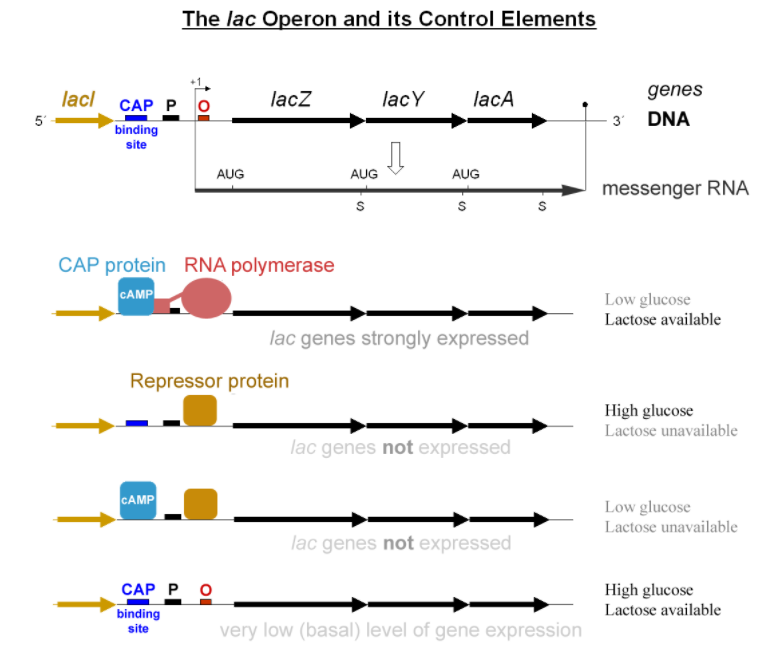
In the absence of allolactose or lactose, the repressor binds to the operator and inhibits RNA polymerase transcription of the operon. Lactose and allolactose stimulate the operon.
Note: Unless a co-inducer binds to the lac repressor, it is always expressed. In other words, it is only transcribed when a small molecule co-inducer is present. In the presence of glucose, the catabolite activator protein (CAP), which is required for enzyme production, remains inactive, and EIIAGlc shuts down lactose permease to prevent lactose transport into the cell. The sequential utilization of glucose and lactose in two distinct growth phases, known as diauxic, is caused by this dual control mechanism.
Complete answer:
The lactose operon (lac operon) is a lactose transport and metabolism operon found in E. coli and many other enteric bacteria. Although glucose is the preferred carbon source for most bacteria, the lac operon allows for effective lactose digestion when glucose is unavailable via beta-galactosidase activity. Because gene regulation of the lac operon was the first clearly understood genetic regulatory mechanism, it has become a leading example of prokaryotic gene regulation. For this reason, it is frequently discussed in introductory molecular and cellular biology classes.
François Jacob and Jacques Monod used this lactose metabolism system to figure out how a biological cell knows which enzyme to synthesize. In 1965, they were awarded the Nobel Prize in Physiology for their work on the lac operon. Bacterial operons are polycistronic transcripts capable of generating multiple proteins from a single mRNA transcript.
In the absence of allolactose or lactose, the repressor binds to the operator and inhibits RNA polymerase transcription of the operon. Lactose and allolactose stimulate the operon.
Note: Unless a co-inducer binds to the lac repressor, it is always expressed. In other words, it is only transcribed when a small molecule co-inducer is present. In the presence of glucose, the catabolite activator protein (CAP), which is required for enzyme production, remains inactive, and EIIAGlc shuts down lactose permease to prevent lactose transport into the cell. The sequential utilization of glucose and lactose in two distinct growth phases, known as diauxic, is caused by this dual control mechanism.
Recently Updated Pages
Master Class 11 Computer Science: Engaging Questions & Answers for Success

Master Class 11 Business Studies: Engaging Questions & Answers for Success
Master Class 11 Economics: Engaging Questions & Answers for Success
Master Class 11 English: Engaging Questions & Answers for Success
Master Class 11 Maths: Engaging Questions & Answers for Success
Master Class 11 Biology: Engaging Questions & Answers for Success
Trending doubts
One Metric ton is equal to kg A 10000 B 1000 C 100 class 11 physics CBSE
There are 720 permutations of the digits 1 2 3 4 5 class 11 maths CBSE
Discuss the various forms of bacteria class 11 biology CBSE
Draw a diagram of a plant cell and label at least eight class 11 biology CBSE
State the laws of reflection of light
10 examples of friction in our daily life