



Where will the hand of a clock stop if it
(1) starts at $10$ and makes $\dfrac{1}{2}$ of a revolution, clockwise?
(2) starts at $4$ and makes $\dfrac{1}{4}$ of a revolution, clockwise?
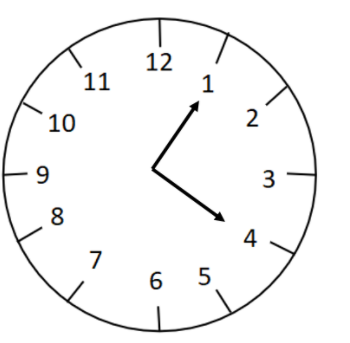
(3) starts at $4$ and makes $\dfrac{3}{4}$ of a revolution, clockwise?
Answer
 Verified
540.3k+ views
Hint: To solve the problems, we have to know how much the hand of a clock moves on as given in the question based on revolutions. We know, $\dfrac{1}{4}$ revolutions subtends a right angle at the centre of the clock. For one right angle the clock hand moves ahead three numbers on the clock. For example, if the hand starts from $12$ and makes a right angle, then the hand will stop at $3$ in the clock, as it goes ahead of the $3$ numbers. So, we are to determine how many angles are subtended in each of the parts of the question and determine the answer.
Complete step-by-step answer:
(1) Given, the clock hand starts at $10$ and makes $\dfrac{1}{2}$ of a revolution, clockwise.
So, the clock hand moves $\dfrac{1}{2}$ of a revolution, clockwise.
That means, it moves $2 \times \dfrac{1}{4}$ of a revolution.
We know, $\dfrac{1}{4}$ of a revolution means the clock hand subtends a right angle at the centre of the clock.
Therefore, $2 \times \dfrac{1}{4}$ of a revolution means it will subtend two right angles at the centre of the clock.
We also know that, for a right angle, the hand moves $3$ numbers.
So, for two right angles the clock hand will move forward $6$ numbers.
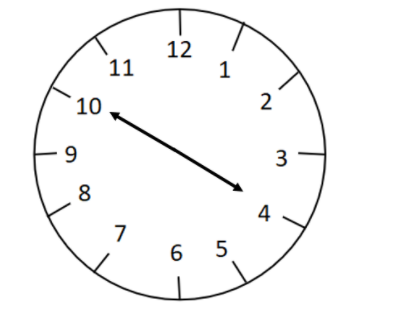
So, if the clock hand starts at $10$, $6$ numbers ahead in the clock will bring it to $4$ in the clock after $\dfrac{1}{2}$ of a revolution.
(2) Given, the clock hand starts at $4$ and makes $\dfrac{1}{4}$ of a revolution, clockwise.
So, the clock hand moves $\dfrac{1}{4}$ of a revolution, clockwise.
We know, $\dfrac{1}{4}$ of a revolution means the clock hand subtends a right angle at the centre of the clock.
We also know that, for a right angle, the hand moves $3$ numbers.
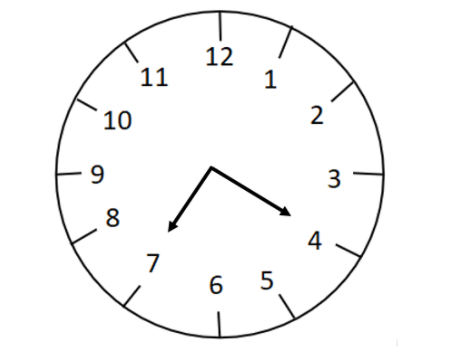
So, if the clock hand starts at $4$, $3$ numbers ahead in the clock will bring it to $7$ in the clock after $\dfrac{1}{4}$ of a revolution.
(3) Given, the clock hand starts at $4$ and makes $\dfrac{3}{4}$ of a revolution, clockwise.
So, the clock hand moves $\dfrac{3}{4}$ of a revolution, clockwise.
That means, it moves $3 \times \dfrac{1}{4}$ of a revolution.
We know, $\dfrac{1}{4}$ of a revolution means the clock hand subtends a right angle at the centre of the clock.
Therefore, $3 \times \dfrac{1}{4}$ of a revolution means it will subtend three right angles at the centre of the clock.
We also know that, for a right angle, the hand moves $3$ numbers.
So, for three right angles the clock hand will move forward the $9$ numbers.
So, if the clock hand starts at $4$, $9$ numbers ahead in the clock will bring it to $1$ in the clock after $\dfrac{3}{4}$ of a revolution.
Note: Many times we can make a mistake in the direction in which the clock hand moves, clockwise or anti-clockwise, there may be questions in which the clock is altered to move in anti-clockwise direction. So, we must keep that in mind.
Complete step-by-step answer:
(1) Given, the clock hand starts at $10$ and makes $\dfrac{1}{2}$ of a revolution, clockwise.
So, the clock hand moves $\dfrac{1}{2}$ of a revolution, clockwise.
That means, it moves $2 \times \dfrac{1}{4}$ of a revolution.
We know, $\dfrac{1}{4}$ of a revolution means the clock hand subtends a right angle at the centre of the clock.
Therefore, $2 \times \dfrac{1}{4}$ of a revolution means it will subtend two right angles at the centre of the clock.
We also know that, for a right angle, the hand moves $3$ numbers.
So, for two right angles the clock hand will move forward $6$ numbers.
So, if the clock hand starts at $10$, $6$ numbers ahead in the clock will bring it to $4$ in the clock after $\dfrac{1}{2}$ of a revolution.
(2) Given, the clock hand starts at $4$ and makes $\dfrac{1}{4}$ of a revolution, clockwise.
So, the clock hand moves $\dfrac{1}{4}$ of a revolution, clockwise.
We know, $\dfrac{1}{4}$ of a revolution means the clock hand subtends a right angle at the centre of the clock.
We also know that, for a right angle, the hand moves $3$ numbers.
So, if the clock hand starts at $4$, $3$ numbers ahead in the clock will bring it to $7$ in the clock after $\dfrac{1}{4}$ of a revolution.
(3) Given, the clock hand starts at $4$ and makes $\dfrac{3}{4}$ of a revolution, clockwise.
So, the clock hand moves $\dfrac{3}{4}$ of a revolution, clockwise.
That means, it moves $3 \times \dfrac{1}{4}$ of a revolution.
We know, $\dfrac{1}{4}$ of a revolution means the clock hand subtends a right angle at the centre of the clock.
Therefore, $3 \times \dfrac{1}{4}$ of a revolution means it will subtend three right angles at the centre of the clock.
We also know that, for a right angle, the hand moves $3$ numbers.
So, for three right angles the clock hand will move forward the $9$ numbers.
So, if the clock hand starts at $4$, $9$ numbers ahead in the clock will bring it to $1$ in the clock after $\dfrac{3}{4}$ of a revolution.
Note: Many times we can make a mistake in the direction in which the clock hand moves, clockwise or anti-clockwise, there may be questions in which the clock is altered to move in anti-clockwise direction. So, we must keep that in mind.
Recently Updated Pages
Master Class 11 English: Engaging Questions & Answers for Success

Master Class 11 Social Science: Engaging Questions & Answers for Success
Master Class 11 Maths: Engaging Questions & Answers for Success
Master Class 11 Biology: Engaging Questions & Answers for Success
Master Class 11 Physics: Engaging Questions & Answers for Success
Master Class 11 Chemistry: Engaging Questions & Answers for Success
Trending doubts