




How do hadrons differ from all other subatomic particles?
Answer
 Verified
599.1k+ views
Hint: Mesons and baryons are together called hadrons. They are made up of quarks. Hadrons are heavy particles (like proton, neutron, etc) unlike leptons which are light particles and they respond to or feel strong nuclear forces, whereas leptons feel the weak nuclear forces.
Complete step by step answer:
Hadrons consist of mesons and baryons. Mesons are namely K-mesons or Kaons (${{K}^{+}},{{K}^{0}},{{K}^{-}},{{\bar{K}}^{0}}$) and $\pi $- mesons or pions (${{\pi }^{+}},{{\pi }^{-}},{{\pi }^{0}}$). Baryons are classified into two categories, nucleons (protons, neutrons) and hyperons ($\lambda ,\sum ,\Xi ,\Omega $). The classifications of elementary particles and some examples are shown in the diagram below,
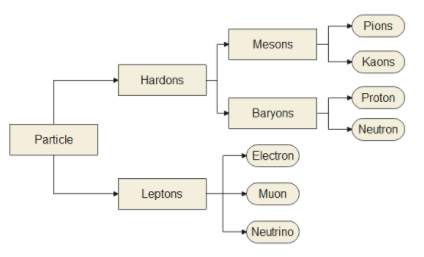
The mesons along with photons and gravitons are called Bosons, these have even numbers of nucleons and does not obey Pauli’s exclusion principle. The baryons and leptons (consisting of electron, muon, tau and their respective antiparticles, their neutrino and antineutrino) together are called fermions, they have an odd number of nucleons and obey Pauli’s exclusion principle. Hadrons are made of three quarks and some hadrons are made of two quarks.
The differences of Hadrons and other subatomic particles are as follows,
Hadrons feel both strong and weak nuclear forces, however leptons, all leptons feel weak nuclear forces. This is how we can distinguish them. Leptons are light particles, but hadrons are mainly heavy particles.
For leptons, the strangeness number is zero, i.e. they are not strange particles. The strangeness number of some hadrons is not zero, i.e. they are strange particles like K-mesons. The strangeness number is conserved in decay via strong interactions, but strangeness number is not conserved in decay via weak interactions.
The particle that decay via weak interactions have lifetimes in the range of ${{10}^{-16}}$s to ${{10}^{-12}}$s, however the particles that decay via strong interactions have lifetimes in the range of ${{10}^{-16}}$s to ${{10}^{-23}}$s.
Baryons have baryon number one or minus one, however leptons have baryon number zero as they are not classified under baryons.
Note:
In decay reactions that happen due to weak interactions leptons are part of the decay products and have longer lifetime as compared to decay reactions that happen due to strong interactions. In strong interactions, normally all conservation laws are conserved, but in weak interactions some laws are violated.
Complete step by step answer:
Hadrons consist of mesons and baryons. Mesons are namely K-mesons or Kaons (${{K}^{+}},{{K}^{0}},{{K}^{-}},{{\bar{K}}^{0}}$) and $\pi $- mesons or pions (${{\pi }^{+}},{{\pi }^{-}},{{\pi }^{0}}$). Baryons are classified into two categories, nucleons (protons, neutrons) and hyperons ($\lambda ,\sum ,\Xi ,\Omega $). The classifications of elementary particles and some examples are shown in the diagram below,
The mesons along with photons and gravitons are called Bosons, these have even numbers of nucleons and does not obey Pauli’s exclusion principle. The baryons and leptons (consisting of electron, muon, tau and their respective antiparticles, their neutrino and antineutrino) together are called fermions, they have an odd number of nucleons and obey Pauli’s exclusion principle. Hadrons are made of three quarks and some hadrons are made of two quarks.
The differences of Hadrons and other subatomic particles are as follows,
Hadrons feel both strong and weak nuclear forces, however leptons, all leptons feel weak nuclear forces. This is how we can distinguish them. Leptons are light particles, but hadrons are mainly heavy particles.
For leptons, the strangeness number is zero, i.e. they are not strange particles. The strangeness number of some hadrons is not zero, i.e. they are strange particles like K-mesons. The strangeness number is conserved in decay via strong interactions, but strangeness number is not conserved in decay via weak interactions.
The particle that decay via weak interactions have lifetimes in the range of ${{10}^{-16}}$s to ${{10}^{-12}}$s, however the particles that decay via strong interactions have lifetimes in the range of ${{10}^{-16}}$s to ${{10}^{-23}}$s.
Baryons have baryon number one or minus one, however leptons have baryon number zero as they are not classified under baryons.
Note:
In decay reactions that happen due to weak interactions leptons are part of the decay products and have longer lifetime as compared to decay reactions that happen due to strong interactions. In strong interactions, normally all conservation laws are conserved, but in weak interactions some laws are violated.
Recently Updated Pages
Master Class 12 Business Studies: Engaging Questions & Answers for Success

Master Class 12 Chemistry: Engaging Questions & Answers for Success
Master Class 12 Biology: Engaging Questions & Answers for Success
Class 12 Question and Answer - Your Ultimate Solutions Guide
Master Class 11 English: Engaging Questions & Answers for Success
Master Class 11 Social Science: Engaging Questions & Answers for Success
Trending doubts
Which are the Top 10 Largest Countries of the World?
The total number of vertebrae in man is a30 b31 c32 class 12 biology CBSE
Draw a labelled sketch of the human eye class 12 physics CBSE
The number of cranial nerves in a frog is A 10 pairs class 12 biology CBSE
Differentiate between homogeneous and heterogeneous class 12 chemistry CBSE
Differentiate between Pyramid of energy and pyramid class 12 biology CBSE