




${{\text{H}}_{\text{2}}}{\text{S}}$ is a:
A. Weak dibasic acid
B. Weak monobasic acid
C. Strong dibasic acid
D. Strong monobasic acid
Answer
 Verified
609.3k+ views
Hint: ${{\text{H}}_{\text{2}}}{\text{S}}$ has a sulphur attached with two hydrogens. It can donate two protons. Hydrogen sulphide can neutralize two base molecules. The strength of an acid to dissociate in solution is determined as the acid dissociation constant. The acid dissociation constant for the first hydrogen of hydrogen sulphide is $1.0 \times {10^{ - 7}}$ and for second is $1.3 \times {10^{ - 14}}$.
Complete answer:
The molecule that can donate protons is known as acid whereas the compound that can accept protons is known as a base.
The power of acceptance of protons of a base is defined as the basicity and power of donation is defined as the acidity of an acid.
Basicity of an acid is defined as the power of an acid to neutralize a base. The basicity of an acid depends upon the number of protons donated by an acid to neutralize the base.
The acidity of a base is defined as the power of a base to neutralize an acid. The acidity of a base depends upon the number of protons accepted by the base to neutralize the acid.
The structure of hydrogen sulphide is as follows:
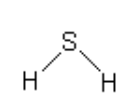
Hydrogen sulphide has two hydrogen atoms that can be donated to neutralize the bases. So, hydrogen sulphide will neutralize two base molecules.
Dibasic acid means that the acid can donate two protons to neutralize two base molecules, so hydrogen sulphide is dibasic acid.
The hydrogen sulphide dissociates as follows:
${{\text{H}}_{\text{2}}}{\text{S}}\, \to \,\,{\text{H}}{{\text{S}}^ - } + \,{{\text{H}}^{\text{ + }}}\,\,{{\text{K}}_{{\text{1a}}}}\, = \,1.0 \times {10^{ - 7}}$
${\text{H}}{{\text{S}}^ - }\, \to \,\,{{\text{S}}^{2 - }} + \,{{\text{H}}^{\text{ + }}}\,\,{{\text{K}}_{{\text{2a}}}}\, = \,1.3 \times {10^{ - 14}}$
The acid dissociation constant hydrogen sulphide is very less, so it is a weak acid.
So, hydrogen sulphide ${{\text{H}}_{\text{2}}}{\text{S}}$ is weak dibasic acid.
Therefore, option (A) weak dibasic acid, is correct.
Note:
Basicity of an acid defines the number of protons that can be donated, not the total number of protons that an acid has. For example, consider boric acid, ${{\text{H}}_{\text{3}}}{\text{B}}{{\text{O}}_{\text{3}}}$, it has three $ - {\text{OH}}$ so, it can donate three protons so,, it should be tribasic. Boric acid donates one proton only so it is monobasic only. Acid accepts electrons. The base loses electrons. The weak acid has very low acid dissociation constant. Generally very less than one. The strong acid has a high acid dissociation constant.
Complete answer:
The molecule that can donate protons is known as acid whereas the compound that can accept protons is known as a base.
The power of acceptance of protons of a base is defined as the basicity and power of donation is defined as the acidity of an acid.
Basicity of an acid is defined as the power of an acid to neutralize a base. The basicity of an acid depends upon the number of protons donated by an acid to neutralize the base.
The acidity of a base is defined as the power of a base to neutralize an acid. The acidity of a base depends upon the number of protons accepted by the base to neutralize the acid.
The structure of hydrogen sulphide is as follows:
Hydrogen sulphide has two hydrogen atoms that can be donated to neutralize the bases. So, hydrogen sulphide will neutralize two base molecules.
Dibasic acid means that the acid can donate two protons to neutralize two base molecules, so hydrogen sulphide is dibasic acid.
The hydrogen sulphide dissociates as follows:
${{\text{H}}_{\text{2}}}{\text{S}}\, \to \,\,{\text{H}}{{\text{S}}^ - } + \,{{\text{H}}^{\text{ + }}}\,\,{{\text{K}}_{{\text{1a}}}}\, = \,1.0 \times {10^{ - 7}}$
${\text{H}}{{\text{S}}^ - }\, \to \,\,{{\text{S}}^{2 - }} + \,{{\text{H}}^{\text{ + }}}\,\,{{\text{K}}_{{\text{2a}}}}\, = \,1.3 \times {10^{ - 14}}$
The acid dissociation constant hydrogen sulphide is very less, so it is a weak acid.
So, hydrogen sulphide ${{\text{H}}_{\text{2}}}{\text{S}}$ is weak dibasic acid.
Therefore, option (A) weak dibasic acid, is correct.
Note:
Basicity of an acid defines the number of protons that can be donated, not the total number of protons that an acid has. For example, consider boric acid, ${{\text{H}}_{\text{3}}}{\text{B}}{{\text{O}}_{\text{3}}}$, it has three $ - {\text{OH}}$ so, it can donate three protons so,, it should be tribasic. Boric acid donates one proton only so it is monobasic only. Acid accepts electrons. The base loses electrons. The weak acid has very low acid dissociation constant. Generally very less than one. The strong acid has a high acid dissociation constant.
Recently Updated Pages
Master Class 11 English: Engaging Questions & Answers for Success

Master Class 11 Social Science: Engaging Questions & Answers for Success
Master Class 11 Maths: Engaging Questions & Answers for Success
Master Class 11 Biology: Engaging Questions & Answers for Success
Master Class 11 Physics: Engaging Questions & Answers for Success
Master Class 11 Chemistry: Engaging Questions & Answers for Success
Trending doubts
Find the value of the expression given below sin 30circ class 11 maths CBSE
Difference between physical and chemical change class 11 chemistry CBSE
Agaragar is obtained from A Chlorella B Spirogyra C class 11 biology CBSE
Agaragar is derived from a A fungi b An algae c Both class 11 biology CBSE
Draw a labelled diagram showing structure of LS of class 11 biology CBSE
Hydrogen bonding is seen in H2O and not in H2S Why class 11 chemistry CBSE