




What is \[[{{H}^{+}}]\] in \[mol/L\] of a solution that is 0.20 M in $C{{H}_{3}}COONa$ and 0.10 M in $C{{H}_{3}}COOH$?
${{K}_{a}}$ for $C{{H}_{3}}COONa$ = $1.8\text{ x 1}{{\text{0}}^{-5}}$
(A) $3.5\text{ x 1}{{\text{0}}^{-4}}$
(B) $\text{1}\text{.1 x 1}{{\text{0}}^{-5}}$
(C) $\text{1}\text{.8 x 1}{{\text{0}}^{-5}}$
(D) $\text{9}\text{.0 x 1}{{\text{0}}^{-6}}$
Answer
 Verified
652.2k+ views
Hint: It is important to know that acetic acid or rather ethanoic acid is a weak organic acid. In addition to that the conjugate base of acetic acid. This reduces the dissociation of the acid in accordance to Le chatlier's principle. Consider the effect of the common added to the solution while determining the dissociation constant.
Complete step-by-step answer:
Organic acids are in general considered to be weak acids due to relatively less stable conjugate base in comparison to a mineral acid.
The structure of ethanoic acid is :
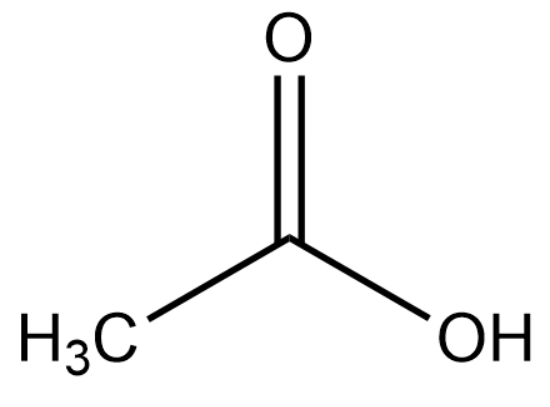
Upon deprotonation, the conjugate base of ethanoic acid becomes:
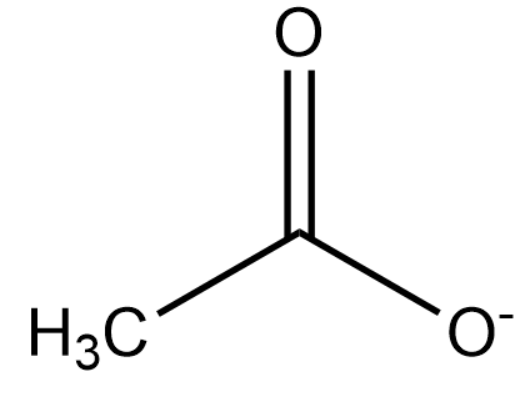 The ionisation of $C{{H}_{3}}COONa$ and $C{{H}_{3}}COOH$ is as follows:
$\text{C}{{\text{H}}_{\text{3}}}\text{COONa }\to \text{ C}{{\text{H}}_{\text{3}}}\text{CO}{{\text{O}}^{-}}\text{ + N}{{\text{a}}^{\text{+}}}$
$\text{C}{{\text{H}}_{\text{3}}}\text{COOH }\to \text{ C}{{\text{H}}_{\text{3}}}\text{CO}{{\text{O}}^{-}}\text{ + }{{\text{H}}^{\text{+}}}$
Due to the common ion $\text{C}{{\text{H}}_{\text{3}}}\text{CO}{{\text{O}}^{-}}$, the equilibrium for the dissociation of acid will shift backwards in accordance to Le Chatlier's principle.
We also know that,
${{\text{K}}_{\text{a}}}\text{ = }\dfrac{\text{ }\!\![\!\!\text{ C}{{\text{H}}_{\text{3}}}\text{CO}{{\text{O}}^{-}}\text{ }\!\!]\!\!\text{ }\!\![\!\!\text{ }{{\text{H}}^{\text{+}}}\text{ }\!\!]\!\!\text{ }}{\text{C}{{\text{H}}_{\text{3}}}\text{COOH}}$
Here we will take the concentration as follows:
$\text{ }\!\![\!\!\text{ C}{{\text{H}}_{\text{3}}}\text{CO}{{\text{O}}^{-}}]$ = 0.2 M
$\text{ }\!\![\!\!\text{ C}{{\text{H}}_{\text{3}}}\text{COOH}]$ = 0.1 M
\[{{\text{K}}_{\text{a}}}\]= $1.8\text{ x 1}{{\text{0}}^{-5}}$
Substituting the above values in the equation we get,
$1.8\text{ x 1}{{\text{0}}^{-5}}\text{ = }\dfrac{[0.2][{{\text{H}}^{+}}]}{[0.1]}$
$[{{\text{H}}^{+}}]\text{ = 9}\text{.0 x 1}{{\text{0}}^{-6}}\text{ mol }{{\text{L}}^{-1}}$
Therefore, the correct answer is option (D).
Additional information: In chemistry, organic compounds are chemical compounds containing carbon-hydrogen bonds in simple terms. Along with carbon and hydrogen, organic compounds contain atoms like oxygen, nitrogen and halogens( Cl, Br ,I, F).
The study of properties, reactions and their mechanisms and their synthesis is known as organic chemistry. Till now we have found and synthesised millions of organic compounds due to the catenation property of carbon.
Note: The common ion effect describes the effect of adding a common ion on the equilibrium of the new solution. The common ion effect generally decreases solubility of a solute. The equilibrium shifts to the left to relieve off the excess product formed. When a strong electrolyte is added to a solution of weak electrolyte, the solubility of weak electrolyte decreases leading to the formation of precipitate at the bottom of the testing apparatus.
Complete step-by-step answer:
Organic acids are in general considered to be weak acids due to relatively less stable conjugate base in comparison to a mineral acid.
The structure of ethanoic acid is :
Upon deprotonation, the conjugate base of ethanoic acid becomes:
$\text{C}{{\text{H}}_{\text{3}}}\text{COONa }\to \text{ C}{{\text{H}}_{\text{3}}}\text{CO}{{\text{O}}^{-}}\text{ + N}{{\text{a}}^{\text{+}}}$
$\text{C}{{\text{H}}_{\text{3}}}\text{COOH }\to \text{ C}{{\text{H}}_{\text{3}}}\text{CO}{{\text{O}}^{-}}\text{ + }{{\text{H}}^{\text{+}}}$
Due to the common ion $\text{C}{{\text{H}}_{\text{3}}}\text{CO}{{\text{O}}^{-}}$, the equilibrium for the dissociation of acid will shift backwards in accordance to Le Chatlier's principle.
We also know that,
${{\text{K}}_{\text{a}}}\text{ = }\dfrac{\text{ }\!\![\!\!\text{ C}{{\text{H}}_{\text{3}}}\text{CO}{{\text{O}}^{-}}\text{ }\!\!]\!\!\text{ }\!\![\!\!\text{ }{{\text{H}}^{\text{+}}}\text{ }\!\!]\!\!\text{ }}{\text{C}{{\text{H}}_{\text{3}}}\text{COOH}}$
Here we will take the concentration as follows:
$\text{ }\!\![\!\!\text{ C}{{\text{H}}_{\text{3}}}\text{CO}{{\text{O}}^{-}}]$ = 0.2 M
$\text{ }\!\![\!\!\text{ C}{{\text{H}}_{\text{3}}}\text{COOH}]$ = 0.1 M
\[{{\text{K}}_{\text{a}}}\]= $1.8\text{ x 1}{{\text{0}}^{-5}}$
Substituting the above values in the equation we get,
$1.8\text{ x 1}{{\text{0}}^{-5}}\text{ = }\dfrac{[0.2][{{\text{H}}^{+}}]}{[0.1]}$
$[{{\text{H}}^{+}}]\text{ = 9}\text{.0 x 1}{{\text{0}}^{-6}}\text{ mol }{{\text{L}}^{-1}}$
Therefore, the correct answer is option (D).
Additional information: In chemistry, organic compounds are chemical compounds containing carbon-hydrogen bonds in simple terms. Along with carbon and hydrogen, organic compounds contain atoms like oxygen, nitrogen and halogens( Cl, Br ,I, F).
The study of properties, reactions and their mechanisms and their synthesis is known as organic chemistry. Till now we have found and synthesised millions of organic compounds due to the catenation property of carbon.
Note: The common ion effect describes the effect of adding a common ion on the equilibrium of the new solution. The common ion effect generally decreases solubility of a solute. The equilibrium shifts to the left to relieve off the excess product formed. When a strong electrolyte is added to a solution of weak electrolyte, the solubility of weak electrolyte decreases leading to the formation of precipitate at the bottom of the testing apparatus.
Recently Updated Pages
If x a + bt + ct2 where x is in meters and t is in class 11 physics CBSE

A car covers the first half distance between two places class 11 physics CBSE
The resultant of two vectors overrightarrow P and overrightarrow class 11 physics CBSE
Find the value of cos 135 class 11 maths CBSE
A mass M is held in place by an applied force F and class 11 physics CBSE
A solution of glucose in water is labelled as 10 dfracwv class 11 chemistry CBSE
Trending doubts
One Metric ton is equal to kg A 10000 B 1000 C 100 class 11 physics CBSE
Find the value of the expression given below sin 30circ class 11 maths CBSE
What do you mean by retardation What is its SI uni class 11 physics CBSE
Draw a diagram of nephron and explain its structur class 11 biology CBSE
10 examples of friction in our daily life
Difference between physical and chemical change class 11 chemistry CBSE